At Working Co., Ltd. (headquartered at 5F WORK VILLA MYJ Kanda, 1-4 Kanda Ogawacho, Chiyoda-ku, Tokyo), the Japanese distributor of "IPCL®" (hereinafter, IPCL) approved by Japan's Ministry of Health, Labour and Welfare in April 2025, conducted an online survey on implantable contact lenses targeting men and women in their 20s to 40s across Japan. IPCL is a treatment known as an "implantable contact lens" that corrects myopia and astigmatism by inserting a small lens inside the eye. It uses an acrylic polymer material primarily composed of HEMA—widely used in intraocular lenses for cataracts and conventional contact lenses. Unlike LASIK, it does not involve cutting the cornea, making it a highly reversible procedure since the lens can be removed in the future. In Japan, following multi-center clinical trials, IPCL received pharmaceutical approval from the Ministry of Health, Labour and Welfare in April 2025 and was commercially launched in September of the same year.
In recent years, vision correction options have diversified, and interest in surgical corrections such as LASIK and implantable contact lenses has grown. According to data published by the Ministry of Health, Labour and Welfare, contact lens use in Japan is widespread across age groups, with particularly high usage rates among those in their 20s to 40s. Against this backdrop, implantable contact lenses are gaining attention as a long-term choice that factors in daily convenience, ongoing costs, and future changes in vision. At the same time, the importance of accurate understanding of safety and risks has also been emphasized. This survey was conducted via the internet to clarify the awareness and understanding of implantable contact lenses among men and women in their 20s to 40s with vision below 0.1.
More than 70% of respondents (72.8%) were aware of implantable contact lenses as a treatment, and approximately 70% (71.9%) expressed interest in the procedure. Women in their 20s and 30s showed a particularly high tendency toward interest. The main reasons for interest were the inconvenience of glasses and contact lenses and the monthly cost of contact lenses. The most commonly cited concerns about the procedure were fear of surgery and safety.
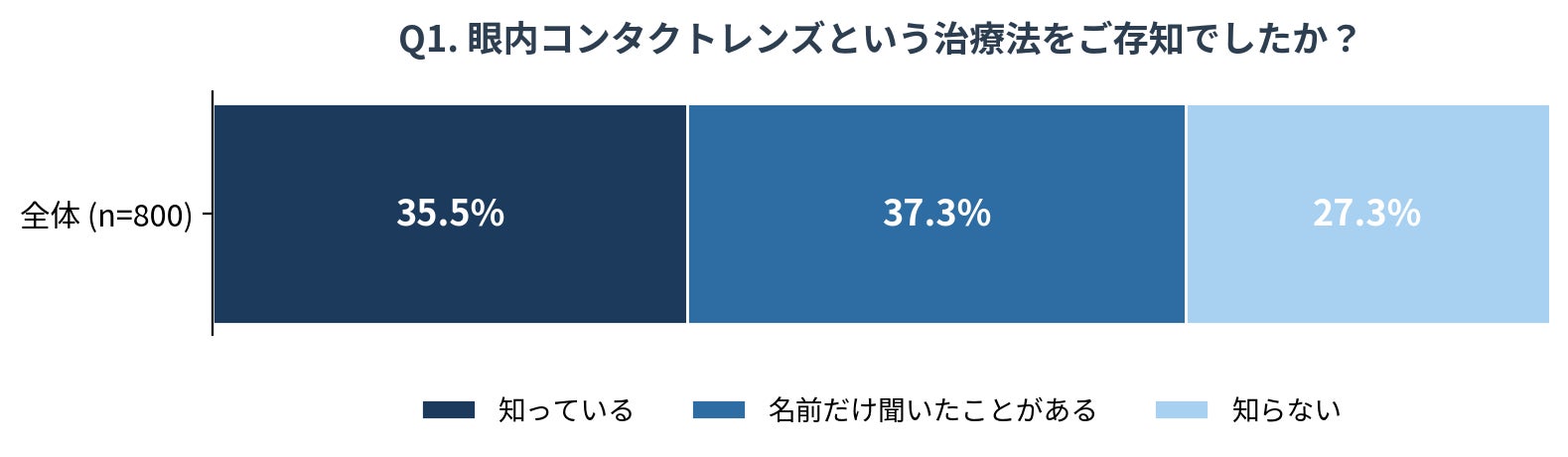
Q1. Awareness Survey Q1. Were you aware of implantable contact lenses as a treatment?
When men and women in their 20s to 40s with vision below 0.1 were surveyed about implantable contact lenses, 35.5% responded "I know about it" and 37.3% responded "I have heard the name." Combined, 72.8% of all respondents had some form of awareness of implantable contact lenses, suggesting that the treatment has achieved a certain level of recognition as a vision correction option.
Q2. Awareness by Gender and Age Q2. Awareness of implantable contact lenses by gender and age
Men and women in their 20s with vision below 0.1...
FACT BOX
- Source: PR Times
- Category: News