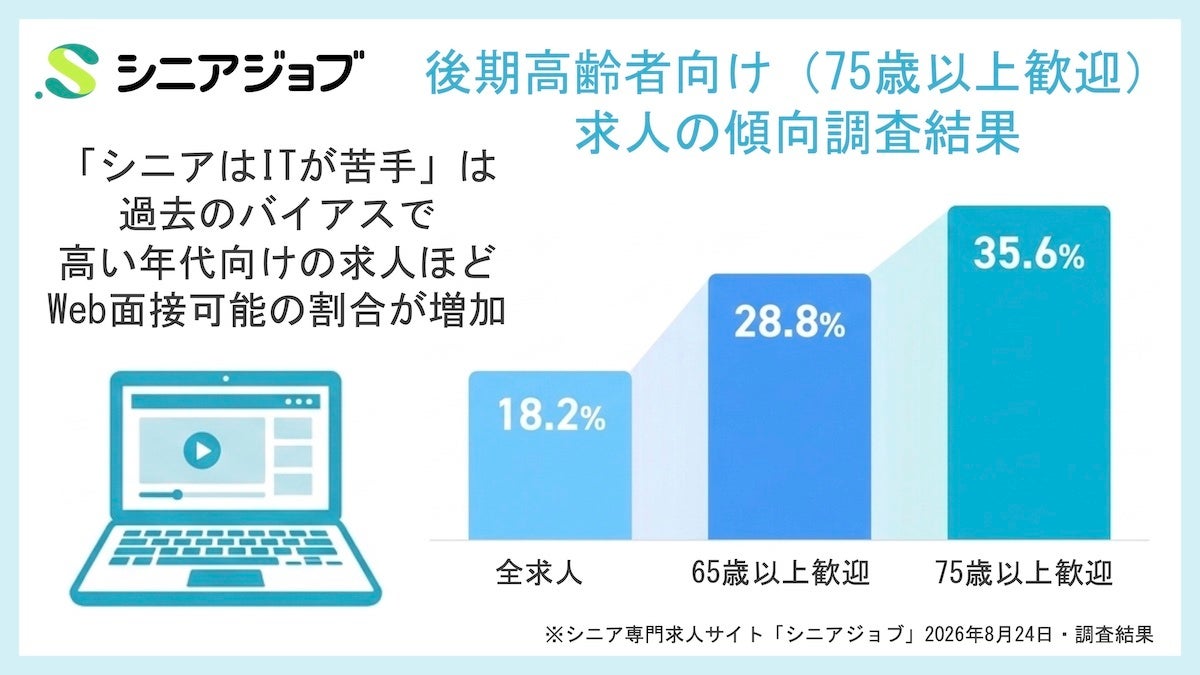
SeniorJob Co., Ltd. (Headquarters: Shinjuku-ku, Tokyo / CEO: Yasue Nakajima), which supports senior career transitions, conducted a survey on job postings targeting late-stage seniors (welcoming applicants aged 75 and over) listed on its senior-specialized job site 'SeniorJob.' Contrary to stereotypes such as 'seniors are not good with IT,' the survey revealed trends such as a higher proportion of job postings offering 'web interviews accepted' as the target age group increases.
Survey Results on Job Postings for Late-Stage Seniors (75+): Higher Acceptance of Web Interviews Among Older Age Groups
Summary of Survey Findings: More Flexible Working Conditions for Older Age Groups, Especially Those Welcoming 75+
To analyze trends in job postings welcoming late-stage seniors (75+), SeniorJob (https://seniorjob.jp/) compared postings targeting seniors (65+) and all job postings. Three main characteristics were identified:
- Job postings welcoming 75+ show a higher proportion of favorable conditions such as proximity to stations, company housing, side jobs allowed, and web interviews accepted—contrary to expectations.
- Job postings with favorable working conditions such as fully two-day weekends increase as the target age rises. For example, 32.9% of 75+ postings offer fully two-day weekends, compared to 28.5% for 65+ and 21.2% overall.
- Even for positions welcoming 75+, wages by occupation remain stable. Some roles, such as beauticians and life support staff, see increased demand as the target age rises.
Detailed Survey Findings: Beauty Industry Jobs Increase with Age
While SeniorJob does not strictly define 'senior,' it targets job seekers aged 50 and over, as employment difficulty significantly increases at this age. In contrast, public systems define seniors as 65+ and late-stage seniors as 75+. This survey aimed to determine whether job trends shift at these thresholds.
The survey found no unique trends exclusive to 75+ postings. Instead, this report summarizes how job trends change with the target age.
Surprisingly, job postings offering station proximity, company housing, side jobs allowed, and web interviews accepted increase as the target age rises.
Contrary to the assumption that older applicants are less familiar with web interviews, the proportion of postings offering 'web interviews accepted' is 18.2% overall, 28.8% for 65+, and 35.6% for 75+—a clear upward trend.
This may be because, as applicants age, employers place greater emphasis on reviewing experience via application documents rather than in-person interviews.
Job postings with favorable working hours and holiday conditions also increase with the target age.
For example, 'fully two-day weekends' are offered by 21.2% of all postings, 28.5% of 65+ postings, and 32.9% of 75+ postings. The proportion of postings with 'no overtime or less than 20 hours per month' rises from 61.5% overall to 79.5% for 75+ postings—nearly 80%.
This likely reflects increased consideration for health and physical stamina as applicants age.
When examining the top 10 occupations by job count across age groups and their average wages, no significant wage drop was found for the same occupation. In some cases, average wages even increased with higher target ages.
For example, 'caregivers, helpers, and nursing assistants'—the most common role across all age groups—offered a maximum hourly wage of ¥3,600 in all categories. Average hourly wages were ¥1,270 for 75+, ¥1,283 for 65+, and ¥1,261 overall. Similar patterns were observed in other occupations.
Additionally, occupations such as 'beauticians and beauty salons' and 'life support staff' show increasing proportions in job postings as the target age rises, indicating higher demand among older applicants. For example, 'beauticians and beauty salons' account for 1.6% of all postings, 2.3% of 65+ postings, and 2.8% of 75+ postings.
Conversely, roles such as 'child guidance counselors' are less common among higher age groups.
By employment type, 'contract employees' and 'outsourced workers' show increasing proportions with higher target ages, while 'dispatched workers' show a decreasing trend. No clear trend was observed for 'part-time' and 'full-time' roles.
Regarding experience, qualifications, and employment gaps, the proportion of 'no qualification required' postings decreases with higher target ages, while 'no experience required' and 'employment gap acceptable' increase.
When analyzing job posting proportions in five-year increments, the share generally decreases with age. However, the proportions for '70+' and '75+' are equal, suggesting that changes in job trends may stabilize after age 70.
Comment from Yasue Nakajima, CEO of SeniorJob
Yasue Nakajima, CEO of SeniorJob
In interviews and public appearances, I often emphasize that corporate stereotypes such as 'seniors are stubborn' or 'seniors are unproductive' are mere biases, and the proportion of inflexible individuals does not significantly differ between younger and senior workers. Of course, certain aspects do change with age. This time, we investigated whether job postings themselves change as the target age increases.
While no drastic shifts were observed at the thresholds of 65 (senior) or 75 (late-stage senior), several trends did evolve as the target age increased.
Even if employer expectations vary slightly by age, the abilities individuals can demonstrate do not diminish with age. Individual differences remain far greater than age-based generalizations—a point I wish to reiterate.
Survey Data: Trends in Job Postings for Late-Stage Seniors (75+)
● Comparison of Location, Work Style, and Screening Conditions Across Age Groups
Within 7-minute walk from station: 75+ (23.3%), 65+ (19.9%), All (14.5%)
Company housing available: 75+ (7%), 65+ (5.9%), All (4.1%)
Side jobs allowed: 75+ (27.1%), 65+ (24.2%), All (14%)
Web interviews accepted: 75+ (35.6%), 65+ (28.8%), All (18.2%)
● Comparison of Holiday and Working Hour Conditions
Fully two-day weekends: 75+ (32.9%), 65+ (28.5%), All (21.2%)
Weekends off: 75+ (12.1%), 65+ (11.5%), All (9.9%)
No overtime or less than 20 hours/month: 75+ (79.5%), 65+ (74%), All (61.5%)
Shortened work hours available: 75+ (13.9%), 65+ (12.4%), All (9%)
● Top 10 Occupations by Job Count for 75+ Postings
1st: Caregivers, Helpers, Nursing Assistants 12.7% (Average hourly wage: ¥1,270, Maximum: ¥3,600)
2nd: Chefs, Cooking Assistants, Head Cooks 9
FACT BOX
- Source: PR TIMES
- Category: Survey