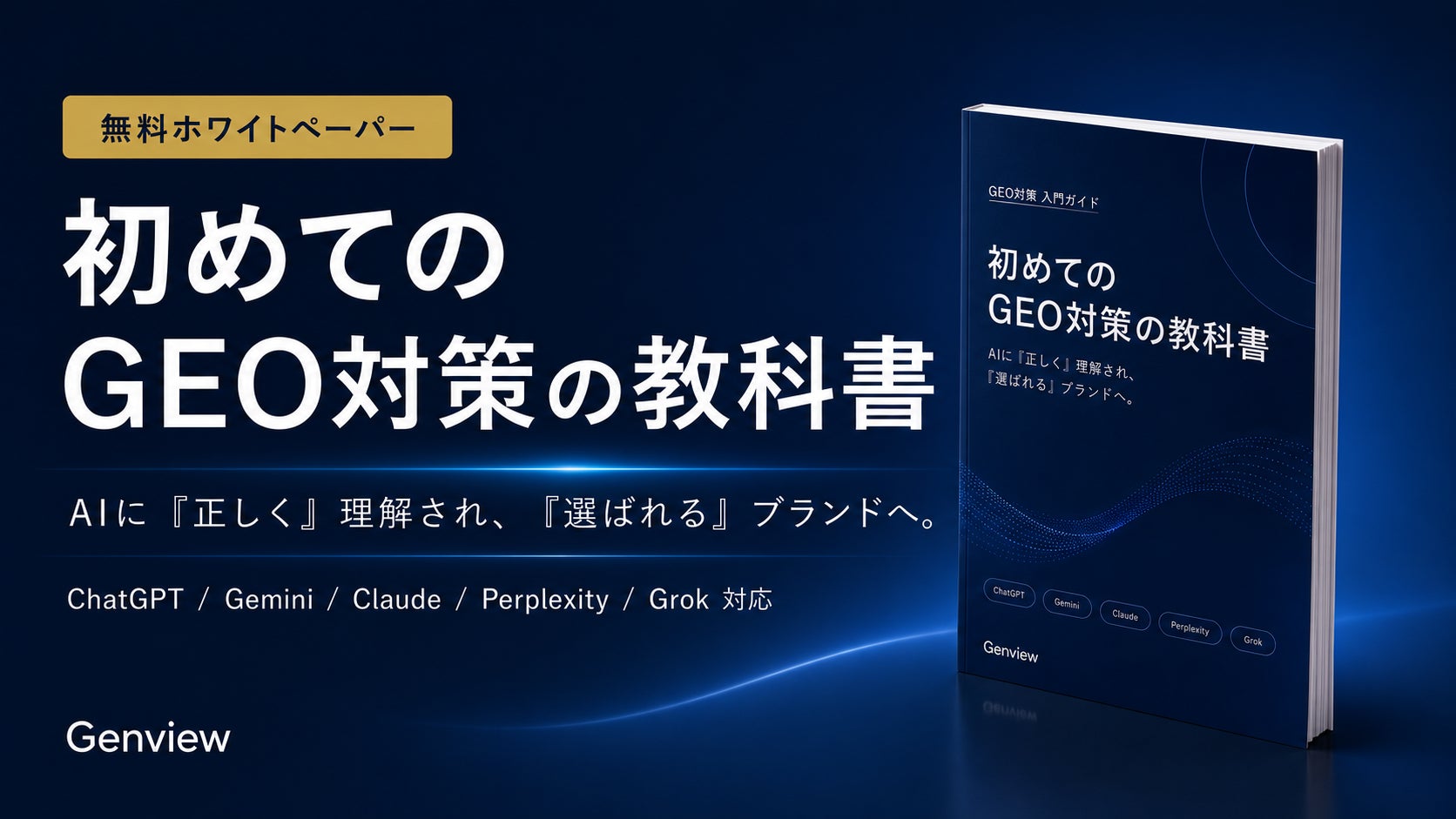
FID Inc. (Headquarters: Shinjuku-ku, Tokyo; CEO: Seisho Wada; hereinafter 'FID'), provider of the Generative Engine Optimization (GEO) platform 'Genview,' has released a free educational resource titled 'The First Guide to GEO Strategies' on July 14, 2026. This guide clearly explains, even for beginners, the concepts of brand communication and web traffic acquisition in the age of generative AI and AI search.
> Download the guide
Background of the Release: A Changing Landscape of Discoverability in Search Results
The widespread adoption of generative AI and AI search tools such as ChatGPT, Gemini, Claude, Perplexity, and Grok is transforming user information-seeking behavior.
Traditionally, users would search on search engines and visit websites from the results. However, today, users increasingly gather information and conduct comparisons directly within AI-generated responses, often making decisions before visiting any website.
In the U.S., HubSpot's organic traffic reportedly decreased from approximately 24.4 million monthly visits to about 6.2 million over two years, due to the rise of AI Overviews and zero-click searches. This trend means that even top-ranking search results are less likely to receive clicks.
*Source: SEMrush / Ahrefs, Seer Interactive (2025)
Similarly, in Japan, website visits originating from Google searches have reportedly declined by about 30% over the past two years, with the click-through rate to linked sites dropping to 36%. *Source: Nihon Keizai Shimbun, November 26, 2025; Survey by Valuates
In this evolving environment, it is becoming increasingly important for companies not only to rank highly in search results but also to understand how their brand and services are mentioned, compared, and recommended within AI-generated responses.
To address this, FID has released a free introductory guide titled 'The First Guide to GEO Strategies,' which organizes the principles of GEO—from foundational concepts to practical implementation steps—for the age of generative AI.
About 'The First Guide to GEO Strategies'
This guide serves as an introductory manual for marketing professionals, web managers, executives, and PR/communications staff who are new to GEO strategies.
GEO refers to the approach of optimizing brand visibility on generative AI platforms such as ChatGPT and Gemini.
The guide clearly explains, with illustrations, the fundamentals of GEO, its differences from SEO, how AI search works, strategies for being mentioned or recommended by AI, and specific implementation steps.
The distinction between SEO and GEO is clarified: while traditional SEO focuses on 'which page appears in search results,' GEO emphasizes 'how generative AI perceives and recognizes your company or service.'
What You Will Learn from This Guide
- What GEO is - The differences between SEO and GEO - Changes in user behavior due to AI search - Why 'comparison' and 'recommendation' queries are crucial in GEO - How AI retrieves and references information from the web - Principles for designing web pages that are easily readable by AI - Basic strategies for being mentioned or recommended by AI - The three fundamentals of GEO - Five steps to start GEO - What can be confirmed using Genview
Main Contents of the Guide
Chapter 1: What is GEO? — Differences and Commonalities with SEO
This chapter explains the fundamental concepts of GEO and its differences and similarities with traditional SEO.
In SEO, the goal was to rank high in search results and attract user clicks. In contrast, GEO focuses on being mentioned as a credible option within AI-generated answers and recommendations.
Chapter 2: What is Happening? — Conditions for Being Chosen by AI
This chapter analyzes changes in user behavior in the age of AI search and highlights the importance of being mentioned or recommended by AI.
It explains that while AI tends to provide self-contained answers for general informational queries like 'What is XX?', specific company and service names are more likely to appear in responses to 'comparison,' 'recommendation,' and 'selection' queries. Therefore, these query types are critical areas for GEO strategies.
Chapter 3: Understanding How AI Search Works
This chapter explains the process by which AI gathers information from the web and uses it in responses.
It breaks down how AI acquires information and references search results, web pages, and external sources in a way that is easy for beginners to understand.
Additionally, it notes that ChatGPT, Gemini, Claude, Perplexity, and Grok each have different information sources and priorities. Therefore, it is essential to design information with multiple acquisition pathways in mind, rather than focusing on a single AI platform.
Chapter 4: Understanding Basic Countermeasures
This chapter introduces fundamental strategies to ensure AI correctly acquires and understands your information.
FID outlines three core components of GEO:
Structured Data Use schema markup/JSON-LD, clear headings, Q&A formats, and placing conclusions at the top to make content easily understandable and extractable by AI.
External Media Increase third-party mentions and backlinks from industry publications, comparison sites, reviews, and social media to establish your brand as a trustworthy information source.
Owned Content Continuously publish primary information such as original research, data, case studies, and comparison materials that AI is likely to reference.
The guide emphasizes that consistently improving these three areas is key to increasing the likelihood of being mentioned or recommended by AI.
Chapter 5: Summary
This chapter summarizes key points for starting GEO strategies.
In the age of AI search, it is crucial not only to monitor search rankings and click-through rates but also to verify how your brand is mentioned in AI responses and whether it appears as a candidate in comparisons and recommendations.
Appendix: Introduction to Genview
Introduces 'Genview,' a GEO platform that visualizes how your company and competitors are mentioned on major AI platforms and reveals how AI perceives your brand.
Recommended For
- Those who want to understand GEO/LLMO strategies from the basics - Professionals already implementing SEO but facing challenges with AI search - Those curious about how their company or service is portrayed on ChatGPT or Gemini - Those concerned that their company is not appearing in AI-generated comparison or recommendation responses - Web development agencies aiming to include GEO in their service proposals - Marketing professionals reevaluating future web traffic and content strategies - Executives, web managers, and PR/communications staff
How to Download the Guide
The guide is available for free download via the following page:
> Download the guide
About the GEO Platform 'Genview'
Genview visualizes the gap between your 'ideal AI perception' (i.e., your company's strengths and uniqueness) and the 'reality' of how AI actually describes you. It then provides concrete improvement suggestions to align AI's perception with your ideal image.
FACT BOX
- Source: PR TIMES
- Category: キャンペーン
- Organizations: HubSpot / SEMrush / Ahrefs
- Products / services: Genview