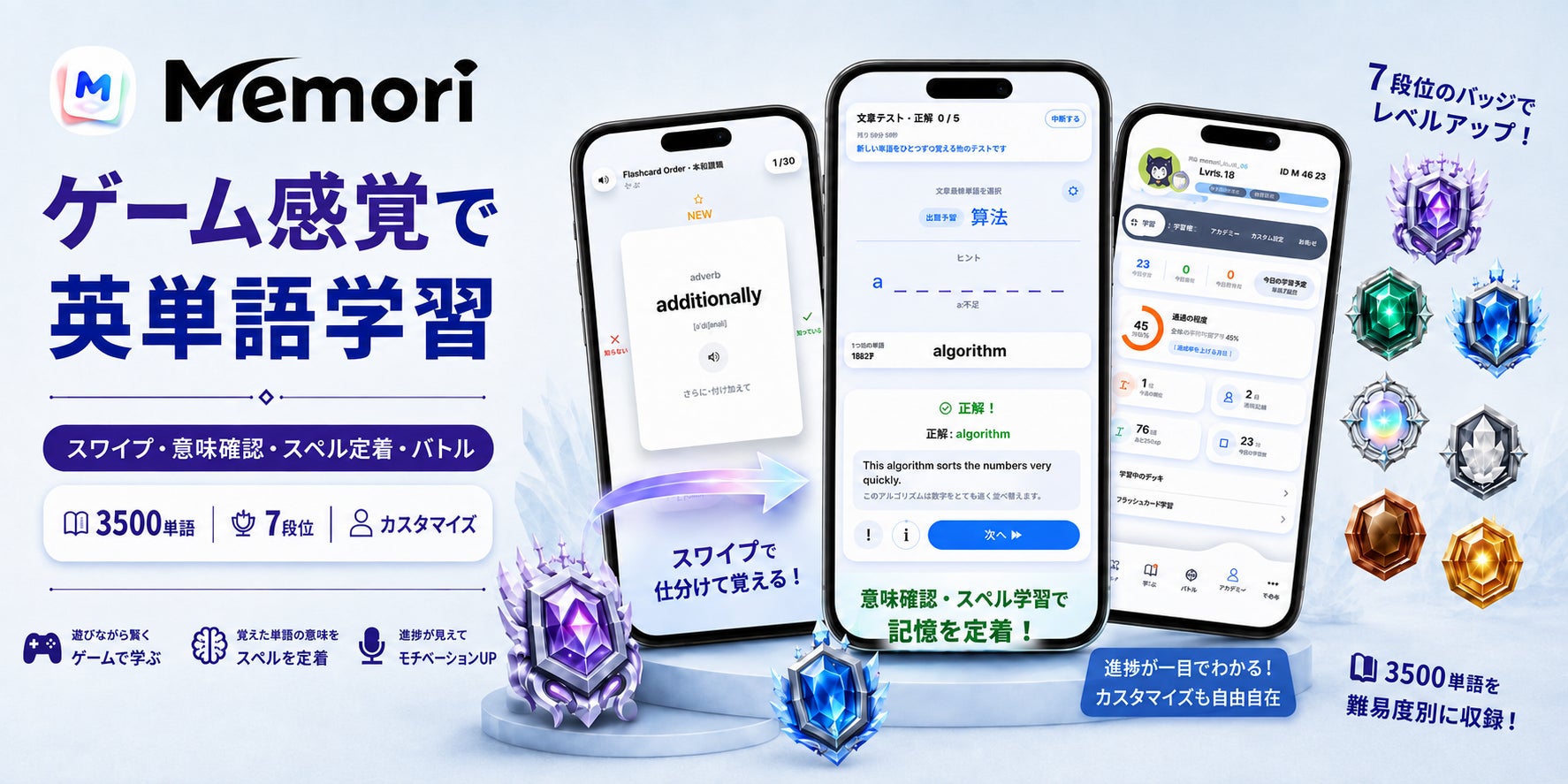
Via Vico Inc. (Headquarters: Shibuya-ku, Tokyo; CEO: Hidenori Sugaura and Morito Ikeda) has officially released 'Memori English Words (Memori),' an English vocabulary learning app developed based on the educational know-how of Amethyst Academy, a U.S. college preparatory school. The app is now available on the App Store and Google Play, and is free to download.
Memori is a vocabulary learning app that allows users to efficiently learn English words through swipe operations, confirm memory retention via two-stage tests, and then compete in real-time buzzer-style matches against users nationwide.
It was developed to move beyond the traditional method of repeatedly reviewing vocabulary books, aiming to integrate the entire learning cycle—'memorizing,' 'recalling,' and 'competing'—into a single app experience.
Download from App Store
Download from Google Play
Introduction Page
Development Background: Vocabulary Books Can't Confirm 'True Mastery'
In university entrance exams and overseas academic pursuits, vocabulary proficiency forms the foundation for reading, listening, writing, and speaking skills.
However, traditional vocabulary book learning often leads to the 'illusion of mastery'—users may recognize meanings when using a red sheet, but fail to recall words during actual exams or conversations.
Additionally, solo memorization tends to be monotonous, making it difficult for learners to sustain motivation over time.
At Amethyst Academy, English instruction emphasizes that practical language ability depends not on how many times a word list has been reviewed, but on whether learners can accurately and quickly recall words in real situations.
Therefore, Memori was designed to go beyond passive recognition—incorporating active recall through testing and rapid output through competitive gameplay.
Feature 1: Real-Time PvP Buzzer Match to Test Vocabulary Skills
The core feature of Memori is its real-time PvP buzzer match, where users compete against others nationwide to test their vocabulary knowledge.
During matches, Japanese definitions or example sentences are displayed, and players must type the corresponding English word using the keyboard. The first player to input the correct answer earns points.
Since players must recall and type the spelling after seeing the meaning, simply 'recognizing' a word is insufficient to win. This requires understanding the meaning, retrieving the correct English word from memory, and accurately typing it—an experience combining quiz buzzers and typing games.
Strategic Scoring Based on Time
As time passes after a question is presented, one letter of the correct spelling is gradually revealed to all players. While waiting increases the chance of guessing correctly, it also risks losing points to opponents who answer earlier. This creates a strategic decision on 'when to answer' for every question.
The first correct answer earns 20 points, subsequent correct answers earn 10 points, and incorrect answers or timeouts result in point deductions. The system is designed so that random guessing won't win—only confident, fast responses succeed.
Two Match Modes
Random Match: Automatically pairs users with others nationwide for a 5-question speed battle. If no human opponent is found quickly, the system automatically switches to a CPU opponent with one of five difficulty levels (from elementary to native), ensuring matches start instantly without waiting.
Free Match: Users can share a 6-digit room code to compete with friends or classmates. Each room supports up to 20 players, and the number of questions can be customized—ideal for classroom-wide competitions.
Additionally, development has begun on a 'Ranked Match' mode. In ranked matches, player ranks will fluctuate based on win/loss records, allowing users to benchmark their vocabulary skills against others.
Unlike solitary vocabulary study, the desire to 'answer the next question correctly' or 'beat the opponent' naturally drives repeated learning. In Memori, the PvP buzzer match is not just an add-on feature—it's positioned as a core output mechanism to practice recalling learned words in real-time scenarios.
Feature 2: Swipe-Based Vocabulary Sorting for Efficient Repetition
The vocabulary used in matches is built through daily swipe learning.
In Memori, users sort displayed English word cards by swiping based on their mastery level:
Left Swipe: Words not yet known
Right Swipe: Words whose meanings are known
Up Swipe: Words fully understood
This allows users to focus repetition on words they need to learn, avoiding wasted time on already-mastered ones.
The intuitive smartphone interface enables fast-paced learning during commutes or short breaks. The app includes 7 level-based decks of 500 words each (approximately 3,500 words total). A diagnostic test at first launch recommends the appropriate deck based on the user's level.
Feature 3: Preventing 'Illusion of Mastery' with 'Memory Test' and 'Retention Test'
In Memori, swiping a word card does not count as 'mastered.'
A word is only marked as learned after passing two stages: the 'Memory Test' and the 'Retention Test.'
In the Memory Test, users select the correct Japanese meaning from four multiple-choice options for a given English word. Pronunciation audio is played automatically, reinforcing memory through both visual and auditory channels.
In the subsequent Retention Test, users must type the English word corresponding to a Japanese definition, using partial spelling hints. This verifies mastery including correct spelling.
By requiring users to actively recall and type words—not just recognize meanings—Memori distinguishes between 'thinking you know' and truly usable knowledge.
Progress is tracked not by how many times a word list has been reviewed, but by whether the user can actually produce the correct answer. Only words mastered to the point of active recall and accurate spelling can be instantly retrieved during matches.
Feature 4: Learning Progress Translated into Ranks and Collectible Items
As users progress in learning and matches, they earn items such as icons and profile decorations.
Profiles can be customized, and learning volume and match performance are visually reflected in the app. As mastery increases, users level up, and one of seven types of 'gems' appears on their profile as a symbol of growth.
By offering multiple goals—leveling up, collecting items, winning matches—rather than focusing solely on memorization, Memori aims to create a sustainable and engaging learning experience.
Development Approach: One CEO, One AI 'Development Team'
Except for BGM production and profile icon design, every aspect of Memori—from concept and learning logic design, UI/UX, frontend/backend development, database architecture, real-time match infrastructure, to App Store and Google Play deployment—was built by CEO Hidenori Sugaura using generative AI.
The concept originated about four years ago. At that time, the technological maturity of generative AI was not sufficient to complete full app development.
FACT BOX
- Source: PR TIMES
- Category: New Product
- Organizations: Amethyst Academy