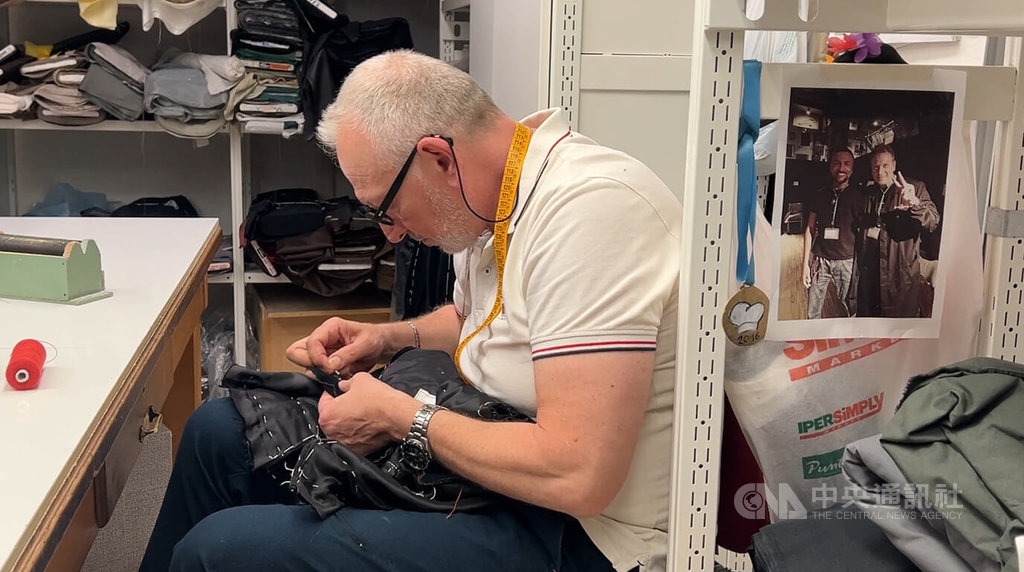
(CNA correspondent Huang Yashi, Rome, 2nd) The Rome Opera House is the venue where Puccini's masterpiece 'Tosca' premiered and a pilgrimage site for music fans. Besides its grand auditorium, the building houses a tailoring workshop that began in the mid-20th century, where the gorgeous and elaborate costumes for each opera are hand-stitched and painted. CNA takes readers on a tour of this behind-the-scenes 'dream factory'.
● Site of 'Tosca' Premiere, Witness to Great Musical Works
The 'Teatro dell'Opera di Roma' was founded in the late 19th century by entrepreneur Domenico Costanzi, hence it is also known as the Teatro Costanzi. Two classic operas premiered here. One was 'Cavalleria rusticana' in 1890, whose intermezzo is often used in famous film scores, such as in 'The Godfather Part III'.
The other was the premiere of Puccini's masterpiece 'Tosca' in 1900, which Puccini himself attended. A stone plaque on the lobby wall commemorates this special moment.
The Teatro Costanzi was purchased by the city of Rome in 1926 under the directive of the then-ruler Mussolini, and was renamed the Rome Opera House in 1946 following the establishment of the Italian Republic. Over its more than 100-year history, it has witnessed countless acclaimed performances and is regarded as an important cradle for nurturing modern musicians.
● The Tailoring Workshop: A Long History of Handmade Custom Costumes
Many audience members have seen the grand auditorium of the Rome Opera House but are unaware that the building also hides a 'tailoring workshop'. A CNA reporter visited the site. Guided through a maze of corridors and staircases, they were greeted by rows of racks filled with costumes. The sheer volume of costumes is so large that the corridor space is barely wide enough for single-person passage.
'The Rome Opera House began making its own costumes around the mid-20th century,' guide Chiara Bettiol told CNA. 'The practice was different before. Initially, each performer wore their own costumes while touring various theaters. For example, the famous singer Mattia Battistini always wore the same costume when performing 'Rigoletto' wherever he went. Battistini was very popular; there's a metro station in Rome named after him.'
Bettiol said that later, the Rome Opera House started making and repairing its own costumes, preserving them for use in other productions. 'Of course, they can't be used entirely in other plays. For example, about 60% of the costumes are remade, but at least about 40% of similar dance costumes can be retained.'
According to the official website, the Rome Opera House's costume tailoring service is now one of the most powerful and prestigious workshops in Italy. During the theater's season, costumes for operas and ballets are entirely made using exquisite handcraftsmanship.
● Unique Costume Styles, Tailors Inherit Skills Not Taught in School
Inside the tailoring workshop, many people are busy with needle and thread, working on the season's costumes. A seamstress named Monja skillfully drapes a custom-made costume on a mannequin, showing great passion for her work. She told CNA that she entered the trade at 25 and has worked here for 30 years. 'I am a trained tailor, but here you can learn many things that school doesn't teach you.'
Bettiol mentioned that old costumes need to be altered after fittings so that actors or dancers can wear well-fitting clothes. 'Some costumes are very old, so we often need to restore them.'
To meet theatrical demands, the workshop also creates entirely new costumes. In another small, separate room, a staff member was painting a costume with a brush. She was working on a costume for the opera house's current season production of 'Tancredi', a work by the famous Italian composer Gioachino Rossini.
The costumes piled up in the Rome Opera House's tailoring workshop are just a part of its vast collection. According to the official website, the opera house has another large factory warehouse near the tourist attraction 'Mouth of Truth', which stores as many as 60,000 exquisite garments. These custom-made costumes, from fabric selection and dye application to jewelry and headpiece creation, painting, and embroidery, demonstrate extremely high creativity, making them the most eye-catching spectacle on the Italian opera stage. (Editor: Tang Shengyang) 1150603
FACT BOX
- Source: CNA (Central News Agency)
- Category: 產業