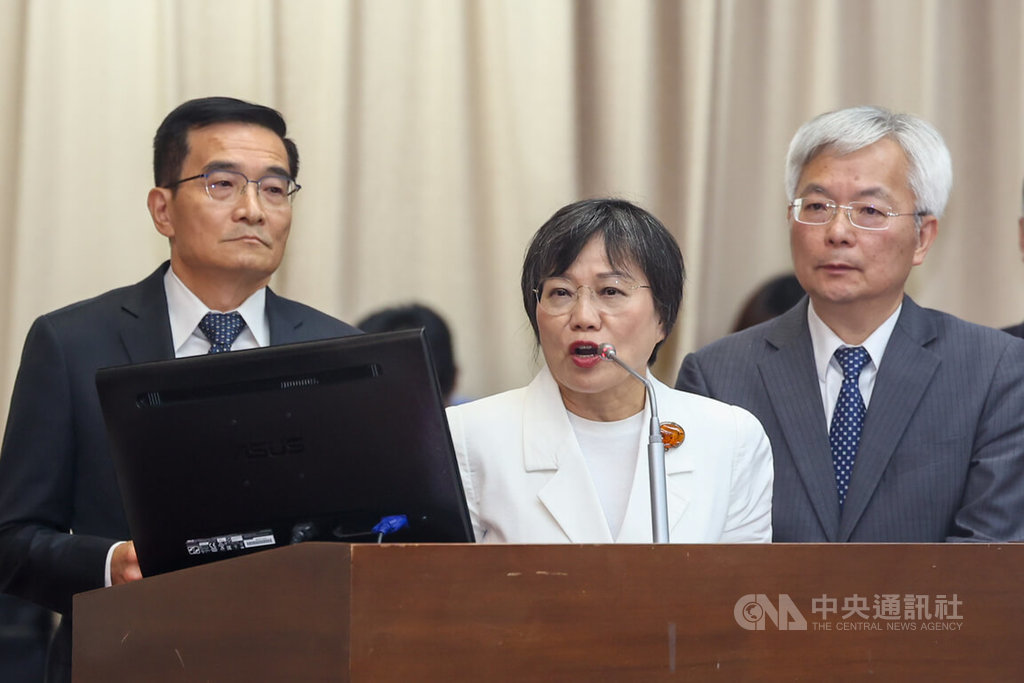
(Central News Agency, Taipei, June 3) Amid frequent drugged driving incidents, Legislator Su Chiao-hui questioned during a session today when the Ministry of Justice (MOJ), having fully initiated the amendment process for drugged driving prevention, would submit the proposal to the Executive Yuan. Deputy Minister of Justice Feng Cheng responded that the relevant amendment content would be discussed with the Judicial Yuan and then submitted to the Executive Yuan as soon as possible, within June.
The Legislative Yuan's Internal Administration Committee held a special report in the morning on "Standards for Setting Up Speed Cameras, Implementation Effectiveness, and Improvements to Adjust Unreasonable Enforcement Points" and "How to Strengthen Enforcement Capabilities and Prevention Strategies in Response to the Surge in Drugged Driving Cases Due to the Proliferation of New Psychoactive Substances," followed by a question-and-answer session.
In his report, Deputy Minister Feng stated that in recent years, new psychoactive substances (NPS) have been rapidly mutating and circulating. The use of NPS like etomidate mixed into e-cigarettes has spread rapidly. After use, it can easily cause confusion, slowed reactions, and loss of limb control, leading to drugged driving and major traffic accidents, posing a serious threat to public safety and the lives of road users.
He said the drugged driving problem requires a comprehensive response through strengthening investigation and source tracing, improving the legal system, and deepening preventive education to effectively curb the harm of NPS and drugged driving.
To prevent the recurrence of drugged driving tragedies, Feng stated that a review and amendment of relevant laws has been initiated. This will comprehensively increase penalty levels for simple drugged driving, drugged driving resulting in death or serious injury, and drugged driving by repeat offenders resulting in death or serious injury. It will also review and amend parole thresholds to enhance the function of crime deterrence.
Furthermore, regarding vehicles used by drugged driving offenders, the amendment will consider adopting mandatory confiscation, meaning regardless of whether the vehicle belongs to the offender, it will be confiscated. This aims to deter and prevent vehicles from being arbitrarily provided to drug users, comprehensively blocking drugged driving behavior.
Feng stated that to ensure the amendment is comprehensive, an expert consultation meeting was held on May 29. The ministry will draft the amendment as soon as possible and submit it to the Executive Yuan for review.
Legislator Su Chiao-hui of the Democratic Progressive Party (DPP) asked in her questions that while more drugged driving cases are being caught, she hopes this is just a recent process and that it ends as soon as possible. She hopes the number of arrests will start to decline, indicating a deterrent effect has been achieved. She asked whether all related legal amendments for drugged driving, which the MOJ mentioned, have been submitted to the Executive Yuan.
She directly asked when exactly the MOJ would submit the draft amendment, as it had promised to do so "as soon as possible."
In his response, Deputy Minister Feng said that the amendment part would be discussed with the Judicial Yuan and then reported to the Executive Yuan as soon as possible. The increase in penalties, stricter future parole thresholds, and stricter criteria for commuting sentences to fines are all included in the comprehensive package. It is expected to be reported to the Executive Yuan within June.
Legislator Liao Hsien-hsiang of the Kuomintang (KMT) also mentioned that the next meeting of the Drug Review Committee is scheduled for June 17. He asked what direction and administrative measures would be taken then to facilitate drug source tracing.
Deputy Minister Feng responded that if drugs seized by various agencies are not yet scheduled, they will be brought to the Drug Review Committee for discussion on whether to schedule them. The committee will also discuss whether to change the classification of existing drugs and adjust the schedule level of drugs like etomidate.
He said the current Narcotics Hazard Prevention Act classifies drugs into four schedules with different penalty levels. Unscheduled drugs will be classified accordingly, allowing for legal enforcement actions subsequently. (Editor: Chang Ming-kun) 1150603
FACT BOX
- Source: CNA (Central News Agency)
- Category: 政策