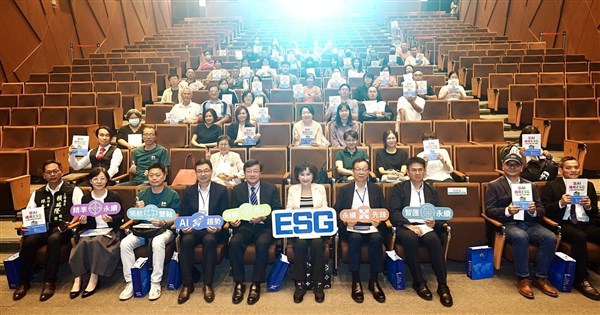
The Central News Agency (CNA) held the "When AI Meets ESG Series Forum" in Kaohsiung on June 3. In her opening remarks, CNA President Hu Wan-ling stated that through a net-zero focused book and the forum, the agency aims to present the challenges enterprises face under the AI wave and establish a dialogue platform for industry, government, and academia to solve current issues.
"Media are not only the eyes recording the times but also the key social gears driving the dual transformation of digital and green development," Hu said. Based on this mission, CNA published the book "When AI Meets ESG" this year and organized the forum, hoping to act as a bridge for dialogue between industry, government, and academia, building a green consensus where technology empowers ESG (Environmental, Social, and Governance).
The event was held at the Kaohsiung Main Public Library, focusing on the dual-axis transformation of AI technology and ESG. It explored smart green energy, the circular economy, and the cultivation of green-collar talent, bringing together industry, academia, and research to drive new sustainable opportunities.
Huang Shih-hung, Deputy Director of the Kaohsiung City Environmental Protection Bureau, stated that Kaohsiung, as an industrial hub in southern Taiwan, has been striving to become a net-zero city in recent years. He noted that the bureau is not only implementing regulations but also promoting carbon reduction through smart technology, hoping that the introduction of AI tools will help local traditional industries and supply chains successfully cross the threshold of net-zero transformation.
Wu Ming-chang, Chairman of Taiwan Sugar Corporation (Taisugar), gave a presentation titled "Turning Agricultural Waste into Green Gold: Taisugar's Circular Economy Practice and Smart Management." He shared how Taisugar uses big data and smart management to successfully convert agricultural waste into green energy and circular resources.
Wu shared that Taisugar produces about 40,000 metric tons of sugar annually. In its manufacturing process, water is recycled, 70% of bagasse is used as biomass fuel for cogeneration, and the remainder becomes organic compost. The company's pig farms use negative-pressure water-curtain barns and have introduced automated feeding systems and smart management systems to reduce waste of feed and water while monitoring the environment and pig health in real time.
Chang Hsin-liang, President of National Formosa University, delivered a keynote speech titled "Technology Empowers ESG: Cultivating AI Green-Collar Talent for the Net-Zero Era." He explained how higher education can integrate smart technology to cultivate innovative green-collar talent with practical net-zero capabilities.
"Beyond academic research, we think about what problems the community needs us to solve," Chang said. He mentioned that the university has spent over NT$100 million to establish an Agricultural and Biotechnology Product Testing Center and has launched a mobile agricultural testing vehicle to inspect pesticide residues at fruit and vegetable markets, taking on greater social responsibility.
The forum concluded with a "Practical Dialogue" session moderated by Huang Cheng-tsung, Chairman of the Taiwan Environmental Justice and Energy Transition Association, featuring business leaders deeply involved in cross-disciplinary green practices.
Wu Chun-lung, Chairman of An Neng Ju Green Energy Co., Ltd., shared how the company transitioned from academia to industry, developing world-leading mass-production technology for carbon fiber recycling. Chou Ho-chung, General Manager of Long Shing Refrigeration Co., Ltd., shared his experience leading the transformation of a traditional refrigeration plant with over half a century of history into an unmanned smart low-temperature logistics center. Yang Hung-wen, General Manager of Liwen Cultural Enterprise, shared the process of leading the transformation of campus bookstores across Taiwan and promoting the digitalization of teaching materials and cultural sustainability.
The organizer stated that in the face of global climate change and international supply chain demands, the adoption of AI technology and the implementation of ESG have become essential for survival and competition. Through cross-sectoral discussions among industry, government, and academia, the forum aimed to explore how to flexibly use AI tools to deepen ESG practices in respective fields, injecting sustainable innovation momentum into the dual-axis transformation of industries in southern Taiwan.
FACT BOX
- Source: CNA (Central News Agency)
- Category: 事件