(CNA reporter Chang Shu-ling, Beijing, 4) Today marks the 37th anniversary of the June 4 incident. In China, the pro-democracy movement of 1989 and the bloody suppression often referred to directly as "June 4" are taboo terms. The Chinese Communist Party’s official history instead calls it "the political turmoil at the turn of spring and summer in 1989."
Not taught in textbooks, not discussed by authorities, and not permitted to be commemorated—most people born in mainland China after 1990 have grown up in an environment where they "do not know June 4." Yet even within this broader environment, there are gaps that help fill the blank spaces of historical memory.
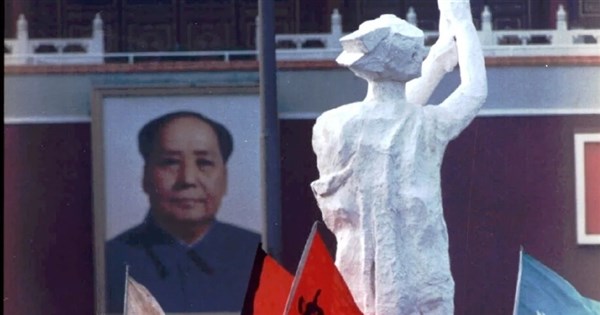
A graduate student in the visual arts, about 25 years old, told CNA with no small amount of pride that the Goddess of Democracy statue that once stood on Tiananmen Square was made by a group of students including her seniors, and that this fact has been passed down as an "unofficial school history" from class to class that everyone cherishes.
Public records show that the Goddess of Democracy was erected on Tiananmen Square on May 30, 1989. Standing about 10 meters tall, it was rushed into being by more than 20 students from eight institutions: the Central Academy of Fine Arts, Beijing Film Academy, Central Academy of Drama, Central Conservatory of Music, Chinese Academy of Traditional Opera, China Conservatory of Music, Central Academy of Art and Design, and Beijing Dance Academy.
A 33-year-old reporter said he knew about June 4 because, as a journalist, his work environment exposes him to more information and it is necessary for his job to be aware of such matters.
Another interviewee, Mr. Zhang (a pseudonym) in his thirties, said he learned about June 4 from a high-school classmate whose parents had been eyewitnesses to the Tiananmen pro-democracy movement. Afterwards, he "climbed the firewall" to look at Wikipedia, searched online for related documentaries and any available images and texts, and collected whatever materials he could find.
He shared with the reporter what June 4 means to someone born after that event.
Before knowing about June 4, Mr. Zhang, like most of his peers, took part in the Young Pioneers and the Communist Youth League and received the state's political ideological education. After learning about June 4, his life changed significantly; it affected his perspective on the world, the country, and history.
He said he was greatly shocked. First, he realized that there had been such a significant pro-democracy movement in history that ended with such violence and gunfire. "But what shocked me even more was that the Communist Party has successfully erased this event from history—not only is it absent from history textbooks, publicly published books, and films, but even my family would never proactively mention it."
This realization made Mr. Zhang feel "terrified," and it led him to begin thinking about how many other things might have been erased. He started seeking out other histories that might be banned by the authorities and became very interested in them.
He finds his own ways to imagine and commemorate June 4. Every year on June 4, he fasts to pay tribute to the students who hunger-struck on the square, and he has kept this up for more than a decade.
A few years ago he went to Hong Kong to participate in the candlelight vigil in Victoria Park. Although he did not understand Cantonese, he joined others in shouting slogans calling for a reevaluation of June 4 and sang the Mandarin song "Bloody Splendor." "I was deeply moved because it was the first time I could shout words in public that could never be shouted on the streets at home. That was very important to me and sparked much reflection," he said.
Under the national security law, June 4 commemoration activities in Hong Kong have been banned.
This year on June 4 the atmosphere on the streets of Beijing was normal. Many WeChat groups also did not display any borderline commemorative remarks. As more people approaching their 40s come to dominate society, topics such as the economy, consumption, the stock market, and social news remain the main subjects on social platforms. (Editor: Chou Hui-ying) 1150604
Choose to stand with the facts. Every donation you make helps defend press freedom.
Download CNA’s "One-Hand News" app to get the latest news in real time.
Text, images, and audiovisual materials on this website may not be reprinted, broadcast, transmitted, or used publicly without authorization.
FACT BOX
- Source: CNA (Central News Agency)
- Category: Survey