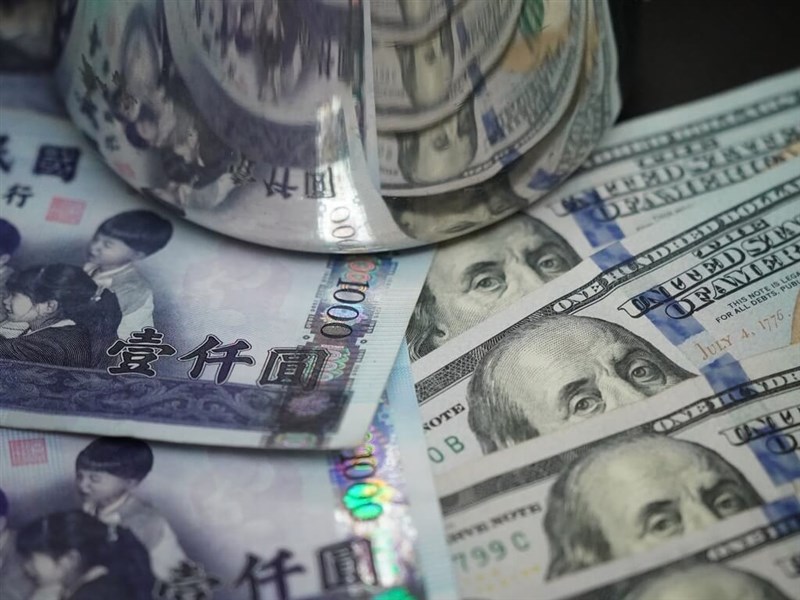
(Central News Agency, reporter Pan Ziyu, Taipei, 5th) The Central Bank of Taiwan announced today that foreign exchange reserves at the end of May stood at US$605.074 billion, marking a second consecutive monthly increase and firmly maintaining the fourth-largest position globally. Notably, as the Taiwan stock market continued to climb, the total value of domestic assets held by foreign investors approached US$1.9 trillion, pushing the ratio to foreign exchange reserves above the 300% mark, both setting new historical records.
According to the central bank's statistics, foreign exchange reserves at the end of May were US$605.074 billion, an increase of US$25.86 billion from the previous month. The main driver was that May is a month with significant interest income, with returns from foreign exchange reserve investment operations being booked. The impact of exchange rate factors was relatively limited.
Regarding the central bank's intervention in the foreign exchange market, Central Bank Foreign Exchange Bureau Director Tsai Chung-min explained that in mid-May, due to a decline in the Taiwan stock market and capital outflows by foreign investors, the central bank intervened. At the end of the month, capital inflows from foreign investors pushed up the exchange rate, prompting another central bank intervention. These opposing interventions offset each other, resulting in no significant change to foreign exchange reserves.
The central bank also announced that at the end of May, the total value of domestic stocks and bonds held by foreign investors, calculated at market prices on that day, along with their New Taiwan dollar deposits, amounted to US$1.8956 trillion, equivalent to 313% of foreign exchange reserves. Both figures set new historical highs.
At the end of April, the total value of domestic assets held by foreign investors was US$1.6149 trillion, equivalent to 268% of foreign exchange reserves. Within just one month, this figure surged at an astonishing pace, with the ratio in May directly breaking through the 300% threshold, drawing significant attention.
Director Tsai commented on this, stating that the large change in the numbers was primarily due to the rise in the Taiwan stock market. Especially at the end of May, the Taiwan stock market had risen to near the 45,000-point level, boosting the market value of foreign-held stocks to nearly US$1.9 trillion. He noted that during the period of the Taiwan stock market's rise, the Korean stock market also performed strongly. In April, the ratio of foreign-held assets to foreign exchange reserves in South Korea reached 386%, higher than Taiwan's 268% for the same period, and it is estimated that this figure for May will continue to be higher than Taiwan's.
Director Tsai added that according to central bank statistics, after accounting for profit repatriation, foreign investors still brought in US$6 billion, highlighting that foreign investors are focusing on the rise of the Taiwan stock market and continue to channel funds into the country.
The media also inquired about the future trend of the US dollar. Director Tsai stated that there are many uncertainties this year, particularly regarding how geopolitical risks will develop, making it difficult to predict the dollar's trajectory.
Director Tsai analyzed that the monetary policy path of the US Federal Reserve (Fed) is a key factor influencing the dollar. Although attention must be paid to the stance of the new Fed Chairman, Kevin Warsh, with inflation data persistently above 2%, investors are betting that the Fed will not cut interest rates this year, and the option of a rate hike cannot be ruled out. He personally believes that compared to a rate hike, the Fed is more likely to keep rates unchanged.
Director Tsai further stated that assuming the Fed keeps rates unchanged this year without any hikes or cuts, the impact on the dollar would be relatively limited. However, as the dollar is a major international currency, an escalation of geopolitical risks would push the dollar higher, and this part carries high uncertainty. (Editor: Yang Kaixiang) 1150605
FACT BOX
- Source: CNA (Central News Agency)
- Category: 事件