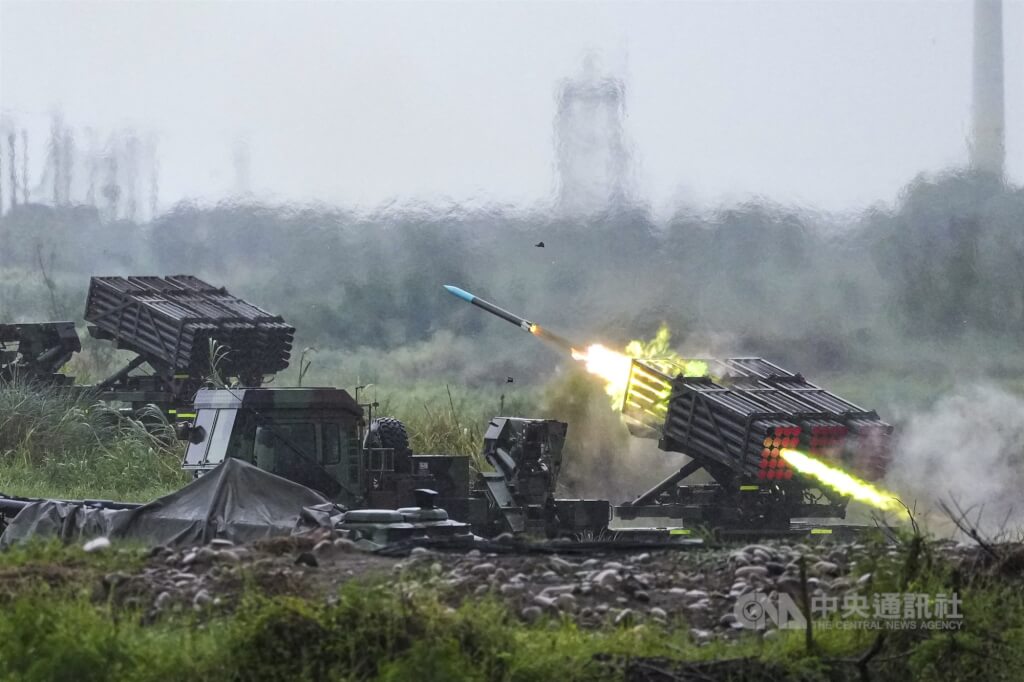
To enhance its combat capabilities, Taiwan's armed forces are promoting combat-realistic training. The Army's 10th Army Corps conducted a heavy artillery drill today. Major Liao Neng-cheng, commander of the 58th Artillery Command's rocket company leading the Thunder 2000 Multiple Launch Rocket System, stated that while in the past they would enter the position a week in advance to prepare, this time they arrived only the day before. He also noted that they usually train on hard ground but successfully completed the mission this time by overcoming environmental factors like the sandy beach.
The Ministry of National Defense invited media today to the vicinity of the north and south banks of the Dajia River mouth in Taichung to cover the 10th Army Corps' "Year 115 Heavy Artillery Firing and New Weapon Integration Verification" training exercise, observing the firing of artillery such as the Thunder 2000 MLRS and M109A2 self-propelled howitzers.
The Army's 10th Army Corps stated that one of the highlights of this exercise was the Thunder 2000 MLRS conducting a live-fire drill within an operational area for the first time in seven years.
Major Liao Neng-cheng, commander of the 58th Artillery's multiple rocket company, said in a post-firing interview that his company used three Thunder 2000 vehicles to fire a total of 180 MK15 rockets, verifying their regular training results and demonstrating their determination to defend the nation.
Regarding the combat-realistic training, Major Liao noted that the Thunder 2000 last fired at this location in the year 109 of the Republic of China (2020) and has now returned. He explained that past live-fire training involved entering the position a week in advance to complete preparations, but this time they arrived the day before, making the schedule tighter.
Major Liao further explained that the firing site for the Thunder 2000 was also different from usual. They typically train on hard surfaces, but suddenly switching to firing from the soft sand of a beach required laying down soft-ground base plates to increase firing stability. For this reason, hard terrain is usually chosen for firing positions, with soft terrain selected only when necessary.
Captain Lin Chun-cheng, commander of the 586th Brigade's 1st Artillery Battery, who directed the M109A2 self-propelled howitzers, mentioned that although the rain made observation more difficult, they have contingency plans and preparations for rainy days and maintained communication using the new Team Awareness Kit (TAK) mobile phone system.
Colonel Weng Yi-ming, Chief of Staff of the 58th Artillery Command, pointed out that this heavy artillery drill differed from past ones in that the artillery was not in a fixed formation but was dispersedly deployed, and the timing for entering the position was based on a realistic combat schedule. He added that there will be more tactical firing exercises in the second half of the year and that they will train even more diligently.
The Army's 10th Army Corps explained that the exercise simulated an enemy amphibious force attempting to invade the central region. The Thunder 2000 MLRS first conducted an area strike against the enemy landing on Baishatun beach, followed by area denial fire from M109A2, M110A2 self-propelled howitzers, and 155mm howitzers to effectively halt and weaken the enemy forces on the Jianan beach. Subsequently, TOW missile vehicles and 120mm mortars provided continuous fire suppression against enemy breakthroughs, allowing the troops to realize that "everywhere is a battlefield, and training is constant."
FACT BOX
- Source: CNA (Central News Agency)
- Category: 事件