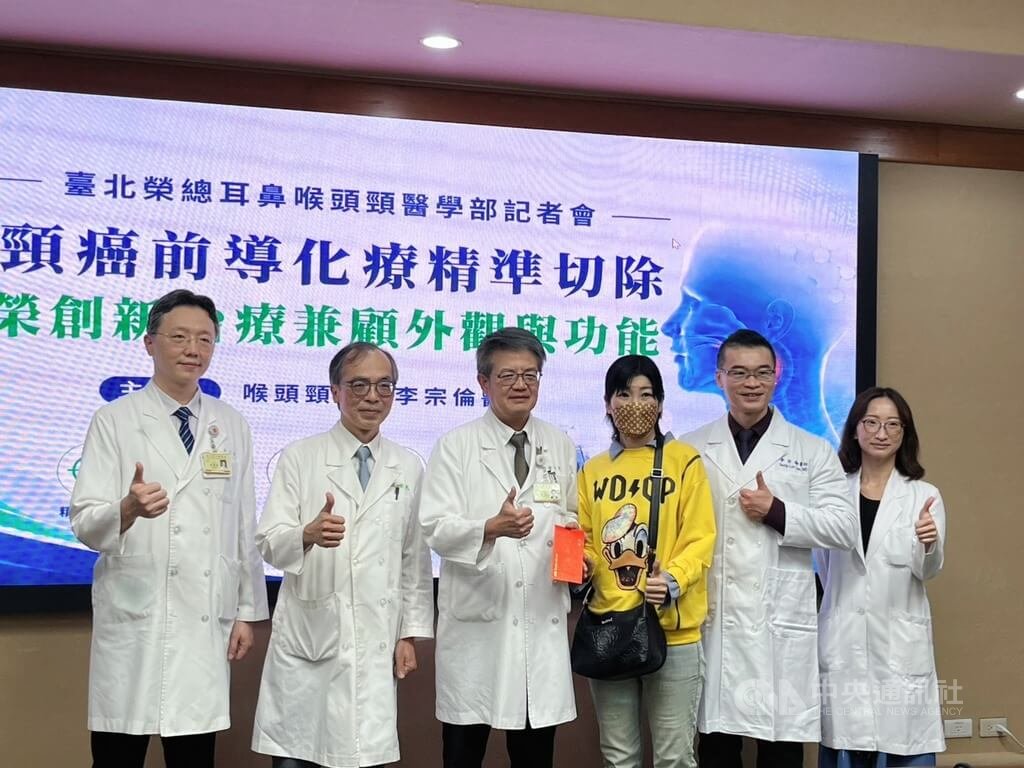
(Central News Agency, Reporter Shen Peiyao, Taipei, 10th) Ms. Xiao, nearly 50 years old, was diagnosed with tongue cancer two years ago. She underwent surgery but the cancer recurred, leaving her feeling depressed. Fortunately, under Taipei Veterans General Hospital's (TVGH) 'neoadjuvant chemotherapy, precise resection' treatment model, she was able to preserve her speech and eating functions, her appearance was unaffected, and she has hope of watching her children grow up.
Looking back on her journey, Ms. Xiao said that two years ago, she first experienced severe toothache, which at one point even caused pain in the back of her head. When she heard from the doctor that she had tongue cancer, her first thought was, 'My children are still young, I can't fall down.' However, her treatment path was not smooth. After the first surgery, her condition did not improve, and the wound even secreted an abnormal discharge.
Ms. Xiao visited several hospitals without a solution, finally going to Taipei Veterans General Hospital. A biopsy confirmed the case as 'Stage II recurrence of right posterior tongue cancer.' If treated with traditional surgical methods, it would inevitably affect swallowing and speech functions.
Dr. Li Zonglun, an attending physician in the Department of Laryngology and Head & Neck Surgery at TVGH's Department of Otolaryngology, Head and Neck Surgery, pointed out in a press conference today that TVGH has been actively promoting a 'neoadjuvant chemotherapy combined with precise transoral robotic surgery' treatment model in recent years. This strategy involves 'first shrinking the tumor with chemotherapy, then performing precise resection' to preserve the patient's appearance as much as possible while effectively restoring swallowing and speech functions.
Dr. Li stated that head and neck cancer patients receive 2 to 3 cycles of neoadjuvant chemotherapy before surgery to first reduce the tumor volume. After evaluating the degree of tumor shrinkage, the laryngology team performs precise robotic resection based on the range of the residual tumor, avoiding the extensive damage of traditional surgery.
Dr. Li pointed out that this cross-departmental integrated treatment not only reduces the appearance defects caused by traditional surgery but also helps preserve the patient's swallowing and speech functions, reducing treatment-related side effects and sequelae. Ms. Xiao fully resumed oral feeding on the 10th day after surgery. Current follow-up shows good tumor control, and her oral and tongue appearance, speech, and eating functions have all returned to normal, with no restrictions on her life.
According to statistics from the Ministry of Health and Welfare, oral and pharyngeal cancer is the 6th most common malignant tumor in Taiwan. Dr. Dai Shiguang, Director of the Department of Otolaryngology, Head and Neck Surgery at TVGH, pointed out that Taiwan has a relatively large number of oral cancer patients and has accumulated considerable clinical experience in neoadjuvant chemotherapy and treatment de-escalation. Several medical centers in Taiwan have gradually adopted this approach and adjust subsequent treatment based on postoperative pathological results. In the future, large-scale, multi-center clinical studies are needed to establish a more complete evidence base. (Editor: Zhang Yajing) 1150610
FACT BOX
- Source: CNA (Central News Agency)
- Category: Taiwan