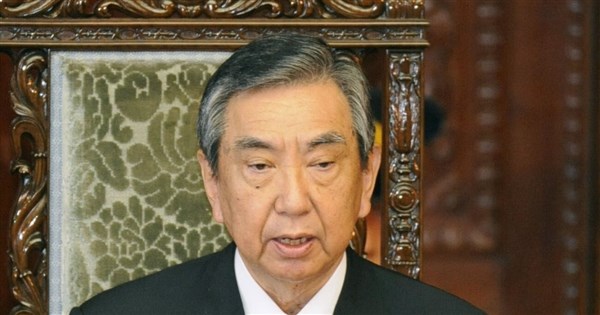
(Central News Agency, Tokyo, 11th – Special Dispatch) Yohei Kono, former president of Japan's Liberal Democratic Party (LDP) and former Speaker of the House of Representatives, passed away on the 8th due to pancreatic cancer. He was 89 years old. Kono held key positions including Chief Cabinet Secretary, Deputy Prime Minister, Minister for Foreign Affairs, President of the LDP, and Speaker of the House of Representatives. He dedicated many years to diplomacy with China and South Korea. The 'Kono Statement' he issued in 1993 became a crucial official position of the Japanese government regarding the comfort women issue.
According to reports from NHK and Nippon TV, Kono was born into a political family. His father, Ichiro Kono, served as Minister of Agriculture and Forestry and Minister of Construction, and his uncle, Kenzo Kono, served as President of the House of Councillors. In the 1967 House of Representatives election, he inherited his father's political base, ran from the old Kanagawa 3rd district, and was elected for the first time. He was subsequently re-elected 14 consecutive times.
In 1976, he left the LDP, criticizing its money-power politics, and formed the 'New Liberal Club,' becoming its representative. In 1985, he entered the cabinet for the first time as Director-General of the Science and Technology Agency in a coalition government formed by the LDP and the New Liberal Club. The following year, the New Liberal Club dissolved, and he rejoined the LDP. In 1992, he became Chief Cabinet Secretary.
In 1993, as Chief Cabinet Secretary, Kono issued the famous 'Kono Statement,' expressing the Japanese government's apology and remorse regarding the comfort women issue. In the statement, Kono acknowledged the involvement of the former Japanese military in the establishment and management of the comfort women system and expressed apologies and remorse to the affected women. This statement became a crucial official position for the Japanese government on the comfort women issue and profoundly influenced Japan-South Korea and broader East Asian diplomatic relations for decades.
Within the LDP, Kono was regarded as a representative 'dove' politician. He consistently maintained a cautious stance on amending Article 9 of the Constitution and advocated for improving Japan's relations with neighboring countries like China and South Korea through dialogue and exchange.
In 2002, suffering from severe liver disease, he received a partial liver transplant from his eldest son, former Foreign Minister Taro Kono. Subsequently, he actively promoted the development of the organ transplant system.
In 2003, he became Speaker of the House of Representatives, becoming a key leader in the Japanese Diet. He did not run for re-election to the House of Representatives in 2009, officially retiring from politics.
In his later years, Kono remained actively engaged in people-to-people diplomacy. As chairman of the 'Japan Association for the Promotion of International Trade,' which promotes Japan-China economic cooperation, he led numerous delegations to China, fostering bilateral economic cooperation and civil exchange. He was considered a significant pro-China figure.
In June of last year, he led a delegation to meet with Chinese Premier Li Qiang at the Great Hall of the People in Beijing. The association had also planned another visit to China in late June of this year, seeking a meeting with Chinese President Xi Jinping to promote bilateral economic cooperation, but news of his death came before the trip could materialize.
The 'China-Japan Chamber of Commerce,' composed of Japanese companies in China, issued a statement of mourning. Chairman Tetsuro Homma stated that they would inherit Kono's will to promote Japan-China friendship and economic cooperation, 'carrying forward the concept of vigorously restoring Japan-China civil economic exchanges,' and continue to deepen economic cooperation and exchanges between the two countries.
Following Kono's death, condolences poured in from across Japan's political spectrum, as well as from various sectors in China and South Korea.
Former Prime Minister Fumio Kishida said that Kono was the president of the LDP when he himself was first elected to the House of Representatives, stating, 'I received his invaluable guidance and learned a great deal from him.' Former Prime Minister Shigeru Ishiba remarked that Kono 'showed a deep understanding of China in diplomacy and was a politician who always pursued his ideals and held fast to his beliefs.' Internal Affairs and Communications Minister Yoshimasa Hayashi also expressed his feelings, saying, 'He always took good care of me.'
Prime Minister Sanae Takaichi posted on social media platform X, stating that Kono dedicated himself to the development of national politics and the establishment of parliamentary democracy for many years, maintained a sincere attitude especially on historical issues, and valued dialogue and understanding. She added that his spirit should be regarded as one of the important cornerstones of Japan's peaceful diplomacy.
China also paid close attention to the news of Kono's death. Chinese media widely mentioned his issuance of the 'Kono Statement' in 1993 and his long-term contributions to promoting Japan-China friendly exchanges. Several media outlets quoted his remarks during his visit to China last year: 'History cannot be forgotten, let alone denied. The past cannot be changed, but the future can be created through effort.'
South Korean media focused on the historical significance of the 'Kono Statement.' Yonhap News Agency noted that Kono was a representative dove politician in Japan who valued relations with neighboring countries like South Korea and China. The Chosun Ilbo reported that the 'Kono Statement' is an important document in which the Japanese government first formally acknowledged responsibility for the comfort women issue, and is regarded as a key turning point in Japan-South Korea relations. (Editor: Tian Ruihua) 1150611
FACT BOX
- Source: CNA (Central News Agency)
- Category: Taiwan