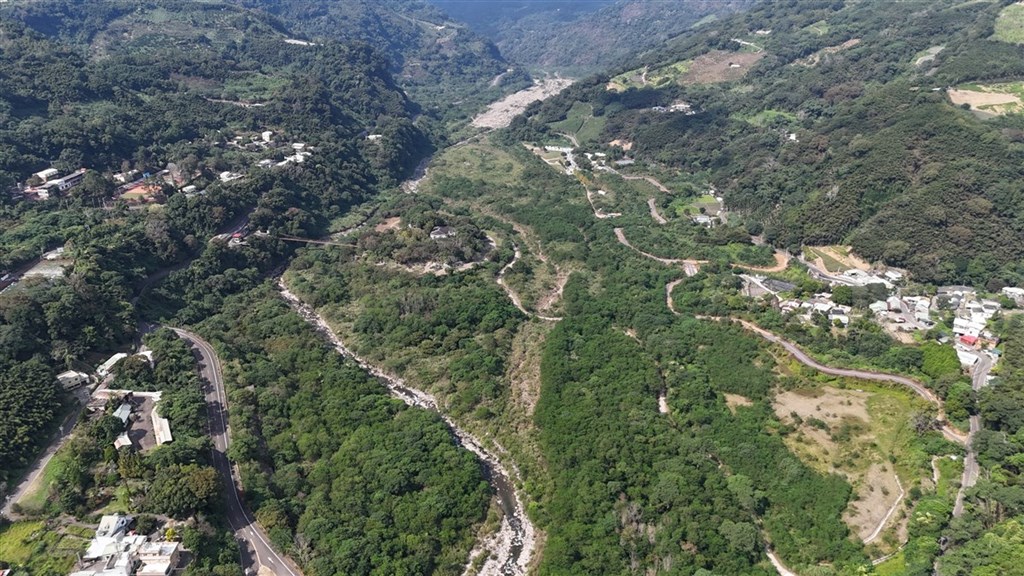
(Taichung, December 12 — Reporter Su Mu-chun) A hot spring development project in Tai'an Township, Miaoli County, faced legal challenges after the nearby Yuandun Tribe, excluded from prior consultation, filed a lawsuit at the Taichung High Administrative Court to revoke the development permit. With the court's mediation efforts, the three involved tribes recently rebuilt mutual trust, reached a settlement, and resolved the legal deadlock.
The Taichung High Administrative Court issued a press release today stating that two major hot spring resort development projects—led by Taian Shanhejing Company and Wenshui Tangyuan Development Company—are located along the Wenshui Creek, within the traditional territory of indigenous peoples. However, only the neighboring Atayal tribes of Swasig and Sapuloku were consulted and granted consent, while the Yuandun Tribe across the river was excluded. This raised controversy over the legality of the development permits issued by the Miaoli County Government to the resort operators.
The Yuandun Tribe, feeling its autonomy was disregarded, filed an administrative lawsuit at the Taichung High Administrative Court, seeking to revoke the development permits granted to the two companies.
The court emphasized that this case transcends a mere legal dispute over indigenous traditional territories; it is fundamentally about how the Atayal 'village cluster' in the Tai'an hot spring area can coexist and share benefits.
To address this, the court appointed external legal expert Attorney Lin San-yuan as the mediator, convening representatives from the Yuandun Tribe, Miaoli County Government, Swasig Tribe, Sapuloku Tribe, hot spring developers, and tribal members. Through in-depth analysis and facilitated dialogue, the mediation process highlighted the historical and cultural context of the Yuandun Tribe, drawing on insights from tribal elders and cultural historians. This helped revive the shared Atayal memory across the Wenshui Creek basin, reestablishing a foundation of mutual respect and peaceful coexistence.
Ultimately, all parties involved in the mediation gained a deeper understanding and built mutual trust. Each of the three tribes subsequently held separate tribal meetings and, through voting, approved the hot spring developers' plans. The successful mediation thus resolved a years-long legal impasse.
The court noted that while the delineation of indigenous traditional territories remains under the jurisdiction of the Council of Indigenous Peoples, this mediation outcome concretely realizes the legislative intent behind the mediation system introduced in the Administrative Litigation Act. Administrative litigation should not be limited to adversarial legal proceedings; it can also serve as a flexible mechanism enabling autonomous dispute resolution among tribes. This case marks a milestone in the development of mediation mechanisms within administrative litigation. (Editor: Chen Jen-hua) 1150612
FACT BOX
- Source: CNA (Central News Agency)
- Category: Taiwan