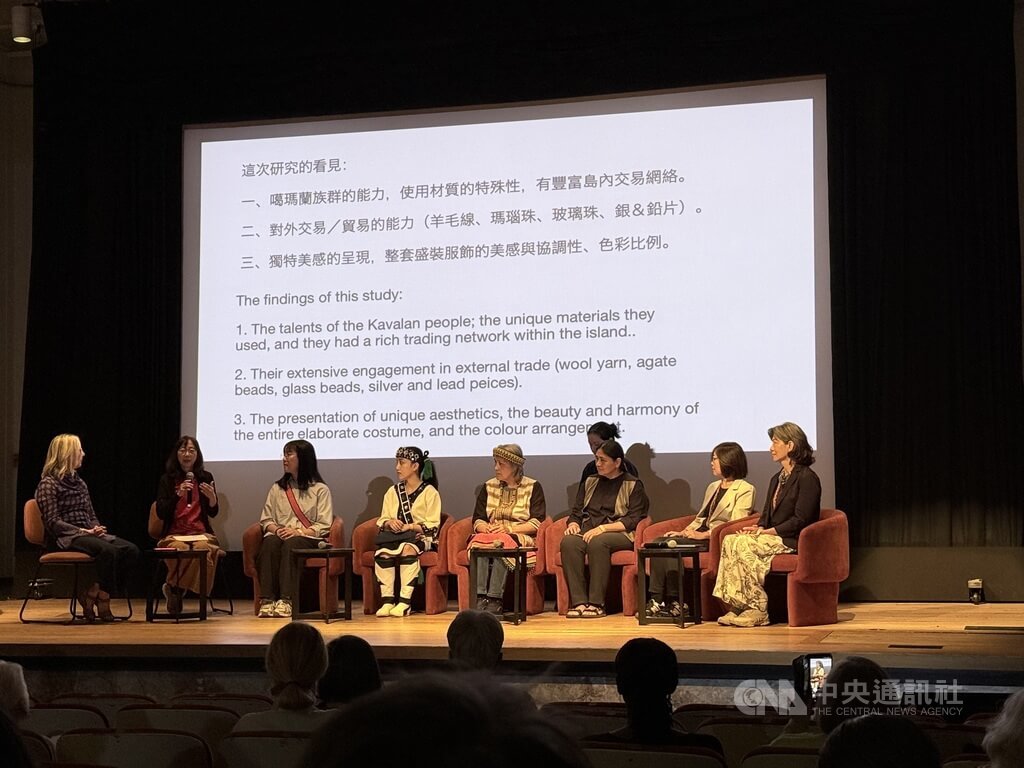
(CNA reporter Hu Yu-li, Toronto, June 15) — In a mission to recover the lost art of banana fiber weaving, seven key participants in Kavalan cultural revival arrived in Toronto on June 5. They spent several days at the Royal Ontario Museum (ROM), closely studying Kavalan cultural artifacts collected over a century ago. On June 13, they held a panel discussion at ROM to share their research insights and emotional reflections.
When discussing this 'Kavalan Banana Fiber Weaving Revival Journey' with over 100 Canadian audience members, Hsieh Shu-yueh, a master artisan from the Banana Fiber Workshop in Hualien's Paterungan (Xinshe) Village dedicated to preserving traditional Kavalan weaving techniques, became deeply emotional, repeatedly expressing her gratitude.
Lin Shu-li, a Shibei dyeing and weaving artisan, said that seeing the century-old Kavalan artifacts in person at the ROM museum was 'eye-opening,' with observational insights far surpassing what could be gained from flat photographs. After returning to Taiwan to organize their findings, they aim not only to 'weave back' the 19th-century Kavalan banana fiber traditional attire but also hope this craft can be integrated into the daily lives of the next generation of Kavalan people.
The story begins with Canadian missionary George Leslie Mackay, who in 1893 sent over 600 artifacts collected during his 30 years in Taiwan—packed in 14 crates—to Knox College in Toronto, which later transferred them to the ROM in 1915.
The late Professor Hu Chia-yu from National Taiwan University confirmed in 2000 during a field visit to Canada that this collection, carefully preserved by the ROM for over a century, includes about 50 items belonging to Taiwan's indigenous Kavalan people. These include banana fiber textiles, headdresses, belts, weaving tools, and even a complete bridal ceremonial outfit.
Since launching a movement to reclaim their ethnic name in 1987, the Kavalan people were officially recognized in 2002 as Taiwan's 11th indigenous group. They have since strived to revive the traditional banana fiber weaving craft. After a decade of planning, the Hualien County Kavalan Cultural Foundation, with support from Taiwan's Ministry of Foreign Affairs, Hualien County Government, Council of Indigenous Peoples, and the ROM, formed a seven-member research team. From June 5 to 17, they traveled to Canada to directly examine and analyze ancestral cultural heritage from over a century ago, reconstructing Kavalan-specific cultural memory of banana fiber weaving.
The June 13 panel discussion at ROM, titled 'Reconstructing Tradition: The Revival of Modern Taiwanese Kavalan Banana Fiber Weaving,' was co-hosted by Cheng Wen-chien, a senior Taiwanese curator of East Asian art who has been shuttling between ROM and Taiwan for nearly nine years. In her opening remarks, she noted that the indigenous artifacts Mackay sent to Canada have survived Taiwan's Japanese colonial era and subsequent turbulent events, and are now globally recognized as the earliest and finest collection of indigenous Taiwanese artifacts.
Sarah Fee, ROM's Senior Curator of Global Fashion & Textiles and co-host, said the Kavalan banana fiber textiles in ROM's collection are among the most beautiful woven pieces she has seen in her 17 years at the museum.
Pan Nien-hsin, a 1997-born Kavalan youth and weaving apprentice, playfully shared during the Q&A that she hopes to 'use the banana fiber techniques learned here to weave a more beautiful and colorful bridal gown, and get married again—though to the same husband.' Her remark drew laughter from the audience.
Liang Yi-peng, Director of the Taipei Economic and Cultural Office in Toronto, attended the panel and told CNA that Mackay, born in Ontario, arrived in Taiwan in 1871, creating a 'wonderful connection' between Canada and Taiwan. 'We are delighted to see the Kavalan Cultural Foundation visit Mackay’s hometown, view their ancestors’ cultural heritage, rediscover ancestral wisdom, and strengthen Kavalan identity and pride. This is truly a beautiful story spanning over 150 years,' he said.
Liang added, 'For the government, Taiwan is a society of multiple ethnicities, cultures, and languages. We support and encourage every ethnic group to build their cultural identity, because without any one piece, Taiwan would not be complete.'
This banana fiber weaving revival journey marks the first time Kavalan people and scholars have closely studied ancestral artifacts. Through material analysis, weave pattern observation, and documentation of weaving aesthetics and techniques, they are laying a vital foundation for future craft revival and cultural education.
The seven-member team includes: Wang Yu-hsin, Professor at National Dong Hwa University's College of Indigenous Studies; artisans Lin Shu-li and Hsieh Shu-yueh; apprentice Pan Nien-hsin; Teng Hsueh-chen, Director of Island People International; documentary filmmaker Pan Yu-fan (Uki Bauki); and photographer Lee Yuan-lung.
They are filming the entire journey into a documentary titled 'The Bridal Gown at the Other End,' with filming locations including Zorra Village in Oxford County, Ontario—the hometown of Mackay. After completion, the documentary is also planned for screening in Toronto. (Editor: Wei Shu) 1150616
FACT BOX
- Source: CNA (Central News Agency)
- Category: Event