U.S.-Iran War Key News
Central Message
(Taipei, Dubai, June 16 — CNA, compiled from international news) Reuters reported that the U.S. military is secretly overseeing dozens of covert 'ship-to-ship' oil transfer operations, using aerial and surface drones along with helicopters to guide convoys to designated tankers, in an effort to maintain the flow of energy exports from the Persian Gulf.
This operation, conducted at the edge of the Strait of Hormuz, employs the same 'shuttle transfer' tactics that Iran has long used to circumvent sanctions.
According to 11 sources familiar with the matter, oil transfers are taking place at two specific locations: one off Fujairah in the United Arab Emirates (UAE), and another off Sohar in Oman.
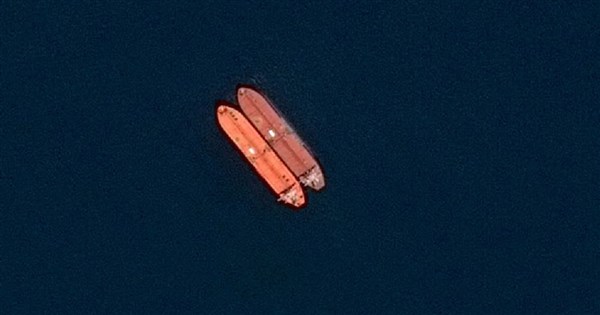
Shipping data and satellite imagery reviewed by Reuters show the operation began in early May and has involved at least 116 vessels to date.
Satellite images analyzed by Reuters show that as of this morning, 12 pairs of ships were seen moored together in the Gulf of Oman: 8 pairs off Sohar, Oman, and 4 near Fujairah. Activity peaked last week on June 11, when 17 pairs of ships were simultaneously conducting oil transfers at both locations.
Four sources, including a former U.S. official familiar with the attack incident, said an Apache attack helicopter shot down by Iran on June 9—triggering U.S. retaliatory airstrikes—was also participating in this mission.
Reuters satellite imagery revealed that on the day the Apache was downed, six pairs of tankers were clustered in a small area off Sohar, Oman.
Reuters could not confirm the specific role the Apache played in the operation.
In response to Reuters' inquiry, a U.S. defense official stated that U.S. Central Command (CENTCOM) forces are not involved in any maritime ship-to-ship oil transfer operations. The official added that both crew members were rescued by an unmanned vessel at the time.
The scale, operational methods, and the Apache's role in these transfers had never been previously reported. The White House referred questions to Central Command. Iran's government did not respond to requests for comment on the transfer operations.
The two transfer points are located in the Gulf of Oman near the exit of the Strait of Hormuz, adjacent to the boundary划定 by Iran's newly established 'Persian Gulf Strait Authority.' Ships failing to comply with Iranian directives face the risk of drone and missile attacks by the Islamic Revolutionary Guard Corps (IRGC).
Although ship-to-ship transfers are high-risk and inefficient, they appear to be part of the Trump administration's efforts to restore normal oil flow through the Persian Gulf.
President Trump stated that under the U.S.-Iran peace framework agreement announced this week, the Strait of Hormuz will reopen on the 19th, though details remain unclear. Reuters could not determine whether the announced agreement has affected the current oil transfer operations. (Translation: Li Pei-shan) 1150617
FACT BOX
- Source: CNA (Central News Agency)
- Category: Taiwan