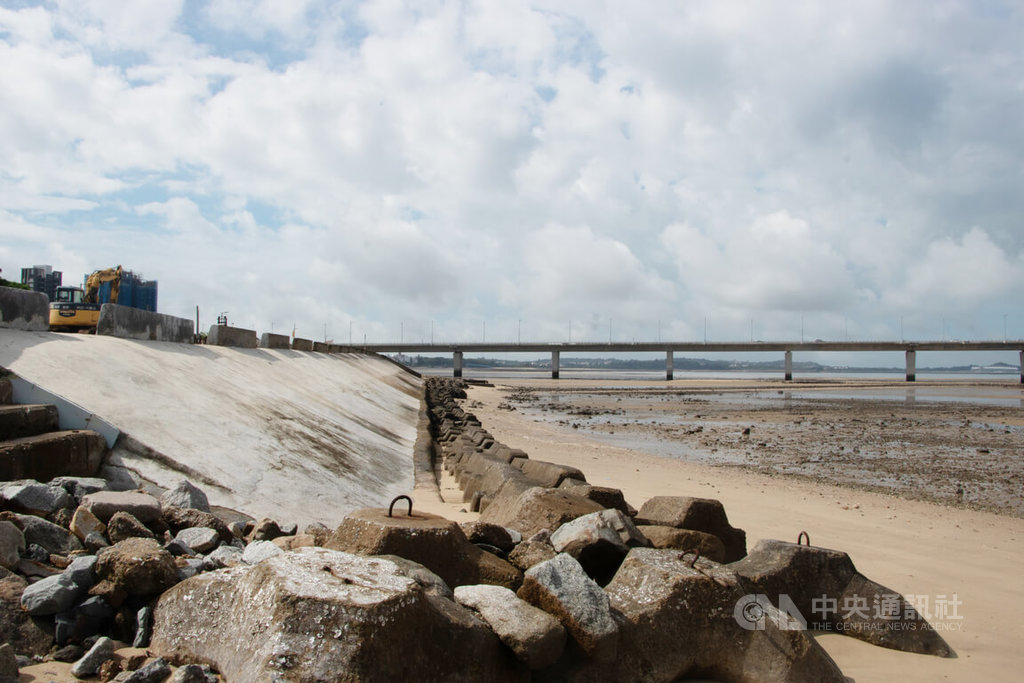
(Central News Agency, Kinmen, June 18) The Huxia seawall in Kinmen is scheduled for an adaptation project. Scholars believe it may affect the habitat of the "living fossil" horseshoe crab and hope the project will minimize environmental impact. The Eighth River Branch stated that the project includes ecological reviews, and the team will conduct regular monitoring, hoping to balance ecology and local development.
The "Kinmen County Huxia Seawall Adaptation Project" is commissioned by the Water Resources Agency, Ministry of Economic Affairs, Eighth River Branch, and undertaken by the Kinmen County Government. According to information provided by the Kinmen County Public Works Department, the project scope covers the section from Huxia Oyster Management Post to the Kinmen Bridge. It will involve thickening the seawall in front (backfilling with soil and sand and dumping rubble) and improving the seawall top space and recreational facilities.
Chang Yi, a professor at the Institute of Marine Affairs at National Sun Yat-sen University, who was previously commissioned by the Fisheries and Aquaculture Administration to investigate Taiwan's three-spined horseshoe crab population, told CNA that the area from Kinmen's Wu Jiang Stream to Huxia was once a natural sandy beach and an important horseshoe crab habitat. Later, a bicycle path and the Kinmen Bridge were built, fragmenting the horseshoe crab habitat. Changes in the proportion of mud and sand in some areas also made it impossible for horseshoe crabs to inhabit.
Chang Yi said that the seawall within the scope of this project has formed a beach below the seawall over a period of time and has gradually stabilized, which may help horseshoe crabs come ashore to lay eggs. However, the area of mudflats and seagrass and the distribution of juvenile horseshoe crabs below the beach are still affected. If this project includes construction methods like dumping rubble, the stones will create eddies, which will further alter the proportion of mud and sand, potentially leading to the death of juvenile horseshoe crabs, which are sensitive to the environment.
Chang Yi suggested that the project should reduce the extent of changes to the natural coastal topography and landforms. For example, the project could be carried out on existing concrete structures to avoid further altering the coastal environment. "The Coastal Management Act explicitly states the need to ensure zero loss of natural coastlines, and our projects should consider this point."
Hong Qingzhang, chairman of the Kinmen Intertidal Zone Society and a long-term observer of horseshoe crab populations, pointed out that after the construction of the Kinmen Bridge, severe sand accumulation occurred at the Huxia seawall, reducing the number of horseshoe crab habitats affected. Coastal engineering impacts are not isolated; changes in ocean currents are difficult to predict. There are still many horseshoe crabs in the nearby Xionghoubao and Nanmen Sea. This project will definitely have an impact on the habitat in this area.
Guo Jianhong, director of the Eighth River Branch, told CNA that the Huxia seawall is a monotonous concrete "three-sided smooth" type. Considering its age, the foundation and some concrete protective works have subsided and deformed, requiring urgent reinforcement. The project's main goal is to improve the structural safety of the seawall body, then thicken the seawall body with accumulated sand from the nearby coast, slow down the seawall slope, increase hydrophilic space, and add rubble protection to prevent wave erosion.
Regarding the project's impact on horseshoe crab habitats, Guo Jianhong said that horseshoe crabs are important ecological indicators in Kinmen. Ecological reviews were conducted during the project planning and design stages, and the number of horseshoe crabs found in the area was relatively sparse. The use of stones in this construction method is considered for its natural porosity, which is beneficial for biodiversity. The backfilled soil is also sourced from natural materials on-site, which should be more friendly to the living space of creatures including horseshoe crabs.
He also said that it is impossible for coastal projects to have no impact at all, but the branch has been monitoring Kinmen's coast for a long time. Related projects have been fully investigated, planned, and evaluated, and the risks are controllable. This project has an ecological review team for regular monitoring as stipulated by the Public Construction Commission. The branch, along with the Kinmen County Government, will pay attention to the impact of construction on horseshoe crab habitats and strive to do its best to balance ecology and local development.
Guo Jianhong pointed out that in subsequent regular meetings and project supervision, experts and scholars will be invited to provide guidance and suggestions. "We are willing to humbly review and incorporate any opinions from the local community into the evaluation." (Editor: Lin Shuhui) 0618
Stand with facts, your every donation is a force to protect the freedom of the press
Download the CNA "One-Stop News" APP for real-time updates
The text, images, and videos on this website may not be reproduced, publicly broadcast, or publicly transmitted and used without authorization.
FACT BOX
- Source: CNA (Central News Agency)
- Category: 環境影響