U.S. President Donald Trump and Iranian President Masoud Pezeshkian signed a memorandum of understanding today aimed at ending the war in the Middle East. Under the agreement, Tehran will dilute its enriched uranium in exchange for large-scale economic relief.
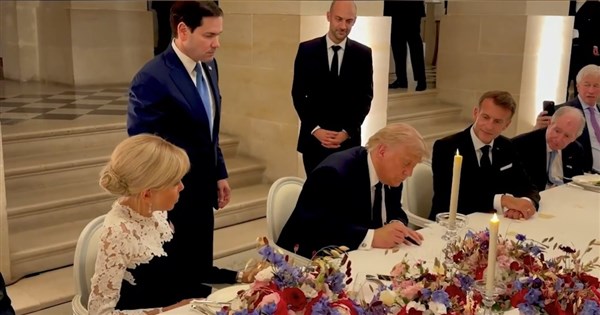
According to U.S. officials, Trump signed the memorandum personally during a dinner with French President Emmanuel Macron at the Palace of Versailles, following the G7 summit.
As Trump exited the Palace of Versailles, he told reporters: "Just signed it."
Iran's state news agency IRNA cited Foreign Ministry spokesperson Esmaeil Baqaei as saying the memorandum "has been finalized and signed by both presidents," and that the next step is implementation.
The document aims to end the war launched by the U.S. and Israel on February 28. That conflict prompted Iran to launch multiple rounds of missile and drone attacks, affecting the entire region and effectively closing the Strait of Hormuz—a waterway critical to the global economy.
Under the agreement, Washington pledged to immediately lift oil sanctions that have severely damaged Iran's economy.
The memorandum also states that once a final agreement on Iran's nuclear program is reached, the U.S. will help release a $300 billion reconstruction fund supported collectively by regional nations.
This document is only a temporary arrangement, intended to buy time to initiate more complex long-term negotiations. Washington has long suspected Iran of secretly developing nuclear weapons.
Earlier today, Trump threatened that if Tehran violates the agreement, he would "blow them up completely."
Iran, meanwhile, insists the memorandum represents a "failure" for the United States.
Naim Qassem, leader of Hezbollah—the Lebanon-based Shia group aligned with Tehran—called it a "major victory" for Iran.
He also thanked Tehran for ensuring Lebanon was included in the ceasefire. Hezbollah had joined the conflict on March 2 by launching rockets at Israel in solidarity with Iran.
Negotiations will now proceed over a two-month period, with the reopening of the Strait of Hormuz as the first priority.
According to the U.S.-released text, Iran will dilute its enriched uranium stockpile, likely under on-site supervision by the International Atomic Energy Agency (IAEA). This step is expected to unlock further large-scale economic assistance for Iran. (Compiled by: Shih Shih)
FACT BOX
- Source: CNA (Central News Agency)
- Category: Taiwan