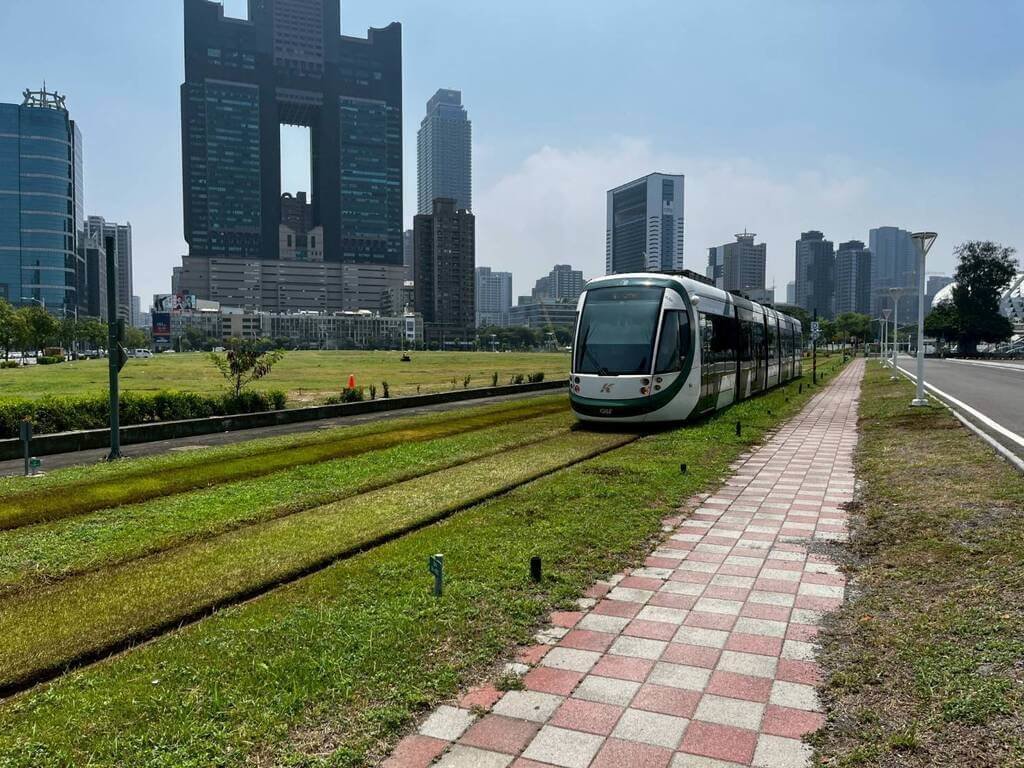
(Central News Agency, Kaohsiung, June 20) To reduce friction noise from light rail tracks, the Kaohsiung Rapid Transit Bureau has introduced IoT-enabled smart "water lubrication" technology. This technology has been implemented in sections within the Asia New Bay Area, Pier-2 Art Center area, Museum District, and Agricultural Expo Park area. The lubrication system automatically activates based on detected track edge noise frequencies.
The Kaohsiung City Mass Rapid Transit Bureau stated in a press release today that to uphold the concept of green transportation and provide citizens with a high-quality and comfortable riding environment, they are continuously improving various engineering details. To effectively reduce friction noise when trains pass through curves, the MRT Bureau has incorporated IoT-enabled smart "water lubrication" technology into the track design, balancing urban noise reduction needs with environmental sustainability.
The MRT Bureau pointed out that this noise-reducing trackside lubrication system has been installed in several key areas, including the Asia New Bay Area (stations C8 to C9), Pier-2 Art Center area (stations C13 to C14), Museum District (stations C20 to C21), and Agricultural Expo Park area (stations C22 to C23).
The MRT Bureau explained that when light rail trains pass through specific curves, physical contact and turning friction between the wheels and the tracks can generate high-frequency sounds. The "water lubrication" system is managed intelligently, primarily by automatically activating the trackside lubrication system based on detected track edge noise frequencies. This effectively reduces the friction resistance at the contact surface between the wheels and the tracks, thereby suppressing sharp noises.
The MRT Bureau stated that compared to traditional maintenance methods using oil-based lubricants and fixed-time controls, the IoT-enabled smart "water lubrication" technology offers environmental advantages. This technological system collects track noise frequencies from different sections and uses remote control and data collection to establish and adapt optimal lubrication and noise reduction parameters. This approach completely avoids secondary pollution caused by oil residue on surrounding soil and rainwater drainage systems. (Editor: Li Xi-zhang) 1150620
Stand with facts, your every donation is a force to protect press freedom
Download the CNA "One-Stop News" APP to get the latest news in real-time
This website's text, images, and videos may not be reproduced, publicly broadcast, publicly transmitted, or used without authorization.
FACT BOX
- Source: CNA (Central News Agency)
- Category: 技術應用