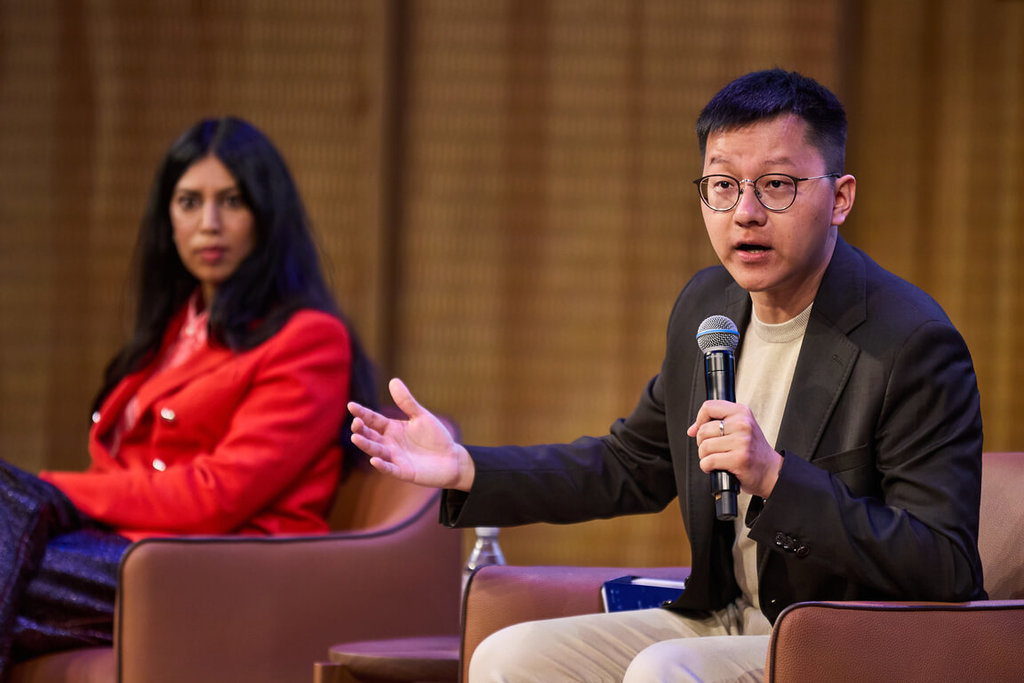
(CNA) NEW YORK, June 22 -- The Obama Presidential Center in Chicago, USA, recently opened, and Lin Yen-ting, selected for the Obama Asia-Pacific Leaders program, participated in an opening forum to share Taiwan's democratic experience. He introduced the "Digital Lee Teng-hui," created with AI based on the writings and speeches of former President Lee Teng-hui, emphasizing the need to ensure democratic systems are not manipulated by information.
The Obama Presidential Center, built by former U.S. President Barack Obama after his term, held its opening ceremony in Chicago on June 18, attended by several former U.S. presidents. A series of opening weekend events took place from June 19 to 21.
Lin Yen-ting, a doctoral candidate in law at UC Berkeley and selected for the Obama Asia-Pacific Leaders program in 2024, attended the opening forum "AI Era: Technology, Truth, and Trust" on June 20. He introduced the "Digital Lee Teng-hui," created with generative AI in Taiwan, to international attendees and shared Taiwan's democratic experience.
The forum was moderated by Jessica Yellin, Chief White House Correspondent for CNN and founder of News Not Noise. Panelists included Nabiha Syed, CEO of the Mozilla Foundation; Valérie Pisano, CEO of Mila, a deep learning research center; and Robert Seamans, a professor at New York University's Stern School of Business and a former scholar on the Council of Economic Advisers in the Obama administration.
Lin Yen-ting, who also serves as a board member of the Lee Teng-hui Foundation, introduced the audience to the PROTOTYPE: Mr. Democracy 2.0 Digital Lee Teng-hui special exhibition, jointly created by the foundation, the Institute for Information Industry, and the Academia Historica. "Digital Lee Teng-hui" was trained on the former President's writings, speeches, and interviews, adhering to the framework of democracy and Taiwan's subjectivity, thus ensuring it would not deviate or say things the former president himself would not say. The public can interact with the digital image and voice of former President Lee to learn firsthand about Taiwan's democratic history.
Lin Yen-ting shared at the forum that the generation born after Taiwan's first direct presidential election in 1996 did not personally experience the democratization process. He recalled being deeply moved during his first conversation with "Digital Lee Teng-hui" when he inquired about the issue of lowering Taiwan's voting age from 20 to 18. "Digital Lee Teng-hui" recounted how former President Lee encouraged youth to participate in public affairs in the 1990s. He described this as "vivid and powerful civic education."
Lin Yen-ting cautioned that while AI can bridge interpersonal distances and lower the threshold for public participation, it is simultaneously being misused through deepfakes, impersonating public figures, and manipulating public opinion and elections.
He cited a recent report by the Reuters Institute for the Study of Journalism at Oxford University, which indicated that social media has surpassed traditional media for the first time as the broadest source of news globally. The public's tendency to believe "seeing is believing" for video content should no longer be the default, and cross-generational dialogue highlighting how emerging technologies impact democracy is increasingly important.
He advocated for a dual approach of media literacy civic education and reasonable regulation. By leveraging AI to deepen democracy, it is crucial to ensure that democratic systems are not eroded by information manipulation. (Editor: Wei Shu) 2024-06-23 )
FACT BOX
- Source: CNA (Central News Agency)
- Category: 政治
- Organizations: CNN / Mila