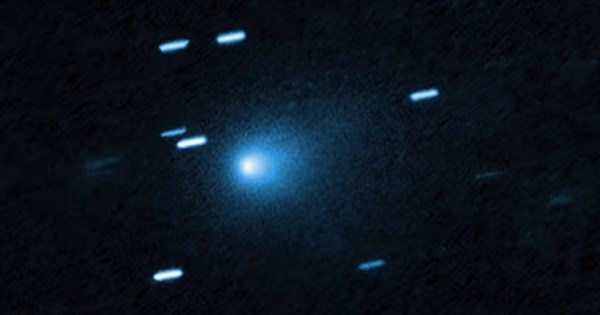
(CNA Paris, 22nd) Scientists studying the interstellar comet 3I/ATLAS announced today that the comet is estimated to have formed in a primordial planetary system 10 to 12 billion years ago, making it nearly three times the age of our solar system and composed of materials vastly different from those found within our solar system.
According to reports from Agence France-Presse and Reuters, 3I/ATLAS is the third interstellar object observed by humanity originating from outside our solar system. Researchers analyzed its chemical composition to understand the planetary system it formed in and the physical and chemical environment there. This research was published today in the authoritative journal Nature.
The lead author of the study, Martin Cordiner, a scientist at NASA's Goddard Space Flight Center, stated that 3I/ATLAS is approximately 2.6 kilometers in diameter and may be the oldest comet known to have traversed our solar system.
The study indicates that 3I/ATLAS likely originated 12 billion years ago in a cold environment at temperatures around -243 degrees Celsius, making it three times older than our solar system, which is approximately 4.5 billion years old. Researchers believe 3I/ATLAS formed within the Milky Way galaxy, but due to its ancient age, the possibility of it originating from another galaxy cannot be ruled out.
Cordiner said, "We have never seen an object like 3I/ATLAS... This might be the oldest object we have observed within our solar system."
Using the James Webb Space Telescope, researchers measured the isotopic ratios observed on 3I/ATLAS. They found that the water content in the comet has about 30 times more deuterium than other comets in our solar system. The ratio of carbon isotopes also differs from those found in objects within our solar system, as well as from the ratios observed in interstellar clouds and planet-forming disks around nearby young stars.
Despite this, 3I/ATLAS is still rich in organic molecules, including compounds of carbon, hydrogen, nitrogen, oxygen, and sulfur. Cordiner pointed out that this suggests that even though it originated from a cold and distant place, it was rich in the volatile elements necessary for life.
3I/ATLAS is currently approaching the orbit of Saturn and is expected to cross the orbit of the dwarf planet Pluto in 2029, and leave the outer boundaries of the solar system around 2035.
Although there were speculations last year that 3I/ATLAS might be an alien spacecraft, researchers remain convinced that it is a natural celestial body. (Compiled by Chang Ming-hsuan) 06232024
Stand with facts, your every donation is a force to protect press freedom
Download the CNA "One-Stop News" APP for real-time updates
The text, images, and videos on this website may not be reproduced, publicly broadcast, or publicly transmitted and used without authorization.
FACT BOX
- Source: CNA (Central News Agency)
- Category: 科学
- Organizations: NASA / Goddard Space Flight Center / James Webb Space Telescope