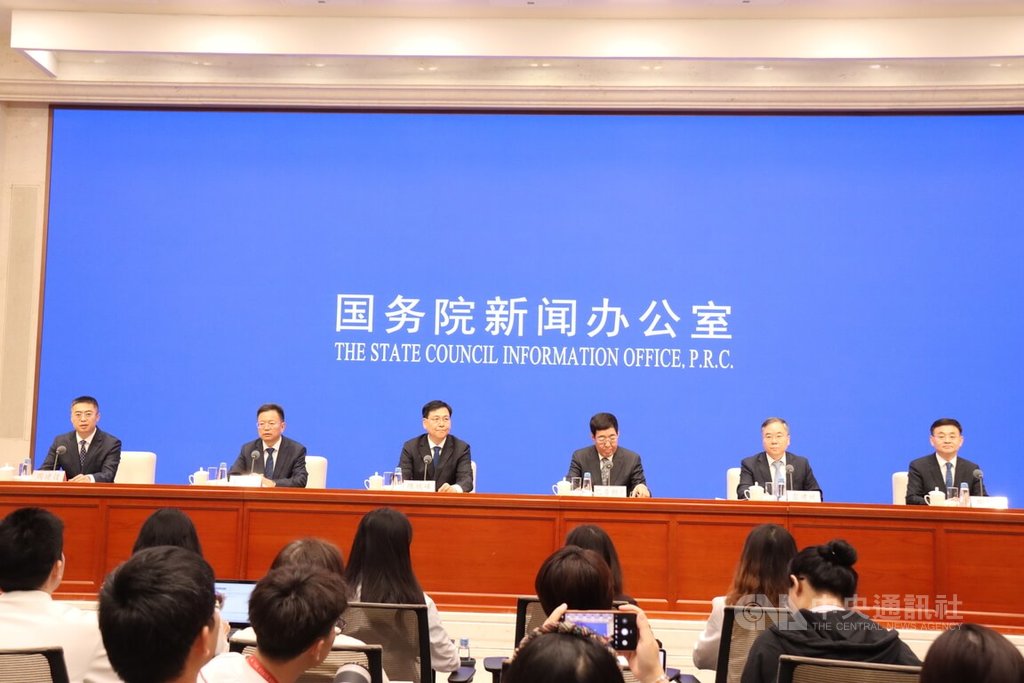
BEIJING, June 24 (CNA) -- China's "Law on the Promotion of Ethnic Unity and Progress," set to take effect on July 1, has drawn international attention regarding its potential for "long-arm jurisdiction." Hu Weilie, China's Vice Minister of Justice, stated today that the relevant regulations are intended to counter various illegal activities related to ethnic affairs originating from outside China and will not affect normal Sino-foreign cultural exchanges.
China's State Council Information Office held a press conference on the morning of June 24 concerning the "Law on the Promotion of Ethnic Unity and Progress." Attendees included Chen Ruifeng, Deputy Head of the United Front Work Department of the CPC Central Committee and Director of the National Ethnic Affairs Commission; Bayinchaolu, Chairman of the National People's Congress Ethnic Affairs Committee; and Hu Weilie, Vice Minister of Justice.
Article 63 of the law states, "Organizations and individuals outside the People's Republic of China who undermine ethnic unity and progress or engage in acts of ethnic separatism within the People's Republic of China shall be investigated for legal responsibility according to law." This has been interpreted as an "extraterritorial application clause."
National security sources have pointed out that the aforementioned regulation attempts to extend political red lines to the international community by holding overseas organizations and individuals accountable, thereby creating a chilling effect on Taiwanese academia, media, and pro-Taiwan individuals, and expanding cross-border suppression through legal tools.
Addressing the attention drawn by Article 63, Hu Weilie stated during the press conference in response to a question that some people "have distorted its interpretation, even slandered it."
He asserted that this is a "normal legislative practice" conducted by a sovereign state in accordance with the law. Article 63 is an exercise of the inherent legislative authority of a sovereign state, consistent with international laws in the fields of national security, anti-separatism, and social governance. It targets illegal acts that undermine ethnic unity and progress and engage in ethnic separatism. Its fundamental purpose is to safeguard ethnic harmony, social stability, and national security, "in line with the spirit of international law and the practices of governance in various countries."
He added that currently, various risk factors both within and outside the country are intertwined. Illegal activities that deliberately provoke ethnic unity and relations, undermine ethnic unity, and endanger national security will erode the foundation of ethnic unity and harm public interests and the legitimate rights and interests of the masses.
Hu Weilie stated that Article 63 "elevates long-standing effective governance experience into a legal system," providing a legal basis for combating illegal activities.
He also indicated that Article 63 is a legislative provision that aligns with the principles of jurisdiction stipulated in relevant Chinese laws. It aims to resist various illegal activities related to ethnic affairs originating from outside China through legal means. "It targets illegal acts, and the investigation of responsibility will be strictly and prudently regulated according to laws and regulations," effectively safeguarding national sovereignty, security, and development interests, as well as the legitimate rights and interests of people of all ethnic groups, and "will not affect normal Sino-foreign cultural exchanges, academic seminars, economic cooperation, and other activities." (Edited by Chu Jian-lin) 1150624
Stand with facts, your every donation is a force to protect press freedom
Download CNA's "First Hand News" APP for real-time updates
The text, images, and videos on this website may not be reproduced, publicly broadcast, publicly transmitted, or used without authorization.
FACT BOX
- Source: CNA (Central News Agency)
- Category: 法律