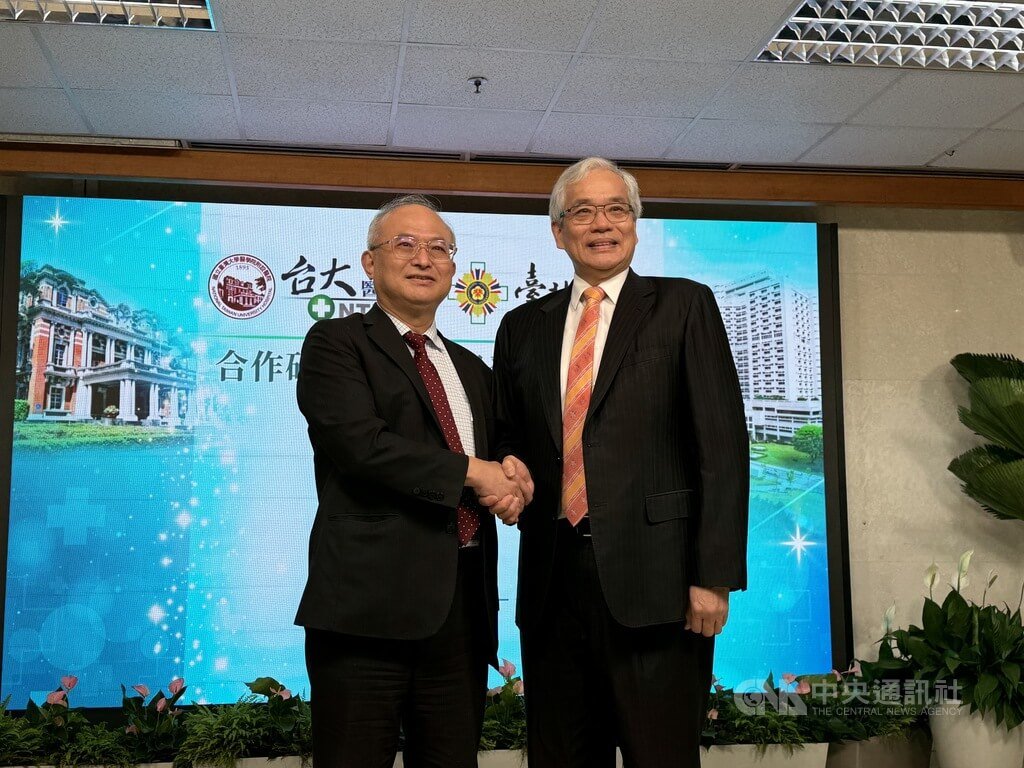
(Central News Agency, Reporter Shen Pei-yao, Taipei, June 24) NTU College of Medicine Dean Wu Ming-hsien is critically ill and undergoing rescue. Taipei Veterans General Hospital Superintendent Chen Wei-ming stated with a somber tone today that the two are like brothers, and Wu Ming-hsien is a highly respected figure in the medical community. Currently, the entire Veterans General Hospital is praying for him and sending him positive energy, hoping he will soon escape danger and return to his post.
Wu Ming-hsien, 61, served as the superintendent of National Taiwan University Hospital from August 2020 to July 2025, and has been the dean of the NTU College of Medicine since August 2025. Wu Ming-hsien was reported to be critically ill yesterday. NTU Hospital confirmed that Wu Ming-hsien was first sent from his home to the Taipei Medical University Hospital for treatment, and then transferred to NTU Hospital for rescue. The detailed condition cannot be disclosed to the public.
"Ming-hsien is a good friend to everyone, and a person of extreme respect. We are like brothers," said Taipei Veterans General Hospital Superintendent Chen Wei-ming in a phone interview with the media today, speaking with deep regret and solemnity about NTU College of Medicine Dean Wu Ming-hsien, who is on a sickbed.
He revealed that he has been looking through photos of himself and Wu Ming-hsien on his phone for the past two days, his heart filled with concern. He has asked all colleagues at Veterans General Hospital to "send him positive energy," hoping that this comrade-in-arms in the medical field can escape danger and recover soon. The medical team at NTU Hospital is currently making every effort to rescue him, and he also hopes to visit once his condition stabilizes.
It is noteworthy that just a few days before falling ill, Wu Ming-hsien had posted an article expressing concern about the record low enrollment rate for internal medicine physicians this year, fearing that the future medical system would be difficult to sustain. Chen Wei-ming also agreed that major hospitals should take action.
Chen Wei-ming stated that in recent years, the National Health Insurance (NHI) point value given to the medical community has been relatively good. If the manpower for critical care specialties like internal medicine and surgery is to be retained, major hospitals should actively implement "unequal pay for unequal work." Taking Taipei Veterans General Hospital as an example, he is currently working hard to widen the salary gap for popular and less critical departments. As long as the hospital has a surplus, the money should be given to those who perform critical care.
Chen Wei-ming lamented that the most popular "stock" department nationwide now is "stock" trading. Everyone is trading stocks, and people's hearts are restless. Seeing how good the stock market is, who is willing to stay? "In the past, we had passion. Performing a surgery saved a person, saved a family, and brought immense satisfaction." But young people today no longer listen to such talk. It's not that the young people are wrong, but the times have changed. Hospitals should adjust salaries as soon as they have a surplus, and not wait for the NHI to increase point values. Otherwise, with declining birth rates and an aging population, who will take care of everyone's health in the future. (Editor: Chen Ching-fang) 1150624
Stand with facts, your every donation is a force to protect press freedom
Download the CNA "One News" APP to get the latest news in real-time
This website's text, images, and videos may not be reproduced, publicly broadcast, publicly transmitted, or used without authorization.
FACT BOX
- Source: CNA (Central News Agency)
- Category: 医疗