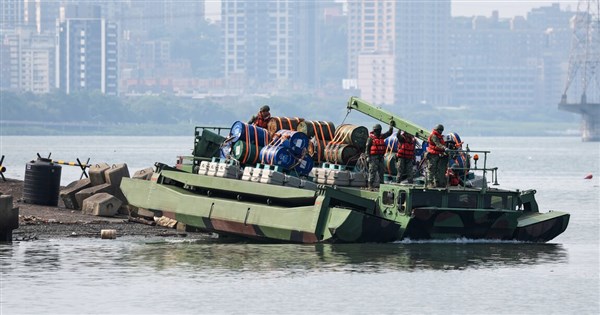
TAIPEI, Taiwan (CNA) -- On the third day of the military's immediate readiness exercise, the Third Theater Command, responsible for North Taiwan's defense, conducted an obstacle deployment drill at the Tamsui River estuary. The 53rd Engineer Group utilized M3 bridges to set up three layers of obstacles including fishing nets, explosive barrels, and platforms, and simulated the deployment of mines in the nearshore waters to prevent enemy hovercraft and other vessels from breaching defenses and directly attacking Taipei's political and economic center.
To enhance the military's immediate response capabilities during high readiness, the armed forces are conducting a 5-day, 4-night immediate readiness exercise from June 22 to 26. The primary objective is to familiarize troops at all levels with combat practices and battlefield environments during the readiness and deployment phase. Unlike the Han Kuang exercise, which simulates the entire process, the immediate readiness exercise focuses on the initial preparatory actions taken by the military when the PLA makes moves but before enemy forces have set sail.
Today, the third day of the exercise, the Third Theater Command, responsible for North Taiwan's defense, conducted an obstacle deployment drill at the Tamsui River estuary. Starting at 8 a.m., the 53rd Engineer Group sequentially deployed two M3 bridges into the Tamsui River, setting up obstacles such as fishing nets, explosive barrels, and platforms. The Navy also simulated mine deployment in the nearshore waters. Given that the Tamsui River channel is still used by tourist boats and fishermen during peacetime, the military plans to establish "multiple locations, each with three layers" of obstacles in the Tamsui River channel if actual signs of enemy invasion appear in the future.
The military has previously stated that the barrels are filled with a certain volume of fuel and are arranged at fixed intervals longitudinally and latitudinally to achieve an effective blast radius, creating a lethal effect against enemy hovercraft. The floating platforms are equipped with remote detonation mechanisms and also incorporate landmine trigger designs, which will detonate explosives upon contact with enemy equipment, ensuring mission accomplishment in various operational scenarios.
Furthermore, the deployment of river channel obstacles must consider both tidal fluctuations and changes in water depth. During the exercise, obstacle positions and mooring lengths were specifically adjusted according to the river channel's tidal range characteristics to ensure stability.
The Tamsui River estuary is a critical point where the enemy might attempt to directly attack Taipei's political and economic center. In the past, to prevent Chinese hovercraft and other vessels from breaching defenses, the military has conducted numerous interception drills in the Tamsui River channel during past exercises, even simulating the demolition of the Guandu Bridge to delay enemy forces by sinking the bridge structure. During today's exercise, tanks and other equipment from the Guandu Command's River Defense Battalion were seen camouflaged and maintaining vigilance towards the Tamsui River estuary.
It is worth noting that the coastal areas of greater Taoyuan and New Taipei are considered significant landing threat zones. Among these, Taipei Port (suitable for administrative offloading, meaning no beach landing is required, but rather capturing existing port facilities), Bali Beach (suitable for conventional landings), and the Tamsui River estuary have always been regarded as strategic strongholds for the defense of northern Taiwan, forming a "steel triangle."
From the exercise that began on the 22nd, it can be observed that the operational areas of multiple combat teams from the 6th Army Corps, including Qingpu in Taoyuan, Taoyuan International Airport, and the Taipei Port area in New Taipei, are primarily focused on familiarizing themselves with the operational environment along these routes, key terrain points, and fields of fire. They are also utilizing the advantages of the road network for rapid deployment. This action not only aims to prevent the enemy from seizing critical facilities and effectively threatening the transportation lifeline of the north but also increases the difficulty of enemy penetration through urban and port defense characteristics, thereby buying crucial time for subsequent troop assembly. (Editor: Lin Shu-yuan) 0624
Stand with facts, and your every contribution is a force to protect the freedom of the press.
Download the CNA "First-hand News" APP for real-time updates.
The text, images, and videos on this website may not be reproduced, publicly broadcast, publicly transmitted, or used without authorization.
FACT BOX
- Source: CNA (Central News Agency)
- Category: 軍事演習