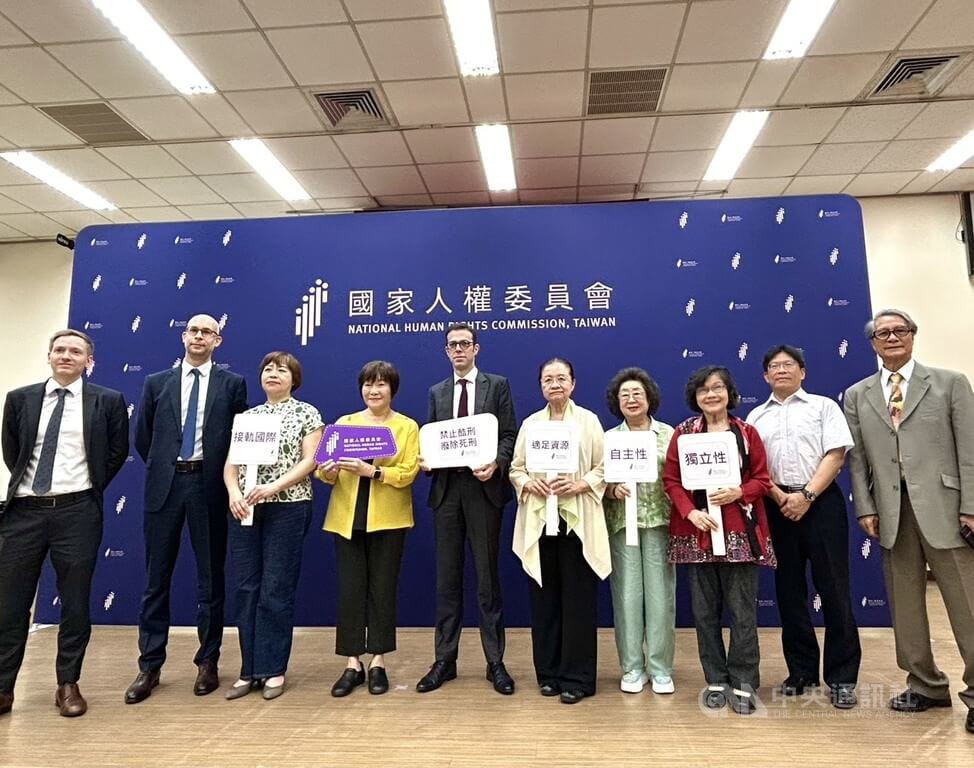
(CNA Taipei, June 24) Opposition parties have threatened to block the nominations of Control Yuan members, raising concerns about the survival of the National Human Rights Commission, as its commissioners are concurrently members of the Control Yuan. Chi Hui-jung, Vice Chairperson of the Human Rights Commission, stated today that if the commission's budget and existence are affected, it could lead the international community to believe Taiwan is unwilling to promote human rights. She expressed hope that the nominations would receive support and called for legislative amendments to ensure the complete independence of the Human Rights Commission.
The terms of the 6th Control Yuan members will expire on July 31. On June 11, the Presidential Office announced a list of 29 nominees for Control Yuan members, and the presidential message has been sent to the Legislative Yuan for confirmation. However, opposition parties advocate for the abolition of the Control Yuan. As Human Rights Commission members are concurrently Control Yuan members, this has drawn attention to the commission's future.
At a press conference today with the French Office in Taiwan on human rights cooperation, Chi Hui-jung said in her speech that Taiwan's human rights efforts still require continuous promotion and supervision, and that preventive and remedial functions need to be strengthened. However, with the terms of the human rights commissioners coming to an end, the Human Rights Commission is facing a difficult time, and everyone is very worried.
Chi Hui-jung stated that the weakening of the Human Rights Commission would be a serious issue for Taiwan, and that Taiwan's human rights efforts should continue to the next term, and the nominations of relevant commissioners should not be absent.
The Human Rights Commission's briefing indicated that if its functions are frozen, Taiwan would face five situations: a lack of independent oversight mechanisms, insufficient attention to disadvantaged groups, difficulty in transforming individual cases into systemic institutional reforms, a decline in the ability to align with international human rights standards, and a weakening of human rights prevention and relief functions.
Franck Paris, Director of the French Office in Taiwan, said in his speech that France's cooperation with Taiwan is based on defending human rights and democratic values, and that their human rights cooperation contributes to Taiwan's democracy and resilience. He noted that Taiwan's democracy, though young, is highly representative and exemplary, and the Human Rights Commission's contributions are very important. France hopes to continue its support and consolidation, and that there is always room for improvement in human rights work. He expressed hope for continued cooperation on shared struggles such as the abolition of the death penalty.
Regarding the future of the Human Rights Commission, Paris emphasized that he would not comment on Taiwan's internal affairs. However, as a member of European countries, he wanted to explain that democratic systems are not limited to elections but are also based on the protection of human rights and related provisions. Therefore, if institutions that protect human rights cannot function properly, it could witness the decline of a democratic society. He added that Europe is currently facing criticism regarding the promotion of human rights, and to prevent human rights from regressing, Europe and Taiwan should advance hand in hand and cooperate to protect human rights.
He also said that human rights should not be entangled in political confrontation, and that human rights make Taiwan's democratic society increasingly resilient and visible to the world. He hoped that Taiwan's political circles would recognize this.
Control Yuan member Kao Yung-cheng, who also serves as a commissioner of the Human Rights Commission, said that when the Organic Law of the Control Yuan was amended, it was explicitly stipulated that the seven Control Yuan members concurrently serving as Human Rights Commission members could not be vacant, indicating that the promotion of human rights is a consensus across party lines. Therefore, he believes that legislative amendments can be promoted in the future to phase out the connection between the Control Yuan and the Human Rights Commission. Before the Control Yuan is truly abolished through constitutional amendment, the eligibility criteria for Human Rights Commission members can be redefined. (Editor: Hsieh Chia-chen) 1150624
Stand with facts, your every donation is a force to protect press freedom.
Download the CNA "First News" APP to get the latest news in real-time.
Text, images, and videos on this website may not be reproduced, publicly broadcast, publicly transmitted, or used without authorization.
FACT BOX
- Source: CNA (Central News Agency)
- Category: 政治