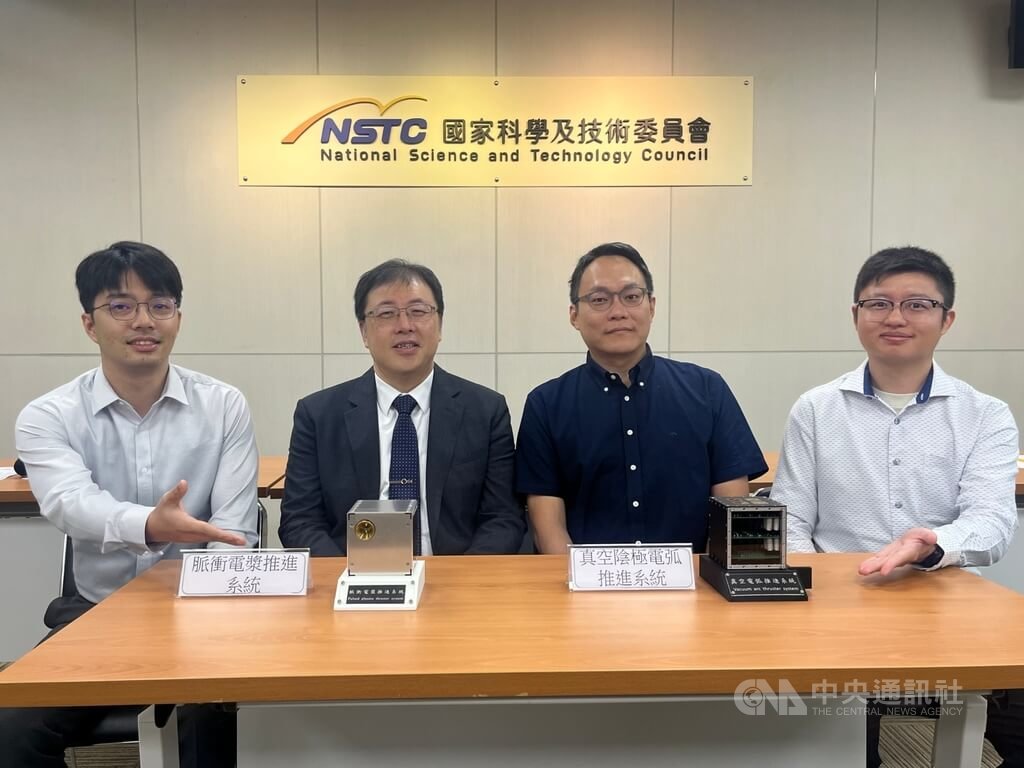
(CNA, Taipei, June 24) Plasma thrusters, with their advantages of high efficiency, low propellant consumption, and system lightweighting, have become core technologies for the precise orbit control and sustainable development of micro-satellites. A team from the National Cheng Kung University (NCKU) Department of Aeronautics and Astronautics, building upon Vacuum Cathode Arc Thruster (VCAT) and Pulsed Plasma Thruster (PPT) technologies, has successfully developed the Vacuum Arc-Ignited Pulsed Plasma Thruster (VAI-PPT). This technology has already obtained patents in three countries and will contribute to Taiwan's autonomous space technology capabilities.
The National Science and Technology Council (NSTC) held a research achievement press conference today. Professor Li Yueh-heng, a distinguished professor at NCKU's Department of Aeronautics and Astronautics, led the ZAP LAB research team. They optimized the ignition stability and system performance of VCAT and successfully integrated it into the "Taiwan Lily-3" (Lilium-3) CubeSat for in-orbit flight verification. Furthermore, the team improved upon the shortcomings of traditional PPTs, such as ignition failure or poor efficiency, by proposing the VAI-PPT technology.
Li Yueh-heng explained that the team began investing in plasma propulsion technology research in 2014 and has since established various types of plasma thrusters and systems for satellites. Plasma thrusters, he elaborated, utilize electrical energy to convert matter into charged particles (plasma), which are then ejected at high speed to generate thrust, propelling the satellite forward through reaction force.
Li Yueh-heng stated that the VCAT developed this time uses solid metal as fuel, eliminating the need for high-pressure fuel tanks like traditional rockets. This makes it lighter, smaller, and safer, making it highly suitable for space-constrained CubeSats. The VCAT weighs less than 1 kilogram, has a volume of approximately 10 cubic centimeters (1U), and consumes less than 5 watts of power, yet it can provide satellites with the capability for orbital maintenance and attitude control in space.
He pointed out that one of the biggest challenges for VCAT was its tendency to fail due to unstable discharge after prolonged use. The team proposed a multi-layer insulator design, replacing the traditional insulating layer and surface graphite layer with a sandwich structure of alternating insulating and graphite layers. This significantly enhanced the thruster's stability, increasing the number of discharge cycles from about 1,000 to over 400,000, thereby significantly extending its lifespan.
Li Yueh-heng further explained that the team has completed over 400,000 ground tests and passed space environment tests including vibration, thermal vacuum cycling, and electromagnetic interference. The technology maturity level has reached TRL 7, indicating it is close to actual space application. Preliminary in-orbit flight verification was completed last year, demonstrating that Taiwan possesses autonomous micro-satellite electric propulsion technology capabilities.
In addition to VCAT, the team continues to develop PPTs. Li Yueh-heng noted that these thrusters use an igniter to trigger a momentary discharge from high-voltage electrodes, vaporizing and ionizing the Teflon propellant surface into high-temperature plasma, which is then ejected at high speed to generate micro-thrust. This is suitable for precise directional control of satellites. However, traditional PPTs have long suffered from igniters failing due to carbon deposition, similar to spark plugs in motorcycles.
Li Yueh-heng stated that to address these issues, the team proposed the VAI-PPT technology, which replaces traditional igniters with a vacuum arc. This significantly improves long-term operational stability, and the related technology has obtained patents in Taiwan, Japan, and the United States.
He explained that the team successfully reduced the thruster's operating voltage from the original 2000 volts to 300 volts. This not only reduces electromagnetic interference and its impact on satellite electronics but also increases propulsion efficiency to more than three times that of traditional systems. Furthermore, the thrust level can be adjusted according to different mission requirements. For instance, in low-thrust mode, it can perform satellite attitude control and orbit maintenance, while in high-thrust mode, it can execute missions such as avoiding space debris or de-orbiting satellites for atmospheric reentry and burn-up, giving micro-satellites greater mission flexibility.
Li Yueh-heng mentioned that related technologies are already being collaborated on with industry partners, and they will continue to accumulate flight heritage to move towards commercialization. In addition to micro-satellite thrusters, the team is also developing space propulsion systems suitable for medium and large satellites. In the future, the team will apply plasma propulsion technology to areas such as satellite orbit maintenance, space debris reduction, multi-satellite formation flying, deep space exploration, and low-Earth orbit satellite communication, while continuing to improve thruster performance and conduct space flight verification. (Editor: Pan Yi-ching) 150624)
FACT BOX
- Source: CNA (Central News Agency)
- Category: 研究成果