German Chancellor Friedrich Merz has repeatedly stated recently that Germany will be the first country to commercialize fusion power. When asked by reporters about major powers like the US and China also investing in the fusion race, what confidence does Germany have in setting such a goal?
Special Report on Europe's Energy Transformation (3 articles total)
By 2025, the EU's proportion of green energy will surpass fossil fuels. However, as the explosion of AI computing power brings an "electricity consumption tsunami," Europe's green energy ideals are showing cracks, prompting many countries to re-strategize—Germany is experimenting with an "artificial sun," Italy is breaking a 40-year taboo to restart nuclear power and participate in the hydrogen corridor, while France views nuclear energy as a strong hand. Europe is unveiling an "energy transformation" crucial for industrial development and geopolitical economic security.
(CNA, Berlin, June 24) Following the energy crisis triggered by the Russia-Ukraine war, Germany is accelerating its search for new solutions that balance energy security, climate goals, and industrial competitiveness. In northern Germany, an experimental facility known as an "artificial sun" is being built. Not only is the country aiming to be the first globally to commercialize fusion power, but it also hopes to seize the initiative in the next wave of the energy revolution.
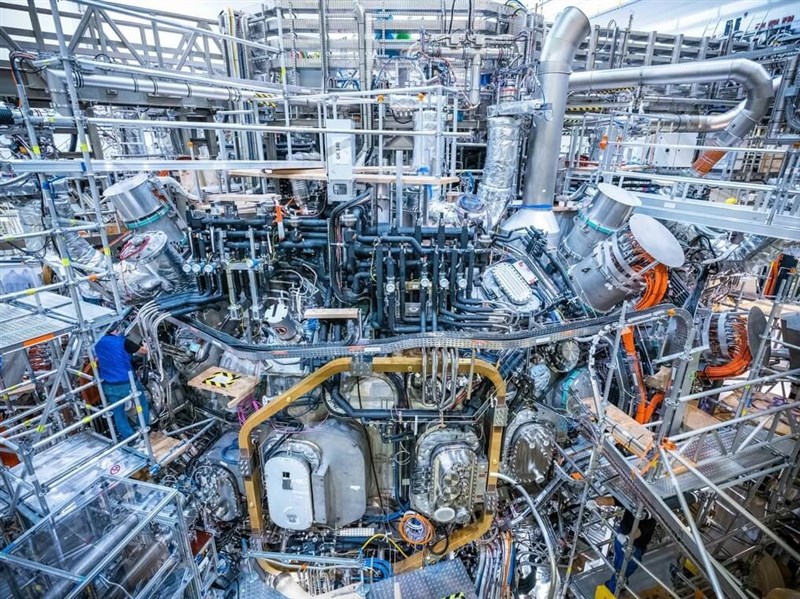
On the Baltic coast in northeastern Germany, between forests and the sea near Greifswald, stands a silvery-white building that looks like it's from a science fiction movie.
Inside the building, 50 superconducting magnetic coils of various shapes are intertwined, forming a twisted toroidal structure. When operating, the magnets are cooled to minus 270 degrees Celsius, while the plasma confined by the magnetic field in the center exceeds 100 million degrees Celsius, about 10 times the temperature of the sun's core.
This is the Wendelstein 7-X, the world's largest stellarator experimental device. This "artificial sun" experimental facility is tasked with verifying whether fusion reactions can operate stably for extended periods and is considered a milestone for Germany's path toward fusion commercialization.
The outbreak of the Russia-Ukraine war exposed Germany's energy security vulnerabilities. The interruption of natural gas supplies from Russia put immense pressure on Germany's industry, which had long relied on cheap energy. To reduce dependence and achieve the EU's net-zero emissions targets, the Federal Ministry for Economic Affairs and Climate Action, then led by the Greens, vigorously promoted the development of renewable energy.
According to the latest data from the German Federal Statistical Office, renewable energy accounted for 53.3% of Germany's domestic electricity generation in the first quarter of 2026. However, persistently high energy costs in recent years continue to impact Germany's industrial competitiveness, and concerns about deindustrialization have not subsided. On the other hand, the rapid development of artificial intelligence (AI), data centers, and the semiconductor industry is also leading to continuously rising future electricity demand.
Robert Compton, Deputy Director of Energy, Building, and Environmental Technology at Germany Trade & Invest (GTAI), an agency of the German Federal Ministry for Economic Affairs, stated in an interview with CNA, "The most important goal of Germany's current energy policy is to ensure energy security while maintaining internationally competitive energy prices."
However, this does not mean Germany is returning to the old path of traditional nuclear power. The Chernobyl nuclear disaster in 1986 profoundly impacted German society, laying the foundation for the subsequent anti-nuclear movement. After the Fukushima nuclear disaster in 2011, then-Chancellor Angela Merkel decided to accelerate the phase-out of nuclear power, and Germany finally shut down its last nuclear power plant in 2023.
Compton pointed out that fusion is often confused with traditional nuclear energy, but they are entirely different technologies. Traditional nuclear power plants use nuclear fission, generating energy by splitting the nuclei of heavy elements like uranium. Fusion, on the other hand, mimics the reactions inside the sun, fusing hydrogen isotopes at extremely high temperatures to release energy.
"Fusion is a long-term, future-oriented project," Compton said. "Currently, related technologies are still in the research and development phase. Therefore, Germany's development of fusion does not mean embracing traditional nuclear power again, but rather planning for the next generation of energy technology."
Against this backdrop, the German federal government last year released its "Fusion Action Plan," allocating over 2 billion euros (approximately 73.8 billion New Taiwan dollars) by 2029 to accelerate the transition of fusion from basic research to commercial application, with the goal of making Germany the first country in the world to achieve fusion power generation.
German Chancellor Friedrich Merz has repeatedly stated recently that Germany will be the first country to commercialize fusion power. When asked by reporters about major powers like the US and China also investing in the fusion race, what confidence does Germany have in setting such a goal?
Compton explained that this confidence is rooted in Germany's strong research foundation. From the Wendelstein 7-X experimental device in Greifswald and the Max Planck Institute for Plasma Physics (IPP) to key technologies like high-power lasers, superconducting magnets, and precision manufacturing, Germany has long held a leading global position. Many international fusion projects currently rely on equipment and components supplied by German companies.
The combination of profound basic scientific research results and German industrial manufacturing technology has also allowed fusion to gradually move out of laboratories and towards industrialization in recent years.
Currently, several German startups are competing in this field, including Proxima Fusion, spun off from the Wendelstein 7-X research team and focused on stellarator technology, as well as Focused Energy and Marvel Fusion, which are developing laser fusion.
The German government is also planning to establish three innovation centers focusing on magnetic confinement fusion, laser fusion, and fuel cycle and materials research, respectively. These centers will help more research outcomes transition to application, further building a complete fusion industry ecosystem from basic research and demonstration reactors to equipment manufacturing.
In Compton's view, fusion is not just an energy policy but also an industrial policy. Germany hopes that by establishing a complete fusion value chain, German companies will be able to provide related equipment and technologies when other countries build fusion reactors in the future.
This is also a key reason why fusion was recently included as one of the six key technologies in the federal government's "High-Tech Agenda." For Berlin, the pursuit of fusion is not just about future energy but also about gaining a competitive advantage in the next industrial era.
However, no one can give an exact answer as to how long Germany is from true fusion commercialization. Compton admitted that many technical challenges still need to be overcome, and even the most optimistic experts believe it will take at least another decade.
"If you don't start, you'll never reach the finish line," Compton said. "If one day humanity can obtain nearly limitless clean energy on Earth, just like the sun, this experimental facility on the Baltic coast, known as the 'artificial sun,' may be marked as the starting point of this energy revolution's dream." (Editor: Tang Pei-chun) 06/24/115
FACT BOX
- Source: CNA (Central News Agency)
- Category: 能源
- Organizations: Proxima Fusion / Focused Energy / Marvel Fusion