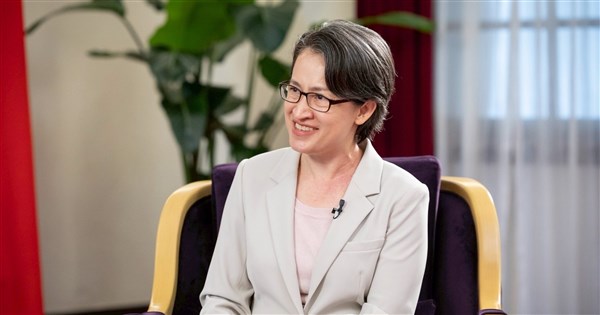
(CNA) Vice President Hsiao Bi-khim stated in an interview with Epoch Times' "American Thought Leaders" program that in the face of China's cognitive warfare, political interference, and authoritarian threats against Taiwan, Taiwan must strengthen its defense mechanisms and uphold core values such as the rule of law, freedom, and democracy. Regarding being listed by China as a "die-hard separatist," she emphasized that Taiwan will absolutely not allow the Chinese Communist Party to define "who we are," nor will sanctions stop her from defending the nation and democratic values.
The Presidential Office issued a press release today stating that the Vice President was recently interviewed by Jan Jekielek, host of Epoch Times' "American Thought Leaders" program. She responded to questions concerning cross-strait relations, Taiwan-US relations, national defense security, industrial and economic development, whole-society defense resilience, Taiwan's foreign policy, and prospects for Taiwan's future. The interview content was broadcast this morning.
The Vice President said that because her mother is from North Carolina, USA, and she grew up with a dual cultural background of Taiwan and the United States, she has always viewed becoming a bridge between Taiwan and the US as a lifelong responsibility and mission. Although she did not anticipate becoming a diplomat and taking on this role in international relations, it has been deeply meaningful to her life's journey.
When the host inquired about the National Security Bureau establishing a "liaison window for Chinese citizens," the Vice President responded that she does not discuss intelligence operations, but the broader context of this matter lies in recent "disappearances" in China, including Taiwanese businesspeople and Taiwanese religious leaders who were proselytizing there.
She said that such disappearances, suppression, and deprivation of fundamental rights are now not only predicaments faced by Chinese citizens but also risks encountered by foreign travelers visiting China. This also reminds everyone how important the rule of law, due process, and the basic rights that maintain the normal functioning of society are.
Regarding the Chinese Communist Party's adept use of the "unrestricted warfare" theory, especially cognitive warfare, the Vice President was asked if Taiwan is also actively enhancing its own cognitive warfare capabilities. She replied that Taiwan is mostly in a defensive posture, as China's cognitive warfare, psychological warfare, political warfare, legal warfare, and increasingly severe interference in Taiwan's internal society and politics have become a grave challenge.
The Vice President stated that Taiwan is well aware that other democratic countries around the world face similar challenges. Therefore, establishing its own defense mechanisms is crucial, especially in the AI era where the spread of many cognitive warfare tactics and disinformation will be amplified. Finding suitable tools and technologies to protect and defend oneself is particularly important.
The Vice President believes that for Taiwan, the most fundamental key lies in self-identity and core values. Therefore, adhering to and highlighting values such as the rule of law, fundamental rights, belief in freedom, and democratic systems are all crucial. While defending itself, Taiwan also strives to become a place that attracts like-minded individuals from the region to engage and cooperate.
When the host asked if Taiwan cooperates with other intelligence agencies or obtains intelligence, the Vice President said she would not comment on Taiwan's intelligence operations or related cooperation with other countries. However, in the public domain, many countries face political interference from authoritarian regimes and political operations supported by those regimes. Therefore, there are many opportunities for interaction among civil society, civic groups, non-governmental organizations (NGOs), and governments of various countries to jointly exchange challenges they face and explore ways to respond.
Regarding being listed by the Chinese Communist Party as a "die-hard separatist" and her views on facing direct threats from Beijing, the Vice President said that China listing her as a "die-hard separatist" and imposing sanctions on her for cooperating with Americans is another reason for China's anger.
The Vice President stated that Taiwan will absolutely not allow the Chinese Communist Party to define "who we are." These tactics are nothing more than intimidation and threats, attempting to obstruct the work Taiwan is striving to advance. Personally, like many others who have been sanctioned, she takes it calmly. Furthermore, this will not stop her from doing what must be done, including protecting the nation, defending Taiwan, safeguarding values, and closely cooperating with international partners to maintain common interests, which means firmly upholding regional peace and stability, and thereby jointly promoting prosperity.
She said that the number of people on the sanction list is growing, but she has no private businesses or commercial interests in China, so most sanctioned individuals can face these sanctions calmly. (Editor: Wan Shu-chang) 0624
Stand with truth, your every donation is a force to protect press freedom
Download CNA's "One-Stop News" APP for real-time updates
The text, images, and videos on this website may not be reproduced, publicly broadcast, publicly transmitted, or used without authorization.
FACT BOX
- Source: CNA (Central News Agency)
- Category: 政治
- Organizations: The Epoch Times / American Thought Leaders / Jan Jekielek