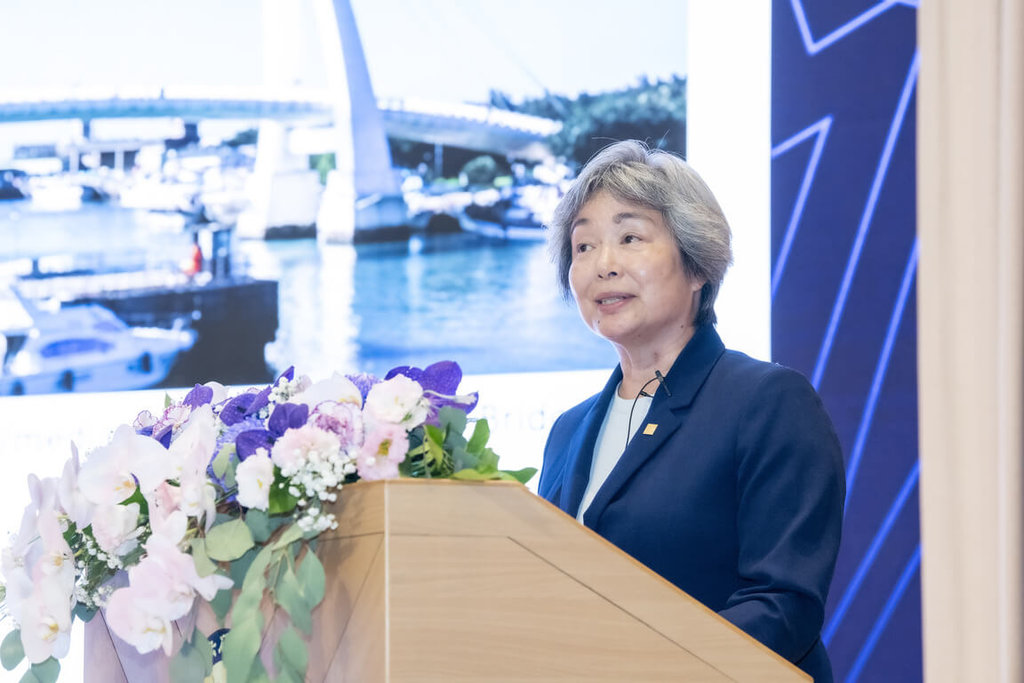
TAIPEI, Taiwan (CNA) -- Humanity has entered the "Age of Intelligence," and international scientific cooperation among like-minded partners will be a crucial key to maintaining technological competitiveness, said Tsu-Jae King Liu, an academician of Academia Sinica and president of the National Academy of Engineering of the United States, on Tuesday.
The 36th Academia Sinica院士會議 (Academia Sinica Academician Conference) kicked off Tuesday, inviting John L. Anderson, an honorary academician of Academia Sinica, former president of the National Academy of Engineering of the United States, and former president of the Illinois Institute of Technology, and Tsu-Jae King Liu, an academician of Academia Sinica and president of the National Academy of Engineering of the United States, to deliver keynote speeches.
Academia Sinica issued a press release stating that Liu, an internationally renowned semiconductor scholar, shared her insights on "The Importance of International Scientific Cooperation." She pointed out that with the rapid development of key technologies such as artificial intelligence, semiconductors, biotechnology, and sustainable energy, humanity has entered the "Age of Intelligence." In the context of increasingly complex global supply chains and intensifying technological competition, international scientific cooperation among like-minded partners will be a crucial key to maintaining technological competitiveness.
Liu proposed the concept of a "global microelectronics ecosystem," explaining that the semiconductor industry has formed a highly specialized international network, relying on cross-disciplinary cooperation in every aspect, from chip design and wafer manufacturing to materials, equipment, and packaging and testing.
She believes that in the face of complex cross-border challenges such as climate change, pandemics, and energy transition, only by establishing open and mutually trusting global partnerships and adhering to the principle of "open as much as possible, with appropriate restrictions when necessary" can we strike a balance between international cooperation and safeguarding research security, jointly stimulate innovation, and protect human well-being.
John L. Anderson, a prominent scholar in the international engineering community, spoke on "Engineering: The Bridge Between Science and Technology," pointing out that the essence of engineering lies in applying scientific knowledge to solve practical problems and create new products, systems, and technologies to respond to human needs and promote social progress.
He used Taipei 101 as an example, illustrating how high-rise buildings must integrate structural engineering, material technology, and safety systems to achieve a balance between height, seismic resistance, safety, and usage requirements. He believes that humanity can establish appropriate regulations and safety mechanisms to address the fear of the unknown, and that professionalism and responsibility will guide technology in a direction beneficial to society while mitigating potential risks.
Liao Chun-chih, former president of Academia Sinica, who participated in the discussion, mentioned that AI will undoubtedly change the research and application methods of science and engineering. Academia and research institutions should respond to this significant change as soon as possible, by both leveraging AI and strengthening human advantages relative to AI.
Chen Chien-jen, president of Academia Sinica, stated that scientific exploration is endless. Even in the mature field of semiconductors, rapid iteration is still needed in terms of performance, manufacturing processes, design, and even novelty. The courage of scientists to challenge existing limits and continuously innovate is the fuel that drives the sustainable progress of the world. (Editor: Li Hsi-chang) 1150706
Stand with the truth, your every donation is a force to protect press freedom
Download the CNA "One-Stop News" APP for real-time updates
The text, images, and videos on this website may not be reproduced, publicly broadcast, publicly transmitted, or used without authorization.
FACT BOX
- Source: CNA (Central News Agency)
- Category: 科技