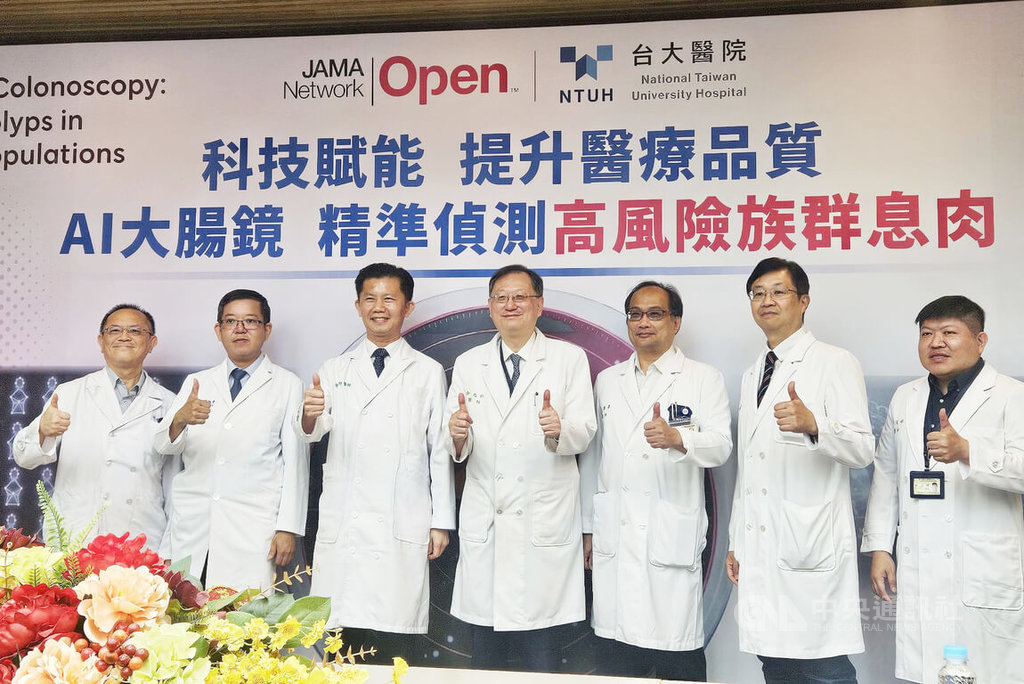
(CNA, Taipei, July 6) A study by National Taiwan University Hospital and other medical centers has confirmed that AI-assisted colonoscopy in high-risk individuals with a positive fecal occult blood test can detect approximately 8 additional adenoma patients per 100 people, even finding adenomas smaller than 1 centimeter. Doctors encourage those with abnormal results from public colon cancer screening to consider using this technology.
Colorectal cancer is the second most common cancer in Taiwan, with over 10,000 new diagnoses annually and more than 5,000 deaths. Colorectal cancer is highly curable if detected and treated early. The Health Promotion Administration of the Ministry of Health and Welfare subsidizes free quantitative immunochemical fecal occult blood tests every two years for individuals aged 45 to 74, and for those aged 40 to 44 with a family history.
The research findings were published on April 15th of this year in the international authoritative journal JAMA Network Open. The study was a collaboration between National Taiwan University Hospital, Fu Jen Catholic University Hospital, Changhua Christian Hospital, and Shin Kong Hospital. Between 2022 and 2024, 1,356 individuals aged 40 to 79 who underwent colonoscopy were enrolled. Participants were randomly assigned to compare the clinical performance of AI-real-time-assisted colonoscopy with standard high-definition colonoscopy.
The study showed that in the high-risk group with a positive fecal occult blood test, approximately 65% of those who underwent AI-assisted colonoscopy were found to have adenomas, compared to about 57% with standard colonoscopy. This means an additional 8 patients with precancerous lesions could be detected per 100 examinees. Overall, the adenoma detection rate in the AI-assisted group was about 59%, higher than the 53% in the standard group, with an average of 0.2 more adenomatous polyps detected per person per examination.
Dr. Chiu Han-mo, Director of the Health Management Center at National Taiwan University Hospital, stated that standard colonoscopy in clinical use often struggles to detect adenomas smaller than 1 centimeter, with human eyes potentially missing 10-20%. This study found that AI's primary improvement is in the detection of adenomas smaller than 1 centimeter. For individuals with a positive fecal occult blood test, even adenomas smaller than 1 centimeter have a higher probability of already having advanced lesions.
Dr. Hsu Wen-feng, Attending Physician of Gastroenterology at the Department of Internal Medicine, National Taiwan University Hospital, explained that for the high-risk group with a positive fecal occult blood test, even adenomas smaller than 1 centimeter carry twice the risk of advanced pathological changes, such as high-grade dysplasia, compared to the general population. Therefore, improving adenoma detection rates through AI assistance, enabling early detection and removal of lesions, has significant clinical implications for reducing the future risk of developing colorectal cancer.
Dr. Chiu Han-mo mentioned that AI-real-time-assisted colonoscopy is currently an out-of-pocket expense. This study confirmed that in the high-risk group with a positive fecal occult blood test, patients are generally more prone to adenomas and have a relatively higher risk of developing colorectal cancer. For this high-risk group, considering AI-real-time assistance during colonoscopy can improve adenoma detection rates and reduce the risk of missed diagnoses.
Dr. Chiu Han-mo also noted that individuals with a family history of colorectal cancer face similar situations and may have an increased risk of hereditary colorectal cancer. Furthermore, even small adenomas less than 1 centimeter can progress to cancer clinically, making AI-real-time assistance during colonoscopy valuable in these cases as well.
Additionally, the study indicated that the improvement was most significant among younger physicians, with the adenoma detection rate increasing from about 48% to 58%. This helps maintain a stable, high quality of care regardless of the physician's experience. With AI's reminder assistance, physicians did not increase the removal of normal or benign tissue; the rate of cutting non-tumor tissue was about 4% in both groups, almost the same, indicating that clinical judgment remains in the hands of the physician. (Editor: Kuan Chung-wei) 1150706)
Stand with facts, your every donation is a force to protect press freedom
Download the CNA "One-Stop News" APP to get the latest news in real-time
Text, images, and videos on this website may not be reproduced, publicly broadcast, publicly transmitted, or used without authorization.
FACT BOX
- Source: CNA (Central News Agency)
- Category: 研究
- Organizations: JAMA Network Open