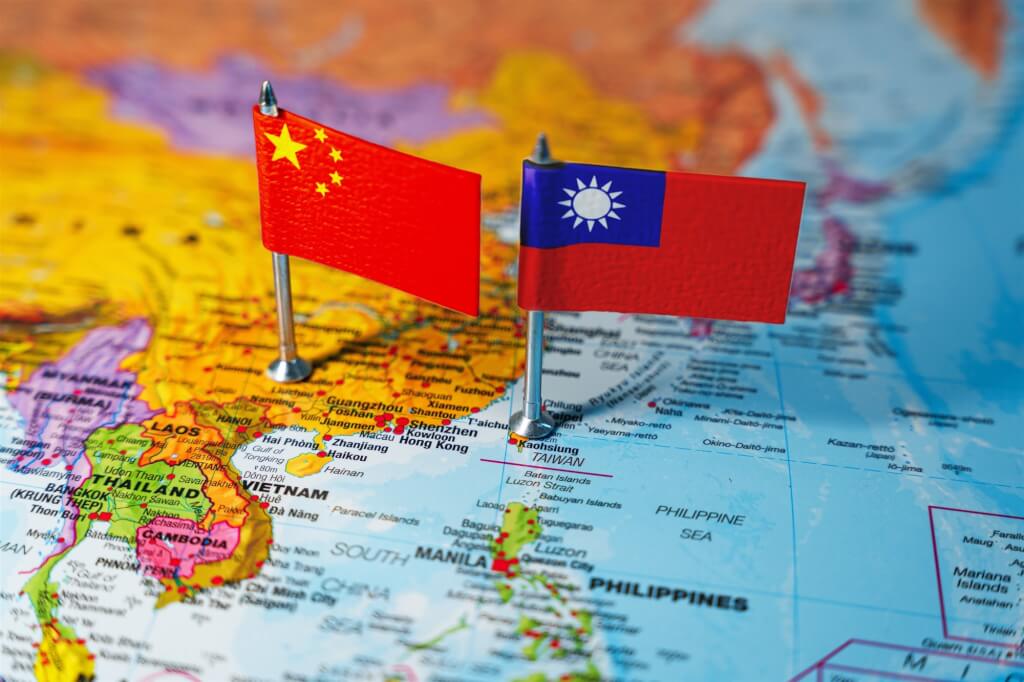
(Central News Agency Washington, July 6, Combined News) A report recently released by a US think tank points out that China actually faces a "Taiwan Strait dilemma," rather than the well-known "Malacca Strait dilemma." Its reliance on Taiwan Strait trade and transportation is even greater than that of the Strait of Malacca, and military action against Taiwan could destroy its economic lifeline.
The Washington-based think tank, the Center for Strategic and International Studies (CSIS), released an analytical report titled "Troubled Straits: Analyzing Trade Chokepoints in the South China Sea."
The article mentions that trillions of dollars worth of goods pass through the South China Sea annually, making it the world's most critical maritime route. The region is also a hotbed of geopolitical tension that could impact global trade.
Amidst the Iran war in 2026 and escalating geopolitical competition, maritime chokepoints have become a global focus. Since March of this year, Iran has almost cut off shipping through the Strait of Hormuz, throwing global energy markets into chaos.
The risks in the South China Sea are even greater because multiple chokepoints connected to the South China Sea involve key global economic hubs. Among these, the Strait of Malacca and the Taiwan Strait are the busiest, with shipping volumes far exceeding that of the Strait of Hormuz, each handling trillions of dollars worth of goods flow annually.
The report's authors state that in the event of a conflict, trade flow in the South China Sea could be severely impacted. Iran's attempt to control the Strait of Hormuz and collect tolls has once again raised concerns that some countries might replicate this in the Strait of Malacca.
The report points out that China's threats to use force against Taiwan also place the Taiwan Strait as one of the world's highest-risk geopolitical hotspots. If shipping in the Strait of Malacca or the Taiwan Strait is obstructed, although alternative routes exist, the cost would still be substantial.
Chinese officials have long warned that the country faces a "Malacca Strait dilemma" because much of China's trade, especially energy imports, must pass through the Strait of Malacca, exposing the country to the risk of trade blockade or interruption.
In 2003, then-Chinese President Hu Jintao warned that some "major powers" (i.e., the United States) were attempting to control the Strait of Malacca, posing a threat to China's energy security. This statement subsequently became the rationale for China to promote diversification of energy imports and, to some extent, shaped current Chinese President Xi Jinping's "Belt and Road" initiative.
However, the CSIS report argues that China faces not so much a "Malacca Strait dilemma" as a "Taiwan Strait dilemma." If China takes military action to disrupt shipping in the Taiwan Strait, the damage to its own economy could far exceed the impact of an obstruction in the Strait of Malacca.
According to data cited in the report, in 2024, approximately 33% of China's imports and 16% of its exports passed through the Taiwan Strait, while 21% and 14% passed through the Strait of Malacca, respectively.
On the other hand, although the United States is not directly highly dependent on South China Sea trade, its key allies and partners are highly reliant on the waterways connecting to the South China Sea, especially the Taiwan Strait.
In 2024, only about 3-4% of goods in overall US trade passed through the Strait of Malacca and the Taiwan Strait, respectively. However, for allies such as Japan, South Korea, and the Philippines, the risks are more severe, particularly in the Taiwan Strait.
In that year, a total of $755 billion worth of goods for Japan, South Korea, and the Philippines were transported through the Taiwan Strait, and approximately $474 billion passed through the Strait of Malacca. For Taiwan itself, the stakes involved in the Taiwan Strait are crucial for its survival.
The report concludes that the South China Sea has long been considered a key trade junction, and the Strait of Malacca is viewed by analysts as the center of global maritime trade. However, the report presents new data that offers a more nuanced perspective on the region.
The authors summarize that while the Strait of Malacca slightly surpasses the Taiwan Strait in overall trade value, several economies are actually more reliant on the Taiwan Strait. Most importantly, these economies include China, Taiwan, and regional allies of the United States, which would be the key actors bearing the brunt of a conflict in the Taiwan Strait. (Compiled by: Chen Cheng-chien) 1150706)
FACT BOX
- Source: CNA (Central News Agency)
- Category: 分析報告
- Organizations: CSIS