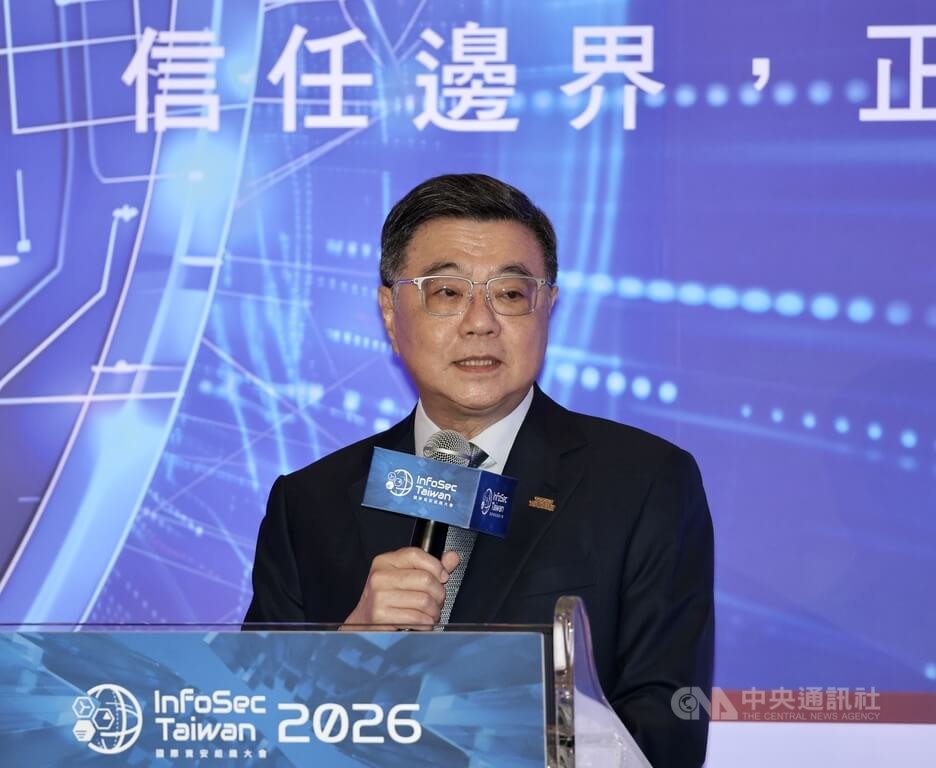
Taipei, July 7 (CNA) Premier Cho Jung-tai said today that with the rapid development of artificial intelligence (AI), the government will continue to cooperate with the industry to strengthen Taiwan's cybersecurity resilience from three major directions. He emphasized that not only do cybersecurity threats know no borders, but human threats do as well. He cited a recent case involving foreign nationals suspected of violent attacks, noting that Taiwan, situated on the front lines of geopolitics, faces more complex and diverse security challenges.
The InfoSec Taiwan 2026 International Cybersecurity Organization Conference opened today. In his speech, Cho Jung-tai stated that this is a community-driven international cybersecurity event, and Taiwan's private sector not only demonstrates abundant technical capabilities but also the ability for public-private collaboration and international connectivity. This is precisely the foundation upon which Taiwan relies on its technological strength to become the world's most reliable and trustworthy partner.
Cho Jung-tai pointed out that with the rapid popularization of technologies such as generative AI and autonomous intelligent systems, past cybersecurity defenses are no longer fully applicable, and instead, many new vulnerabilities have emerged. Therefore, the global technological architecture and social trust must be reshaped. He further elaborated that technology brings change, and cybersecurity is a defensive technology that is key to maintaining national security, promoting the digital economy, and safeguarding democratic society.
Cho Jung-tai stated that the government will continue to cooperate with the industry from three major directions. Firstly, it will improve laws and regulations. The "Cybersecurity Management Act" was amended and promulgated, coming into effect in December last year, strengthening the cybersecurity defenses of government agencies and critical infrastructure, promoting inter-agency cooperation and regional joint defense, and ensuring that regulations are aligned with international standards.
He said that the second direction is to strengthen supply chain security. Global supply chain security is a major focus of current international trade and economics. The Digital Development Administration is also fully promoting a cross-departmental and cross-industry cybersecurity joint defense system, and the government and industry will work hand in hand to build a more comprehensive autonomous defense engineering.
Cho Jung-tai pointed out that the third direction is to cultivate top cybersecurity talent. The government will combine the strengths of industry, government, academia, and research institutions, and engage in comprehensive and close alignment with international efforts to invest in cybersecurity talent cultivation, training more elites to protect society. At the same time, it will create an international-level cybersecurity talent cultivation environment and industrial cluster, forming a new and powerful industry, and enhancing the cybersecurity defense capabilities and resilience of the entire Taiwanese society.
Cho Jung-tai stated that cybersecurity threats know no borders, and cybersecurity is not just a national security issue but a crucial element of global security. Only through international cooperation, intelligence sharing, and collaboration across communities and industries can new borders with proactive defense capabilities, resilience, and trust be established.
He also mentioned that threats from abroad are not limited to cybersecurity but also include human threats. Following a recent case where foreign nationals were suspected of violent attacks and attempted to flee the country in disguise, law enforcement agencies quickly apprehended the suspects. Taiwan, situated on the front lines of geopolitics, faces more complex and diverse security challenges.
Cho Jung-tai emphasized that personal data and corporate trade secrets must be protected, and national security must be protected even more. For constantly evolving threats, the methods of cybersecurity defense need to be rethought and redefined. The government will continue to cooperate with all sectors to safeguard the security of individuals, society, and the nation. (Editor: Yang Lan-hsuan) 1150707
Stand with facts, your every sponsorship is a force to protect the freedom of the press
Download the CNA "One-Stop News" APP for real-time updates
The text, images, and videos on this website may not be reproduced, publicly broadcast, publicly transmitted, or used without authorization.
FACT BOX
- Source: CNA (Central News Agency)
- Category: 政策與科技
- Organizations: InfoSec Taiwan 2026