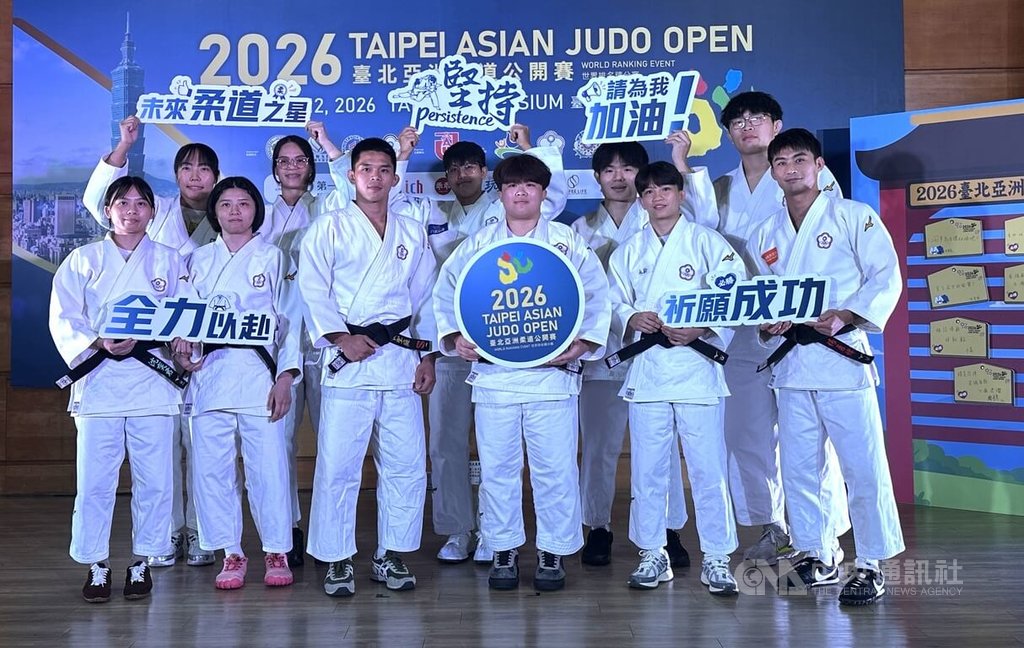
Taipei, Taiwan (CNA) - Taiwan's "Judo Prince" Yang Yung-wei attended a press conference today before the Taipei Asian Judo Open, encouraging his younger counterparts to establish a strong presence in international competitions based on his own experiences. Yang Yung-wei also revealed that he plans to move his training to Japan on September 9th, hoping to increase the intensity of his preparation for the Asian Games.
Yang Yung-wei was eliminated in the repechage round at the Ulaanbaatar Grand Slam in Mongolia in mid-June, failing to secure a medal. He also sustained a wrist injury, marking the end of his final international competition before the Nagoya Asian Games.
Speaking to the media today, Yang Yung-wei stated that his wrist injury is not serious and has mostly healed. He is currently continuing his adjustment at the National Sports Training Center and is scheduled to depart for training in Tokyo, Japan, on September 9th. He will remain there until September 24th before heading to Nagoya.
He mentioned that after the Nagoya Asian Games, he will immediately participate in the Judo World Championships on October 4th. The consecutive major competitions pose a challenge to his preparation status.
"In the past, the judo events at the Asian Games were scheduled earlier. This year, they are moved to the middle to later stages. This means that less than two weeks after competing in the Asian Games, I will have to participate in the World Championships. Therefore, the intensity of my training in Japan must be increased to prepare for competing in two major events back-to-back," said Yang Yung-wei.
Yang Yung-wei also joked, "In the past, judo at the Asian Games started earlier, and the pressure to win a medal was a bit greater. This year, it's scheduled later, so I might have the chance to watch other events and feel the excitement of other athletes winning medals to motivate myself."
Regarding the change in judo scoring methods after the Paris Olympics, with the addition of "Waza-ari" (effective) scores, Yang Yung-wei analyzed that it has both pros and cons. The advantage is that one can find a rhythm from the start, making it easier to score during the match and avoiding golden score situations.
He emphasized that the pinning time for ground techniques has also been reduced to 5 seconds. "This is an advantage for me, as I am more proficient in ground techniques, and the opportunity to score is greater." (Edited by Chang Ming-kun) 0707
Stand with facts, your every sponsorship is a force to protect the freedom of the press
Download the CNA "One-Stop News" APP for real-time updates
The text, images, and videos on this website may not be reproduced, publicly broadcast, publicly transmitted, or used without authorization.
FACT BOX
- Source: CNA (Central News Agency)
- Category: 體育