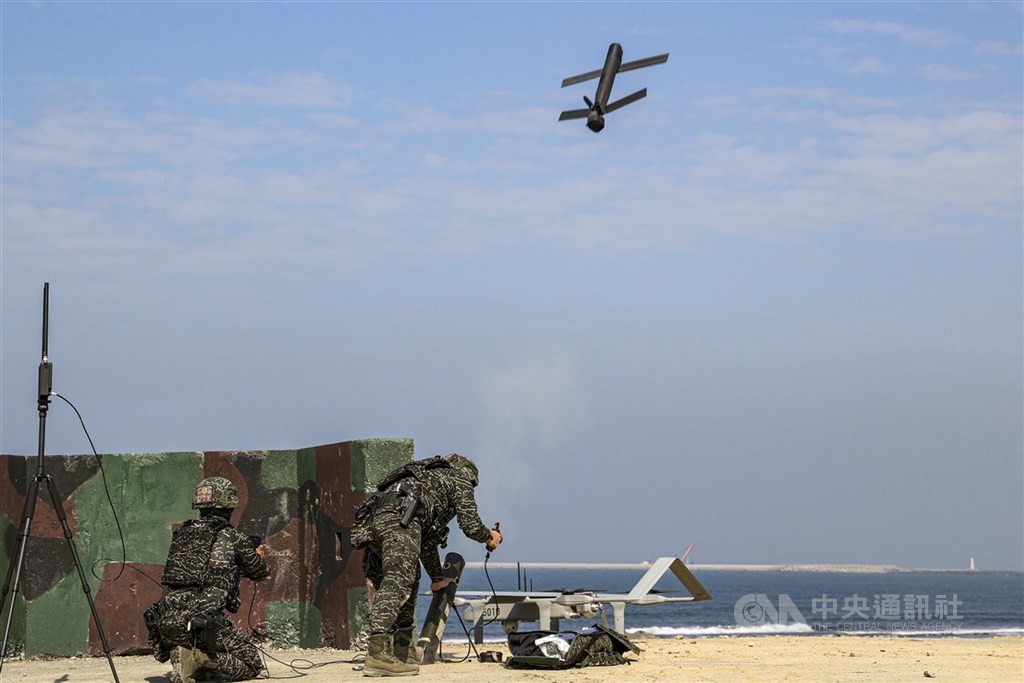
(Central News Agency, Taipei, July 7) On July 3rd, the Legislative Yuan sent the Executive Yuan's version, the Kuomintang's version, and the Taiwan People's Party's version of the drone regulations draft to committee for review. A defense expert pointed out that while the blue and white versions nominally balance national defense and industry, they do not specify the scale of equipment procurement for the three important unmanned equipment items the military needs to supplement, nor do they provide guarantees for stable orders for the industry.
On July 3rd, the Legislative Yuan sent the "National Defense Autonomous Unmanned Vehicle Technology Development and Procurement Act" draft proposed by the Kuomintang caucus, the "Strengthening National Defense Autonomy and Drone Industry Development Act" draft proposed by the Taiwan People's Party caucus, and the "Special Act for National Defense Autonomous Unmanned Vehicle Procurement" draft proposed by the Executive Yuan to the committees on economics, foreign affairs and national defense, and finance for review.
An expert familiar with defense affairs stated that the Executive Yuan's version focuses on three types of equipment originally included in the commissioned items of the NT$1.25 trillion special defense act. These items were deleted at the time, and Minister of National Defense Wellington Koo described it as hollowing out combat power. The US also expressed that the delay in acquiring these important equipment items would only benefit the CCP and believes that supplementing them is urgent. The Ministry of National Defense aims to fill this "combat power gap" with the current drone regulations.
The expert said that the two opposition versions do not include the specific items and funding in the articles for the three important unmanned equipment items that the military needs to supplement. The Kuomintang's version vaguely mentions it, while the Taiwan People's Party's version excludes unmanned boats.
The expert mentioned that the opposition parties, citing annual budgeting and annual oversight, insist on handling this through the annual budget. Setting aside the fact that the central government's general budget for 2026 has been stalled for over 300 days and has not yet been reviewed, if it were handled annually, the urgent defense budget's future would be uncertain. In fact, even cross-year special budgets require annual review by the legislature. The opposition parties' reasoning clearly lacks factual basis.
The expert analyzed that regarding the responsible authority for the three versions of the drone regulations, the Executive Yuan's version follows precedent and assigns it to the Ministry of National Defense, with the bill sent to the Foreign Affairs and National Defense Committee. Both the Kuomintang's and Taiwan People's Party's versions change the responsible authority to the Ministry of Economic Affairs, sending the bill to the Economic Committee. Once national defense matters are involved, it may require joint review, doubling the number of people who can access classified information.
The expert said that while the two opposition versions nominally balance national defense and industry, they do not specify the scale of equipment procurement nor provide guarantees for stable orders for the industry. The hard indicators for localization, case-by-case review, and annual budgeting, each restriction written into the articles, could become points of contention for future obstruction. If this pace is maintained, the most urgent combat power will be supplemented the slowest, and the industry may not even receive orders it can rely on, ultimately resulting in failure on both fronts. (Editor: Hsieh Chia-chen) 1150707
Stand with facts, your every donation is a force to protect press freedom
Download the CNA "One-Stop News" APP for real-time updates
The text, images, and videos on this website may not be reproduced, publicly broadcast, publicly transmitted, or used without authorization.
FACT BOX
- Source: CNA (Central News Agency)
- Category: 政策