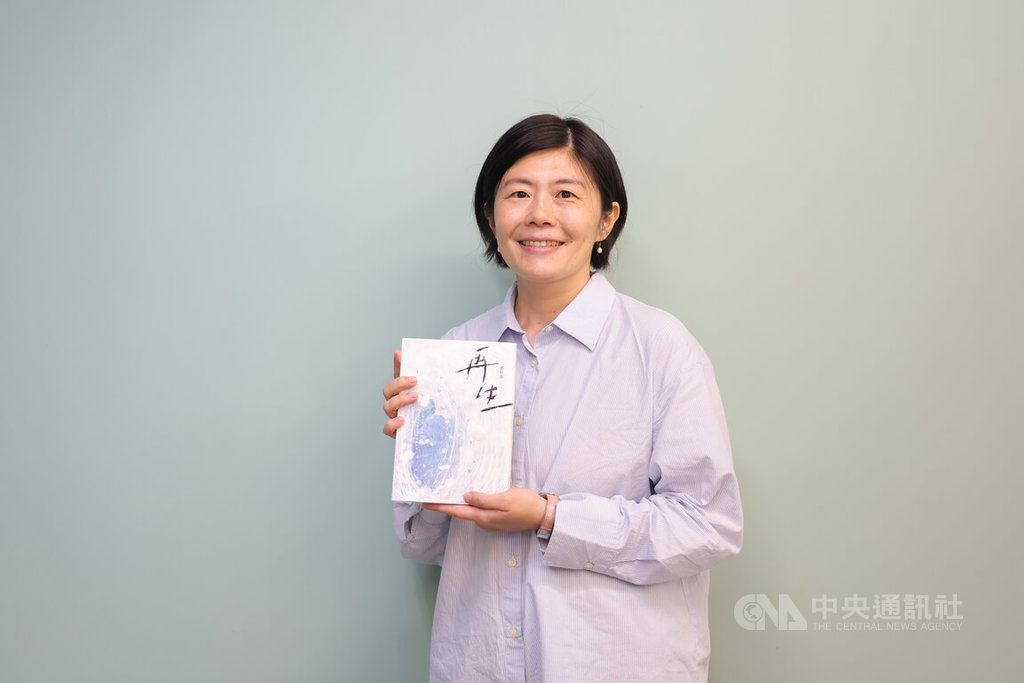
(CNA, reporter Chiu Tzu-yun, Taipei, July 7) Writer Liu Tzu-chieh first gained recognition 20 years ago with "Seven Days After Father." Twenty years later, she confronts death again with her short story collection "Rebirth." In an exclusive interview with CNA, Liu Tzu-chieh said, "What are these deaths trying to tell me? I want to find the answer."
"Seven Days After Father," from a single essay to a collection and then adapted into a film, explored the separation and death that Taiwanese people have always avoided, with Liu Tzu-chieh's delicate yet slightly humorous style. It brought public attention to death and folk customs, making her a bestselling author. However, Liu Tzu-chieh feared being typecast, so she resolutely turned away, immersing herself in the lives of urban women and love stories, distancing herself from death and the persona that made her famous.
Liu Tzu-chieh said, "The halo at that time was too immense. I was very afraid of being typecast, afraid that Liu Tzu-chieh would become a rural writer, a family writer, a funeral writer."
Until she reached her 40s, when friends of her generation began to pass away one after another, she felt perplexed. "Why do I have to start saying goodbye to my peers at this age?" She tried to look back, using fiction again to answer a question she had been avoiding for over a decade: "What is death trying to tell me?"
Several years after "Seven Days After Father," her maternal grandfather passed away. Her grandfather had served the God Xuan Tian Shang Di his entire life and had specified he wanted to be buried. Unexpectedly, a few days before the funeral, her uncle, who served as a spirit medium, suddenly became possessed and, in the guise of the deity, instructed that he would personally escort her grandfather on the day of the farewell ceremony. The family was half-believing, half-doubting. At the end of the family and public memorial services that day, after the coffin was carried out, another uncle who was a spirit medium became possessed, ran upstairs to fetch a statue of Xuan Tian Shang Di, and danced all the way to the cemetery. He only retreated after the burial and covering with soil.
The process was as dramatic as "Seven Days After Father." "I could have written this experience as a rural legend, but I had already written 'Seven Days After Father.' I didn't want to write another 'Seven Days After Grandpa,'" Liu Tzu-chieh said.
This matter was put aside for a long time. It wasn't until recent years that Liu Tzu-chieh began to frequently visit her grandfather's temple to conduct interviews, even pretending to seek spiritual guidance to observe how the spirit medium translated divine messages. Combined with her long-term observations of society, these experiences gradually formed many chapters in the novel "Rebirth."
Some of these stories involve facing the deaths of those around them, while others have the protagonists personally experiencing death. Whether they are involuntary or clear-minded, Liu Tzu-chieh does not intend to provide simple answers to how these stories conclude.
"We are currently living in a world of five turbidities and evil. What we should consider is how to make every step we take full of awareness and autonomy."
In this era where friends bid farewell one after another and cities disappear at an astonishing speed, Liu Tzu-chieh no longer evades but honestly gazes at death and herself. "Rebirth" offers no standard answers, but it contains the skills she has honed over the years. She attempts to take each step steadily and autonomously. The novel contains life insights she couldn't write in her 20s and 30s, expressing impermanence and accidents, while also filled with liberation and blessings. (Editor: Chang Ming-kun) 1150707
Stand with the facts. Your every donation is a force to protect press freedom.
Download the CNA "One-Stop News" APP to get the latest news in real-time.
Text, images, and videos on this website may not be reproduced, publicly broadcast, publicly transmitted, or used without authorization.
FACT BOX
- Source: CNA (Central News Agency)
- Category: 文化