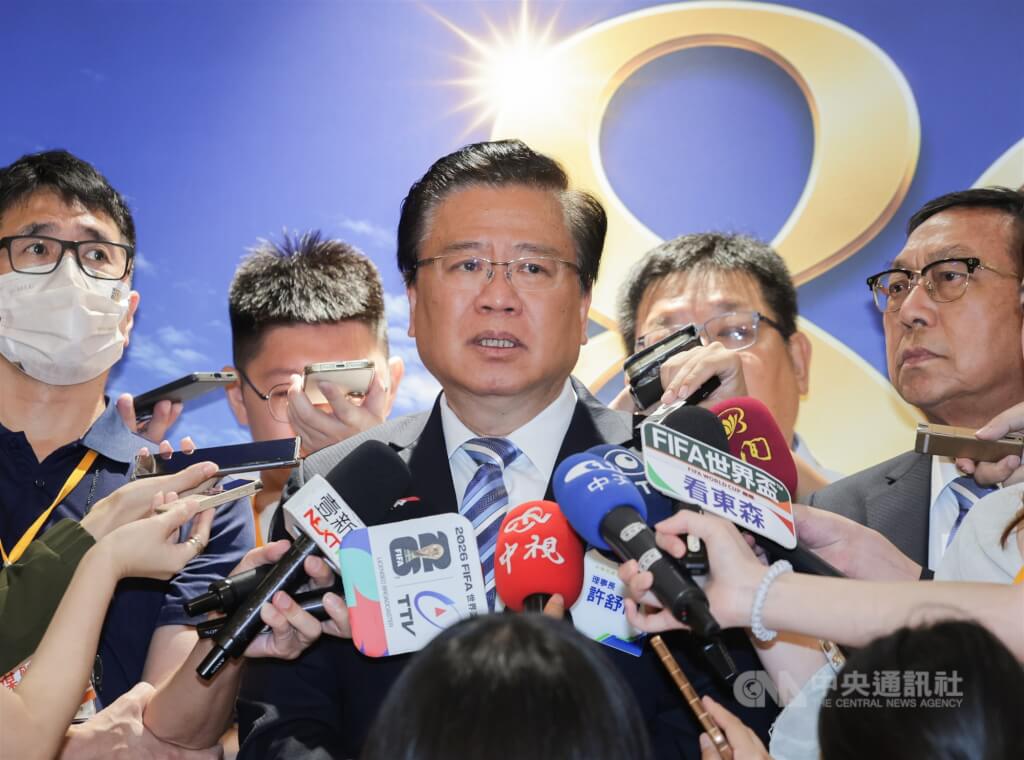
(CNA, Taipei, July 8) China's "Law on the Promotion of National Unity and Progress" took effect on July 1. The public is concerned about its impact on Taiwanese businesses operating in China and cross-strait economic and trade exchanges. Hsu Shu-po, Chairman of the General Chamber of Commerce of Taiwan, stated today that business should be viewed with a separation of politics and economics. As long as it does not lead to unfair trade practices or restrictions, political factors will not be a primary consideration.
The General Chamber of Commerce held its 12th session, 3rd general meeting today and signed a memorandum of cooperation with the Taiwan Chamber of Commerce and Industry in Japan. Hsu Shu-po said that the signing of the memorandum with the Taiwan Chamber of Commerce and Industry in Japan is just the beginning. Memoranda of cooperation will subsequently be signed with the Taiwan Chamber of Commerce and Industry in Asia, North America, Oceania, Europe, and the World, with major arrangements expected to be completed by the end of September.
Hsu Shu-po expressed his hope to establish a global network of Taiwanese businesses, enabling Taiwanese businesses worldwide to assist Taiwanese enterprises in market expansion, forming a cooperative model of "Taiwanese helping Taiwanese." This is also the General Chamber of Commerce's most important task this year.
Hsu Shu-po revealed that the General Chamber of Commerce will seek support from the Executive Yuan by the end of the year to organize the "Taiwan Service Industry International Expo." This event will invite global buyers to Taiwan and integrate local Taiwanese business organizations and related industries to participate, aiming to market Taiwan's high-quality products worldwide.
Regarding whether China's recent implementation of the "Law on the Promotion of National Unity and Progress" will affect Taiwanese businesses, Hsu Shu-po reiterated that business should be viewed separately from politics and economics. As long as it does not result in unfair trade practices or adverse effects on economic and trade activities, relevant political factors will not be a primary consideration. The General Chamber of Commerce is willing to assist enterprises in finding cooperation partners in Taiwan as long as there are business opportunities.
Furthermore, regarding the recent proposal by the Taiwan Stock Exchange to extend stock trading hours, Hsu Shu-po pointed out that if the government extends trading hours, securities transaction tax revenue may increase, which is beneficial for the government. However, it may also bring different impacts to society and the investment environment. He believes that relevant systems should be fully communicated with the industry, and it is not advisable to announce implementation hastily before a consensus is reached. (Editor: Lin Ke-lun) 1150708
Stand with facts, your every donation is a force to protect press freedom
Download the CNA "First News" APP to get the latest news in real-time
Text, images, and videos on this website may not be reproduced, broadcast, transmitted, or used without authorization.
FACT BOX
- Source: CNA (Central News Agency)
- Category: 商业