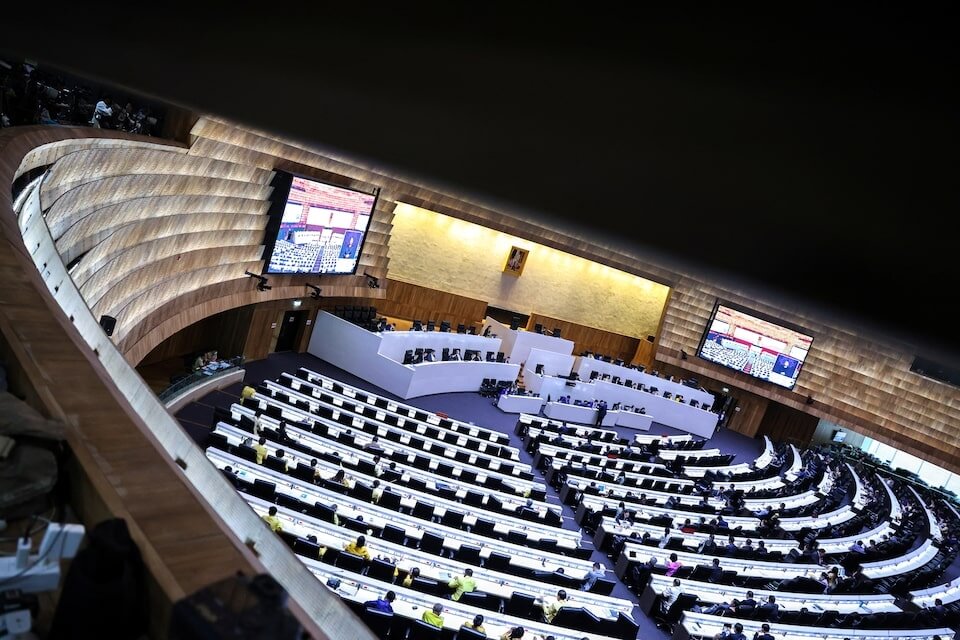
BANGKOK, July 8 (CNA) - The Thai House of Representatives today began its final deliberation on the "Peaceful Society Promotion Bill," commonly known as the political amnesty bill, which aims to pardon individuals convicted, prosecuted, tried, or accused in political cases over the past 20 years, but excludes offenses such as lese-majeste. Scholars point out that excluding lese-majeste from the amnesty will not resolve political divisions.
The main beneficiaries of this highly anticipated bill include various factions involved in political demonstrations since the 2000s, such as the "United Front for Democracy Against Dictatorship" (UDD), associated with the Red Shirts, the "People's Alliance for Democracy" (PAD), the Yellow Shirts, and the "People's Democratic Reform Committee" (PDRC), which initiated anti-government protests from 2013 to 2014.
Thai Public Broadcasting Service (Thai PBS) cited the bill's content today, stating that the amnesty covers cases involving political crimes over the past 20 years, but excludes Article 112 of the Criminal Code (lese-majeste), corruption cases, and criminal cases resulting in death or serious injury to others.
If the bill officially takes effect, legal responsibilities for those involved in political cases over the past 20 years will be revoked, criminal records of those convicted will be expunged, and ongoing court cases will be terminated. Additionally, those in detention will be released, and related charges will be dropped.
According to Thai media statistics, over 3,000 people are eligible for amnesty. The House of Representatives passed the bill in its third reading last October and subsequently sent it to the Senate for deliberation. The Senate recently completed its review, proposed some amendments, and sent the bill back to the House for a final vote.
The Bangkok Post reported today that the Senate maintained its original principle of excluding lese-majeste offenses from the amnesty and added a provision stipulating that individuals under 18 years old involved in lese-majeste cases are also not eligible for amnesty. This amendment was made because some political activists accused of violating Article 112 of the Criminal Code are still minors.
Korrawee Prissananantakul, chief whip of the ruling coalition, stated that the ruling coalition has decided to accept the Senate's amendments because they do not alter the core principles or legislative intent of the bill previously approved by the House. He also noted that parties within the ruling coalition will hold further internal discussions before the vote in the House, but the government's stance remains unchanged.
Thai PBS reported that Yutthaporn Issarachai, a political scholar at Sukhothai Thammathirat Open University, said that this bill is the broadest amnesty in Thai political history, covering political demonstration cases from 2005 to 2025.
However, he pointed out that excluding lese-majeste offenses from the amnesty will not truly resolve Thailand's long-standing political divisions. (Editor: Tian Ruihua) 1150708
Stand with facts, your every sponsorship is a force to protect press freedom
Download the CNA "One-Stop News" APP for real-time updates
The text, images, and audio on this website may not be reproduced, publicly broadcast, publicly transmitted, or used without authorization.
FACT BOX
- Source: CNA (Central News Agency)
- Category: 政治