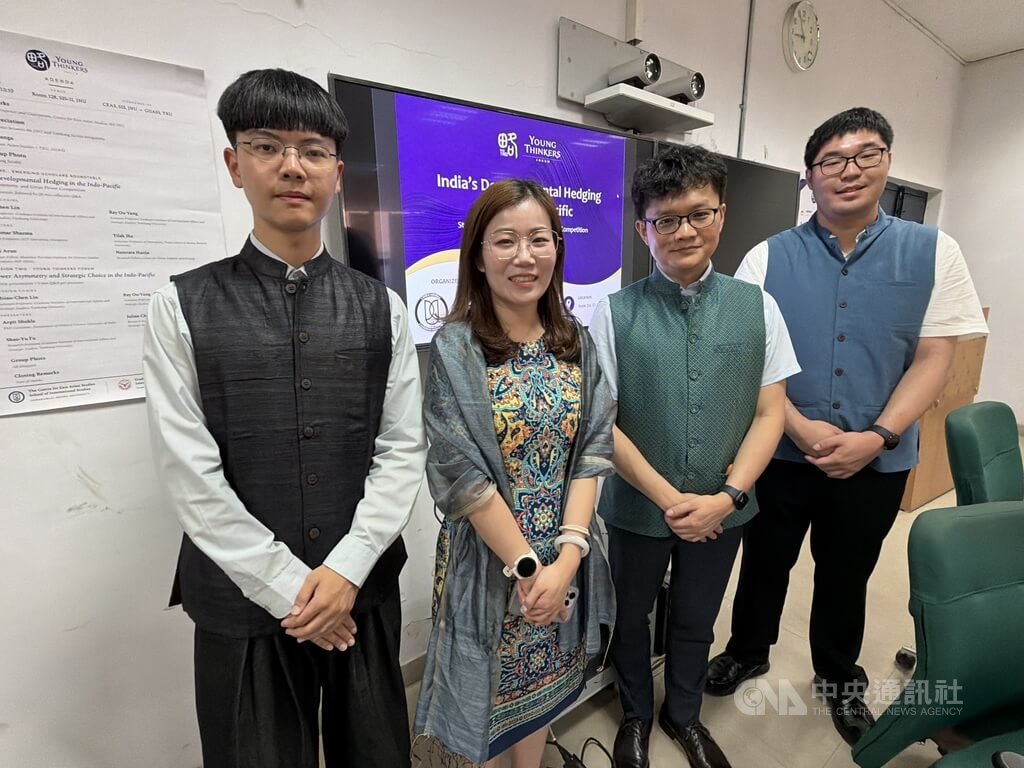
(CNA Reporter Li Chin-wei, New Delhi, July 8) Tamkang University students Qiao Yuejing and Fu Shaoyu, led by Assistant Professors Lin Xiao-zhen and Ouyang Rui from the Graduate Institute of International Affairs and Strategic Studies, visited India for an exchange with scholars. They gained an in-depth understanding of India's "non-alignment" foreign policy strategy and discussed how smaller nations and middle powers can maintain policy autonomy in an international environment of asymmetrical power.
The Young Thinkers Forum, held at Jawaharlal Nehru University (JNU) in India, focused on the theme "India, the Indo-Pacific, and the Framework of Strategic Autonomy." It centered on India's strategic autonomy and hedging strategies within the evolving Indo-Pacific geopolitical landscape, as well as policy choices amidst great power competition.
Professor Srikanth Kondapalli from the East Asian Studies Centre at JNU's School of International Studies told CNA reporters that the Indian government's stance on the Taiwan issue has evolved over time, but there are increasing opportunities for mutual understanding, which is highly beneficial for both sides. "I believe we need to foster more interaction between Taiwanese scholars, people from various sectors, and India. Forums like this are an excellent example of promoting mutual understanding between Taiwan and India."
Assistant Professor Lin Xiao-zhen of the Graduate Institute of International Affairs and Strategic Studies stated that this Young Thinkers Forum delved into international relations, approaching issues from the perspectives of strategic autonomy and diplomatic diversification. Indian scholars explored India's foreign policy priorities, while the Taiwanese side studied the inspirations drawn from the New Southbound Policy, aiming to promote intersections in research between Taiwan and India.
Lin Xiao-zhen added that in past discussions on international relations, there was a greater emphasis on national security and self-interest. "This time, we hope to focus more on cross-domain cooperation between the two sides when jointly discussing international relations issues." Through areas like AI and semiconductors, they aim to find more diverse ways to collaborate and identify common ground.
Ouyang Rui mentioned that bringing students to India not only promoted exchange between Taiwan and India but also aimed to help students and provide them with opportunities for better future research development. "As we often say India is a strategically autonomous country, but it is also influenced by China to some extent. Our exchange here allows us to gain insight into how China's foreign policy operates."
Tamkang University student Qiao Yuejing said that he grew up in the United States and later returned to Taiwan to study, learning to view the world and cross-strait relations from both Western and Taiwanese perspectives. Meeting with scholars in India and sharing his research allowed him to understand that "India has its own approach to handling international relations, enabling me to further see how different countries manage their international relationships."
Fu Shaoyu stated in an interview that his personal research discusses the diplomatic development of Taiwan and India, examining Taiwan's New Southbound Policy and India's Act East Policy. "I believe Taiwan and India should have many opportunities for cooperation within the framework of these two policies."
Swati Arun, an Associate Fellow at the Indian think tank MP-IDSA, told CNA reporters that the Young Thinkers Forum is an excellent platform. "We often understand our own country's situation best and are capable of responding to various challenges, but listening to voices from the other side is equally crucial. We need to understand each other's needs and expectations."
Arun added that although such dialogues may have occurred many times, new conversations emerge with the participation of the new generation of young scholars. Especially considering that 10 years ago, India-Taiwan relations were still in their nascent stages, but they have since made significant progress. "This demonstrates that it has indeed been a very successful endeavor, and the current achievements fully validate this point." (Editor: Chang Chi-hsuan) 1150708
Stand with facts, and your every contribution is a force to protect the freedom of the press.
Download the CNA "One-Stop News" APP for real-time updates.
Text, images, and videos on this website may not be reproduced, publicly broadcast, publicly transmitted, or used without authorization.
FACT BOX
- Source: CNA (Central News Agency)
- Category: 國際交流
- Organizations: MP-IDSA