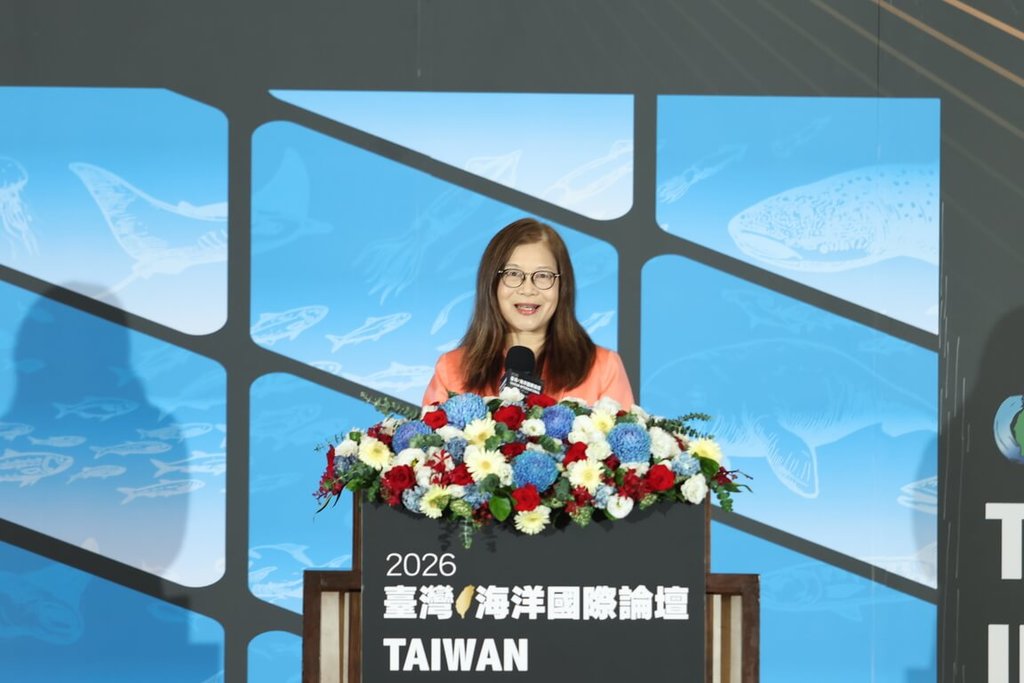
(CNA, Kaohsiung, July 8) Minister of the Ocean Affairs Council (OAC) Hsu Chih-chun stated today that China is altering the status quo through gray zone actions and urged democratic partners to establish a joint coordination mechanism. Through sharing maritime domain awareness and other measures, they can jointly safeguard peace and stability in the Taiwan Strait and the Indo-Pacific.
The "2026 Taiwan International Ocean Forum (TIOF)," hosted by the OAC, was held in Taipei today. This year's forum aligns with the national policy of "whole-society defense resilience," focusing on "maritime resilience." It invited heavyweight parliamentarians, incumbent officials, think tank experts, and business leaders from 16 countries worldwide to gather in Taiwan.
Hsu stated that countries in the Indo-Pacific region, including Japan, Taiwan, and the Philippines, are jointly facing the "gradual accumulation and long-term pressure" gray zone actions of authoritarian states. Through means such as coast guard activities, military exercises, interference with submarine cables, and law enforcement against merchant vessels, they are eroding the existing international order and regional status quo bit by bit, without crossing the threshold of traditional warfare.
"No decisive war has occurred on any given day, but the original status quo no longer exists," Hsu said. If the international community continues to treat the abnormal as normal, the status quo will eventually be rewritten without war. Therefore, democratic partners should establish a joint gray zone threat assessment mechanism to clearly identify "yellow lines" and "red lines." Through sharing maritime domain awareness, intelligence exchange, and coordinated responses, they can form a stronger "chain of democratic peace" to jointly safeguard peace and stability in the Taiwan Strait and the Indo-Pacific.
The highlight of the first day of the forum was the "High-Level Dialogue" held in the morning, hosted by Thomas P. McDevitt, Chairman of The Washington Times, bringing together several heavyweight international dignitaries and security strategy experts.
During the dialogue, Hsu further elaborated that in the face of gray zone challenges, the international community can strive towards four concrete directions. First, clearly articulate positions based on international law to leave no room for ambiguity and manipulation. Second, strengthen intelligence exchange and strategic communication to jointly identify patterns of behavior. Third, clarify the thresholds for altering the status quo to establish early warnings. Finally, establish a joint response mechanism to form effective coordinated deterrence.
The OAC stated that like-minded countries speaking in unison demonstrates that safeguarding a free and open maritime order and Taiwan Strait stability is a shared responsibility of democratic partners and a common interest of the international community. They will continue to work hand-in-hand with like-minded countries to jointly enhance maritime security resilience, uphold a rules-based international maritime order, and contribute to peace and stability in the Indo-Pacific and global maritime governance. (Editor: Huang Ming-hsi) 1150708)
Choose to stand with the facts. Every contribution you make is a force to protect press freedom.
Download the CNA "First News" APP to get the latest news in real-time.
Text, images, and videos on this website may not be reproduced, publicly broadcast, publicly transmitted, or used without authorization.
FACT BOX
- Source: CNA (Central News Agency)
- Category: 國際關係