WASHINGTON (CNA) - China's recent test of a submarine-launched intercontinental ballistic missile capable of carrying nuclear warheads has drawn international dissatisfaction. Former U.S. Defense official Randall Schriver stated today that this signifies an enhancement of China's "nuclear triad" capabilities, adding submarine-launched nuclear warheads to its existing air-launched and land-launched arsenals, primarily targeting the United States and representing a facet of U.S.-China competition.
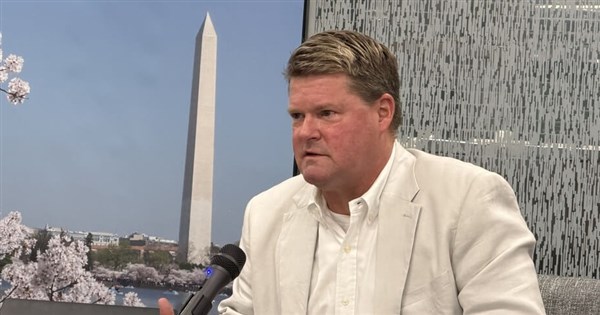
Randall G. Schriver, former Assistant Secretary of Defense for Indo-Pacific Security Affairs (now Department of Defense), stated at an event hosted by the U.S. think tank Institute for Indo-Pacific Security (IIPS) today that China is showcasing its military might through various military activities and initiatives, including the recent test of a submarine-launched ballistic missile (SLBM) in the South Pacific. He noted that "this is not unusual" and it has been some time since their last such test.
Schriver, now Chairman of the Institute for Indo-Pacific Security, told CNA in a post-event interview that the missile China launched is nuclear-capable and can carry a nuclear warhead, demonstrating an enhancement of its nuclear triad capabilities, adding submarine-launched nuclear warheads to its air-launched and land-launched systems.
"This is primarily aimed at us, and it's part of U.S.-China competition and its strategic elements," he said.
Schriver further elaborated that China's activities in the South Pacific, whether visible or covert, are becoming increasingly frequent. "This is a very high-profile demonstration of their military capabilities, taking place near some of our closest partners and allies." Therefore, he believes this also sends a message to these countries.
Amid China's continuous expansion of influence in the South Pacific, Australia and Fiji recently signed a new defense alliance agreement, further deepening bilateral security cooperation. Schriver commented that this is a development worth noting.
Schriver analyzed that in terms of China's nuclear capabilities and overall defense posture, "this is a step forward," and therefore, "it is something we need to be concerned about."
Retired U.S. Navy Rear Admiral Mark Montgomery believes that although not frequent, such tests by China are still routine. He suggested that the timing of this test might be an attempt to remind the U.S. and European nations, during the North Atlantic Treaty Organization (NATO) summit, that China is a Pacific power.
Montgomery, now a senior fellow at the Washington-based think tank Foundation for Defense of Democracies, stated in an email response to reporter inquiries that he is more concerned about the drills conducted by the People's Liberation Army around Taiwan and in the East China Sea, which he believes are an attempt to undermine Taiwan's resilience against Chinese coercion.
China's state media, CCTV News, reported that a strategic nuclear submarine of the PLA Navy successfully launched a submarine-launched strategic missile "carrying a training simulated warhead" into "relevant high seas waters of the Pacific" on the 6th, and it "accurately landed in the predetermined sea area."
Although Beijing insists this was a "routine arrangement for annual military training" and claims it is "not engaging in a nuclear arms race with any country," the move has already sparked international dissatisfaction and protest.
Minister of National Defense Wellington Koo pointed out that the model of the submarine-launched missile launched by the PLA into the Pacific is the "JL-2" and condemned the PLA's action for disrupting regional stability. (Editor: Chen Hui-ping) 1150709
Stand with facts, your every donation is a force to protect press freedom
Download the CNA "One-Stop News" APP for real-time updates
The text, images, and audio on this website may not be reproduced, publicly broadcast, or publicly transmitted and used without authorization.
FACT BOX
- Source: CNA (Central News Agency)
- Category: 国际新闻