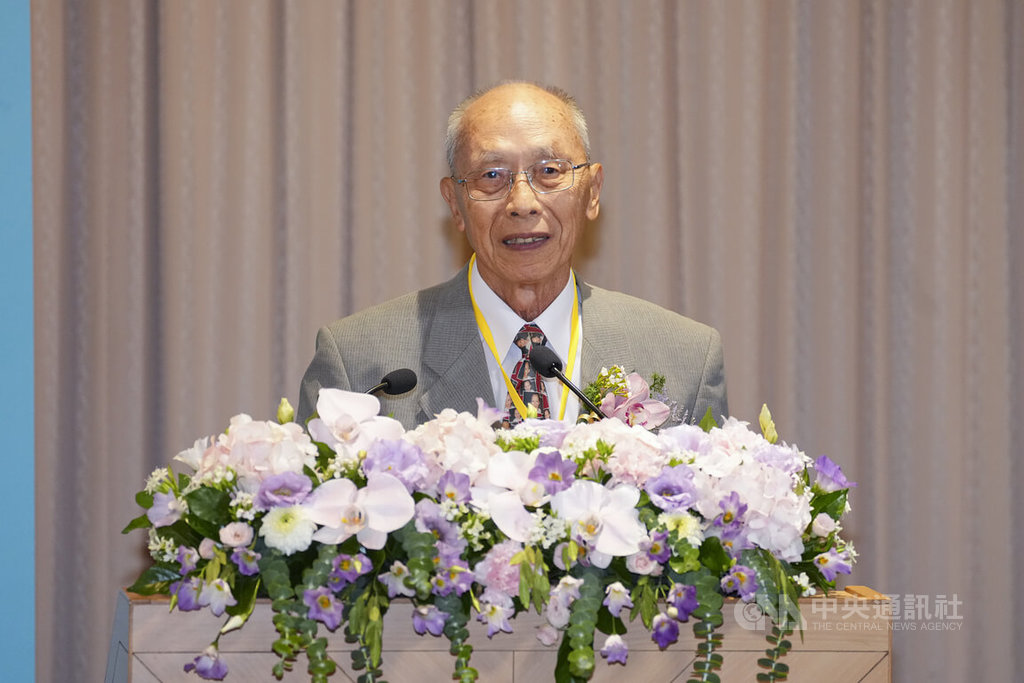
(Central News Agency, Reporter Wu Hsin-yun, Taipei, July 9) The Academia Sinica announced its new academicians today, including scholar Huang Kuan-chung, who has dedicated 27 years to studying the Southern Song Dynasty. He stated today that with the rapid development of AI, humanities and social sciences, though seemingly disadvantaged, are best able to showcase human nature, and he urged all sectors to support the development of these fields.
The new academicians of Academia Sinica were announced today, with a total of 19 scholars and experts elected, including 8 women and 11 men, with women accounting for 42%. In the Humanities and Social Sciences group, there are 4 new academicians this year: Li Hsiao-ti, Li Chien-liang, Li Shih-hsueh, and Huang Kuan-chung.
Huang Kuan-chung is a scholar of Song Dynasty history. According to information, he is one of the most prolific scholars in Song Dynasty history research since the 20th century. In addition to publishing over ten books, he has provided original new insights into Chinese history, particularly the Southern Song Dynasty, by meticulously analyzing texts and consolidating scattered and little-known historical materials.
Huang Kuan-chung stated today that his election as an academician is not due to personal achievement, but rather because his research on the Southern Song Dynasty has finally received relative recognition. The Southern Song Dynasty is a difficult era to research due to complex data, but influenced by his mentor, he has been dedicated to Southern Song research for 57 years since publishing his first paper at the age of 20. "I have never left the Southern Song Dynasty."
Huang Kuan-chung expressed that although he once felt like he was stuck in a mire, it also gave him the opportunity to re-understand this long-misunderstood era thoroughly, allowing the outside world to have a more comprehensive and clear understanding of the Southern Song Dynasty, which is what he is most proud of in his life.
Huang Kuan-chung also said that with the rapid development of AI, humanities and social sciences, though seemingly disadvantaged, are best able to showcase human nature. He hopes that all sectors will continue to support and strengthen the cultivation of talent in humanities and social sciences.
He also cited his experience teaching in the medical department at Chang Gung University as an example, pointing out that students with medical, science, and engineering backgrounds generally neglect humanities education. Therefore, he offered courses to help future physicians understand the social responsibility and humanistic spirit of intellectuals. "Physicians truly face people, not just diseases and instruments." Good communication, empathy, and judgment all require the support of humanities education.
Following the renowned civil law scholar Wang Tse-chien, this year's new academicians also include a legal scholar, Li Chien-liang, Director of the Institute of Law at Academia Sinica. In his speech, he expressed his gratitude to Wang Tse-chien, stating that Wang was his enlightenment teacher in law and a benchmark and direction for his legal research.
Li Chien-liang said that being elected an academician is a great personal honor and an affirmation of the efforts of many public law scholars in Taiwan in public law research and the deep cultivation of legal awareness in Taiwan. Being elected an academician also represents a responsibility. In the future, he will continue to contribute to building Taiwan's public law knowledge system and to deepening Taiwan's democracy and rule of law.
In addition to Huang Kuan-chung and Li Chien-liang, Li Hsiao-ti is a Distinguished Professor at the Graduate Institute of History, National Central University. His research over the past few decades has focused on the thought, culture, and social history of modern China and the Ming and Qing dynasties, as well as urban history. Since 2000, he has successively led the collective projects "Society and Life in the Ming and Qing Dynasties" and "Urban Culture and Life in the Ming and Qing Dynasties," collaborating with nearly ten colleagues from Academia Sinica specializing in history, literature, and art history, dedicated to the study of new cultural history. These studies have opened up new directions and topics and have had a significant impact in Taiwan and mainland China.
Li Shih-hsueh is a distinguished research fellow emeritus at the Institute of Chinese Literature and Philosophy, Academia Sinica. His work focuses on the "literary" issues within the transmission of Western learning to the East during the Ming and Qing periods. Since the publication of his book, scholars studying the transmission of Western learning to the East during the Ming and Qing periods, both in China and abroad, have begun to consider the term "literature." Li Shih-hsueh's monographs and scattered writings have become indispensable works for scholars interested in the transmission of Western learning to the East during the Ming and Qing periods, and are required reading. (Editor: Chen Ching-fang) 1150709
Stand with facts, your every contribution is a force to protect press freedom.
Download the CNA "One-Stop News" APP for real-time updates.
Text, images, and videos on this website may not be reproduced, publicly broadcast, publicly transmitted, or used without authorization.
FACT BOX
- Source: CNA (Central News Agency)
- Category: 科學研究