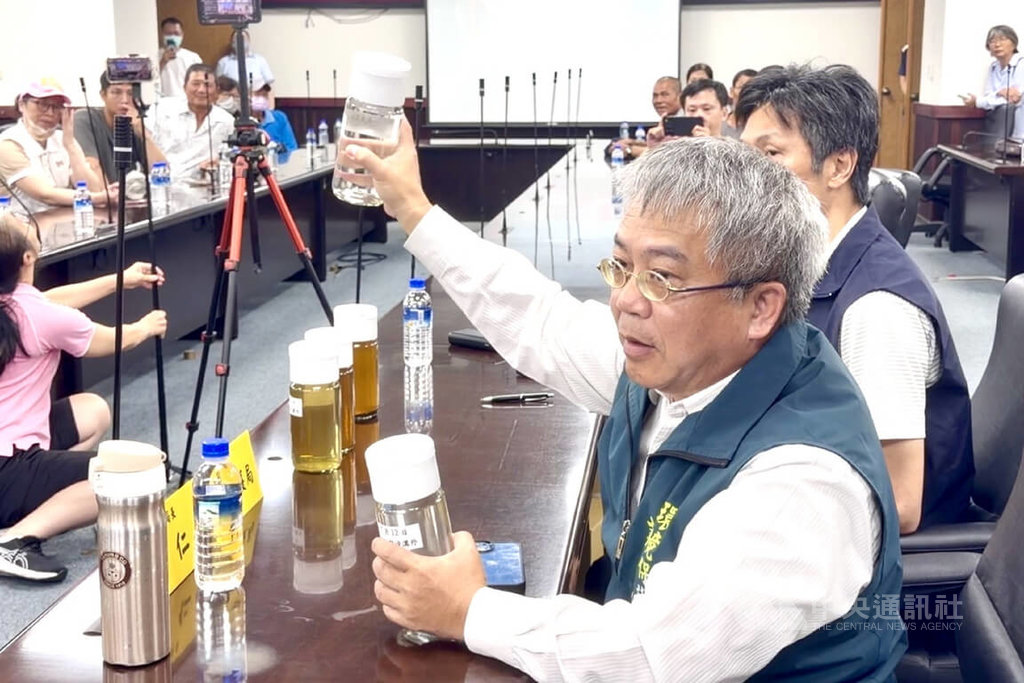
(Central News Agency reporter Yang Sui-jui, Tainan, July 13) Aquaculture groups and several city councilors and council candidates held a press conference today, alleging suspected wastewater leakage from the Chengxi landfill that may affect nearby aquaculture farms. The Tainan City Environmental Protection Bureau stated that all treated effluent meets regulatory standards and will conduct an on-site inspection on July 16 to clarify the situation.
Kuo Kun-shan, chairman of the Tainan City Aquaculture Development Association, along with several Kuomintang city councilors and candidates from the Kuomintang and Taiwan People's Party, held a press conference at the city council today. They released test results from an independent water sample collected on June 22 from the Qingcaolun drainage channel, showing an ammonia nitrogen concentration of 26 milligrams per liter.
Kuo stated that multiple test results fail to meet environmental standards for aquaculture water use. Discharging wastewater into the Qingcaolun intake and drainage channels could cause a sharp drop in dissolved oxygen and ammonia toxicity, harming fish and shrimp. The suspected pollution has already caused some fishermen to refrain from pumping water into their ponds. He urged the council to establish a special task force to monitor follow-up actions.
Hsu Jen-tze, Director of the Tainan City Environmental Protection Bureau, responded on-site, stating that the so-called 'black water' phenomenon is not due to illegal discharge from the landfill. To identify the source of the wastewater, an on-site inspection has been scheduled for July 16 to help alleviate local concerns.
The Tainan Environmental Protection Bureau held a separate press conference today. Hsu emphasized that the Chengxi Incinerator achieves zero wastewater discharge, and the small amount of leachate from the landfill is treated through a three-stage reverse osmosis (RO) system. After confirming compliance with national effluent standards, it is legally discharged or reused in street-spraying vehicles.
He stated that since June 26, all effluent has been fully contained within a closed area, isolated from tidal ditches and windbreak forests, and is being recirculated through a closed-loop treatment system, preventing any external discharge.
Hsu pointed out that the dark brown color of the tidal ditch water is primarily due to natural environmental factors, including sediment and organic matter released by tidal disturbances, stormwater runoff carrying organic materials into the water, decomposition of fallen leaves and plant debris in windbreak forests producing tannic acid, and decomposition of dead algae causing localized hypoxia and reduction reactions—all of which can alter water color.
Hsu added that the Environmental Protection Bureau conducts monthly water quality monitoring of effluent and continues to monitor groundwater, surface water, and surrounding environments. All test results are publicly available on the bureau's official website. This time, third-party testing and analysis have been commissioned to Chia Nan University of Pharmacy and Science. Additionally, aerial photography has been applied for through the Taijiang National Park Management Office to scientifically reconstruct the truth. Experts and scholars will be invited to form a team to develop strategies for improving the aquatic environment. (Editor: Li Hsi-chang) 1150713
FACT BOX
- Source: CNA (Central News Agency)
- Category: Taiwan