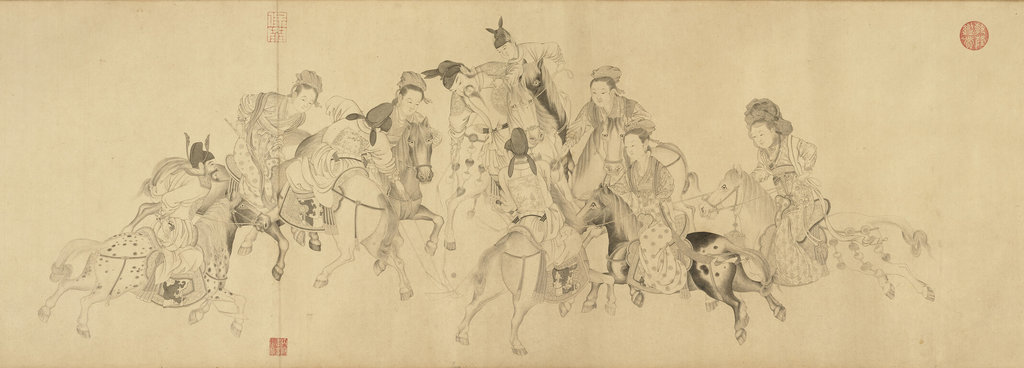
(CNA reporter Wang Pao-erh, Taipei, July 13) As the FIFA World Cup heats up, ancient depictions of ball games can also be found in Palace Museum artworks. The National Palace Museum's Northern Branch has launched the 'Chengji and Sports' exhibition, allowing visitors to travel through time and witness how ancient people played ice skating, mountain climbing, and ball games.
Pu Li-an, Assistant Curator at the National Palace Museum's Department of Painting and Calligraphy and exhibition curator, explained in a press release that today's concept of 'sports' includes individual exercise, group competitions, and mountain hiking. While ancient times lacked a unified term, words such as 'she' (shooting), 'yi' (art), 'ji' (skill), 'xi' (game), and 'you' (recreation) were used to describe various physical activities and skill demonstrations.
The exhibition 'Chengji and Sports – Physical Skills and Athletic Activities in Painting and Calligraphy' is divided into four sections: 'Martial Practice and Ritual,' 'Ball Games and Competition,' 'Showcasing Skills,' and 'Climbing High to View the Distance.' It also features multiple interactive experiences, allowing visitors to personally engage with the physical skills depicted in the artworks. These include a multimedia interactive area for the ancient game of 'touhu' (pitch-pot) and a large interactive book to closely examine painting details.
Among the ball game themes, 'cuju,' similar to modern football, and 'jiju,' a form of polo played on horseback with sticks, are featured. The traditionally attributed Song Dynasty work 'Children Playing Ball' by Su Han-chen depicts a group of people encircling a ball, their focus entirely on the game. Qing Dynasty artist Ding Guan-peng's 'Emperor Tang Minghuang Playing Jiju' moves the action to horseback, with goalposts and goalkeepers shown on both sides.
Artworks also depict ice-skating activities comparable to modern times. Shen Yuan's Qing Dynasty 'Imperially Composed Rhapsody on Ice Play' captures winter scenes on frozen lakes, with skaters gliding across Taiye Pool, illustrating how Qing court ice activities combined training with entertainment. Meanwhile, mountain climbing, familiar to modern audiences, was historically linked with rituals, imperial tours, leisure, and self-cultivation.
The national treasure 'Miscellaneous Writings' by Xue Shao-peng of the Song Dynasty includes the 'Poem on Yunding Mountain,' recounting a challenging ascent, describing the steep terrain and difficulty of climbing, and expressing the joy of overlooking the landscape after enduring hardship. Wang Yuan-chi's Qing Dynasty 'Autumn Colors of Mount Hua' was painted after the artist's visit to Mount Hua, with inscriptions detailing his journey and expressing regret at not reaching all the peaks.
The 'Chengji and Sports – Physical Skills and Athletic Activities in Painting and Calligraphy' exhibition runs from July 13 to September 16 at the National Palace Museum's Northern Branch. The national treasure 'Yuan Shizu Hunting Scene' by Liu Guan-dao will be on display until August 16. (Edited by Lin Shu-hui) 1150713
FACT BOX
- Source: CNA (Central News Agency)
- Category: Event