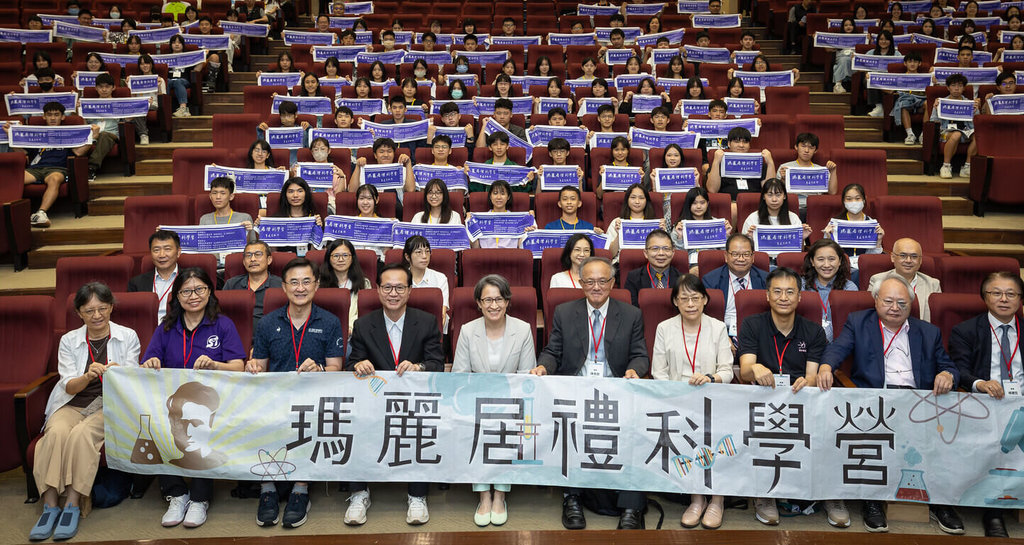
(CNA reporter Yeh Su-ping, Taipei, 13th) Vice President Hsiao Mei-juin stated today that possessing military strength or having a large territory does not necessarily confer an advantage. Instead, in the future, it may be smaller nations that are smarter, more agile, and capable of rapidly applying and integrating emerging technologies that will safeguard their survival. Using the animated series 'Little Heroes of the North Sea' as an example, she encouraged participants, emphasizing that overcoming difficulties should not rely on fists or muscles, but through thinking and applying scientific methods to find solutions.
According to a press release from the Presidential Office, Vice President Hsiao attended the opening ceremony of the '2026 Marie Curie Science Camp' this afternoon.
Regarding one of the event's themes, 'resilience,' the Vice President noted that this term has recently become frequently mentioned, with many foreign guests visiting Taiwan centering their discussions around resilience, making it one of Taiwan's defining characteristics. Resilience does not mean being immune to all threats, but rather the ability to flexibly adapt and calmly respond to various risks, disruptions, and even natural disasters, recovering normal life as quickly as possible.
The Vice President pointed out that many people believe national defense and science are parallel paths, but this is not the case. For example, the U.S. Defense Advanced Research Projects Agency (DARPA) has conducted numerous forward-looking scientific studies, developing technologies such as GPS, the internet, and optical radar used in autonomous vehicles—technologies later widely applied—demonstrating the integration and close relationship between military and civilian technologies.
She noted that the global order is currently being restructured, with significant changes in geopolitics. From Russia's invasion of Ukraine to conflicts in the Middle East, these events have not only affected the energy sector but also triggered major geopolitical shifts.
She explained that behind the geopolitical competition among nations lie several strategic-level issues closely related to science, including key technological fields such as chips, computing power, data security, and algorithms, as well as energy, rare earths, and communication technologies. At the tactical level, emerging technologies such as unmanned vehicles, sensor technology, lasers, electronic warfare and jamming equipment, and AI-assisted decision-making are all crucial to global geopolitical changes and national survival security.
She believes the changes in geopolitics offer an important lesson: internationally, possessing military force or having a large territory does not guarantee dominance. Instead, in the future, it may be smaller, smarter, more agile nations capable of quickly applying and integrating various emerging technologies that will protect their survival. This is also her hope for Taiwan's next generation, as Taiwan's free, democratic way of life and national development are deeply intertwined with science.
Citing the animated series 'Little Heroes of the North Sea,' the Vice President encouraged the students, noting that the protagonist does not overcome difficulties through physical strength, but rather, in every obstacle, challenge, and predicament, uses thinking and scientific methods to find solutions.
She urged the students to become problem-solvers for the future, guardians of Taiwan's security and future—the little heroes—and to transform the scientific experiences and knowledge gained from this camp into lasting motivation for innovative thinking and practical action. (Edited by Lin Hsing-meng) 1150713
FACT BOX
- Source: CNA (Central News Agency)
- Category: Event