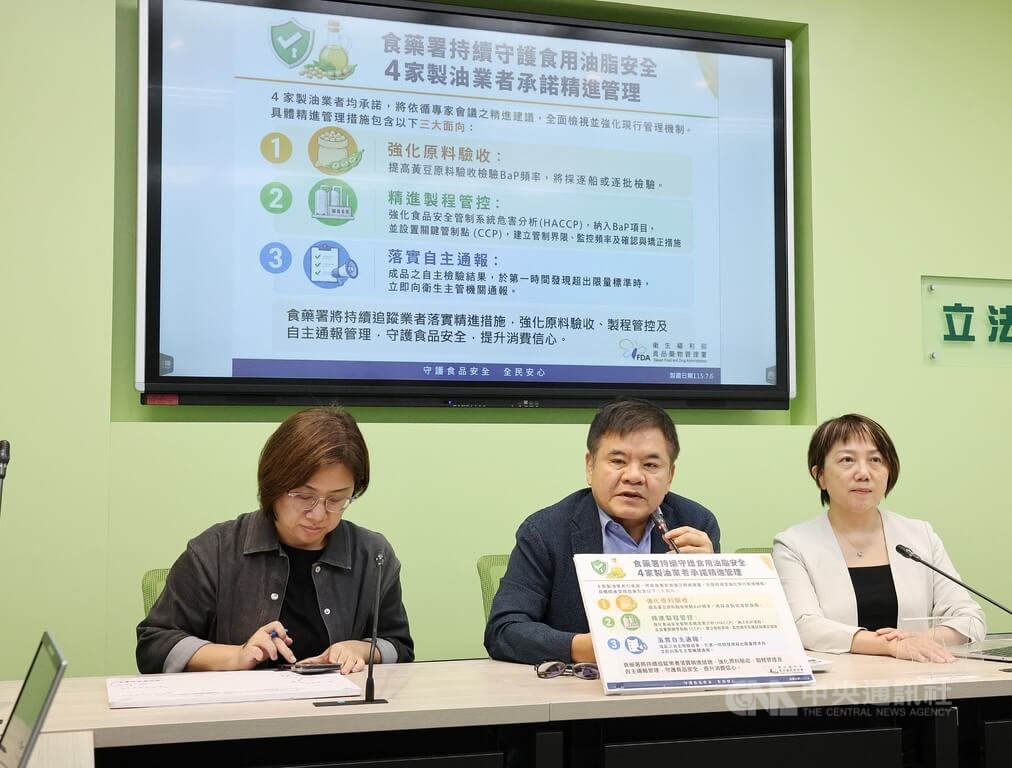
Taipei, Central News Agency (Reporter Lin Jing-yan, January 13) — A food safety controversy has erupted after carcinogenic substances were found to exceed safety limits in products from Chung Lian Oil. President Lai Ching-te recently stated that amendments to the Food Safety and Sanitation Act should be considered. The Democratic Progressive Party (DPP) caucus in the Legislative Yuan declared today that amending the Food Safety Act is indeed necessary. Measures such as strengthening self-regulation, introducing third-party inspections, and extending statutes of limitations should be reviewed to better protect public health, which reflects a responsible government.
Lai Ching-te, who also serves as DPP chairperson, outlined four principles regarding the Chung Lian Oil incident during the party’s Central Standing Committee meeting on the 8th, instructing the legislative caucus to collaborate with the Executive Yuan to discuss amendments to the Food Safety Act and further enhance food safety protections. Minister of Health and Welfare Shih Chou-liang stated yesterday that for food companies above a certain scale or with oligopolistic high-risk operations, the board of directors should include independent directors with expertise in food science, medicine, or public health. This would introduce more transparent corporate governance mechanisms and strengthen food safety management.
Chuang Jui-hsiung, DPP caucus whip, said the Food Safety Act indeed needs revision. Beyond public discussions on traceability, issues such as how to strengthen self-regulation, enhance third-party inspections, and whether statutes of limitations should be extended must be addressed to ensure public health. This is what a responsible government should do.
On the issue of independent directors, Chuang said it is certainly one method of oversight. However, he questioned how much impact adding one independent director would have on food safety, emphasizing that the core issue lies in systemic reform.
Chuang noted that issues such as mandatory self-reporting by businesses, source management, and clearer coordination between central and local governments to swiftly close regulatory gaps are critical. The recent oil contamination incident, involving carcinogen超标, is not merely causing public panic—governments must make faster and clearer decisions. Multi-tiered recalls can cause chaos, so establishing systems that enable accurate, clear, and rapid government decisions is essential to protect stakeholders’ rights.
Chuang reiterated that simply adding an independent director cannot fully resolve systemic vulnerabilities. He suggested discussing whether Taiwan should establish an independent food safety agency, similar to the UK’s Food Standards Agency created after the mad cow disease outbreak, to ensure public confidence in food safety. Ultimately, it is the government’s responsibility to ensure people can eat without fear.
Regarding impact on businesses, Chuang emphasized the need for clearer standards. Without clear criteria, sudden recalls can overwhelm small companies with endless returns and recovery processes. Only by improving the system can long-term solutions be achieved. (Editor: Su Chih-tsung)
FACT BOX
- Source: CNA (Central News Agency)
- Category: Taiwan