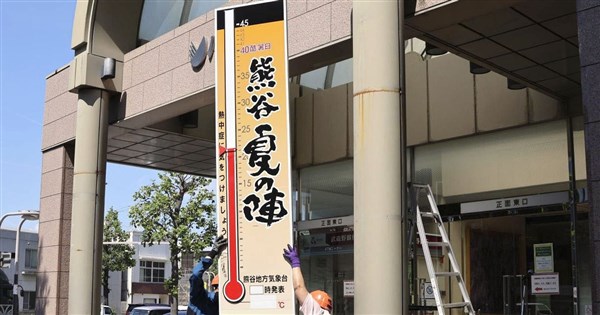
Japan's summers are growing hotter, forcing companies to rethink work models. Tokyo's summer temperatures and humidity now frequently match those of Southeast Asian cities, with nationwide work hour losses due to heat exceeding 2.8 billion hours annually.
According to Nikkei Asia, as heat-related illness cases continue to rise, adjusting work practices to reduce the impact of extreme heat on workers has become a critical challenge for Japan.
At a hospital construction site in Sakai City, Osaka Prefecture, around 100 workers head to rest areas after each work phase, using portable air conditioners to cool down and enjoying shaved ice to recover after working in hot and humid conditions.
Konoike Construction, managing the project, has launched a heat-avoidance program aiming to reduce working hours during extreme heat while maintaining total work volume. Specifically, workers are given nine consecutive days off each month from July to September, with two Saturdays from October onward scheduled for makeup work, when temperatures are typically lower.
Yoshihiro Aoyagi, a senior executive at Konoike Construction, stated, "Workplace efficiency drops significantly in summer, and accident rates remain high." In 2025, the number of heatstroke cases among Konoike's workers doubled compared to the previous year, prompting the company to adjust work hours across multiple sites.
Japan's summers are becoming increasingly hot. Nikkei Asia analyzed climate data from 2020 to 2025 using meteorological information from the U.S. National Oceanic and Atmospheric Administration (NOAA), finding that Tokyo's peak temperatures and humidity in July and August have approached levels seen in Bangkok and Singapore, significantly higher than in the 2000s and 2010s—indicating the capital is gradually "tropicalizing."
Declining productivity due to climate change is emerging as an economic cost. An international study led by The Lancet, a prestigious British medical journal, factored in labor intensity and workforce size, revealing a link between extreme heat and reduced efficiency across industries.
The study showed that in 2024, each Japanese worker lost approximately 43 potential work hours due to heat, equivalent to over five workdays. Nationally, workers collectively lost 2.89 billion hours—double the 2010s average of 1.43 billion hours.
The impact of extreme heat extends beyond Japan. In China, where agriculture and construction employ a higher proportion of workers, each laborer lost 96 work hours in 2024 due to heat.
Globally, potential economic losses from extreme heat in 2024 reached $1 trillion. In Europe, deadly heatwaves in June caused construction sites and other workplaces to shorten or suspend operations.
Countries are strengthening measures in response to heat threats. Qatar has banned outdoor work from 10 a.m. to 3:30 p.m. during summer since 2021, and prohibits outdoor work regardless of time when the Wet-Bulb Globe Temperature (WBGT) exceeds specific thresholds.
Spain began regulating outdoor work in high temperatures in 2023. South Korea, starting in 2025, mandates employers to schedule rest periods based on actual perceived temperature.
Japan revised occupational safety and health regulations in 2025, requiring employers to implement preventive measures for workers exposed to high temperatures and establish emergency response mechanisms for heatstroke. However, government data shows over 1,800 heat-related workplace injuries and fatalities in 2025, the highest on record for the second consecutive year.
Employers are legally required to immediately report to local labor authorities if an employee takes more than four days off due to heatstroke or dies.
Heatstroke cases are also rising in manufacturing and retail. Indoor workplaces often lack sufficient heat protection, and chronic labor shortages and an aging workforce further increase heatstroke risks.
Seichi Horie, president of the University of Occupational and Environmental Health in Kitakyushu, stated that if government statistics included workers taking three or fewer days off, "the number of heatstroke patients would likely increase by another digit."
Takuya Shinohara, chief analyst at the think tank NLI Research Institute, emphasized that heat countermeasures should shift from "lowering body temperature" to "reducing exposure time to high-temperature environments." He noted that necessary measures include shifting work to early mornings or evenings, adjusting work hours seasonally, and promoting remote work. (Translation: Shih Shih)
FACT BOX
- Source: CNA (Central News Agency)
- Category: Survey