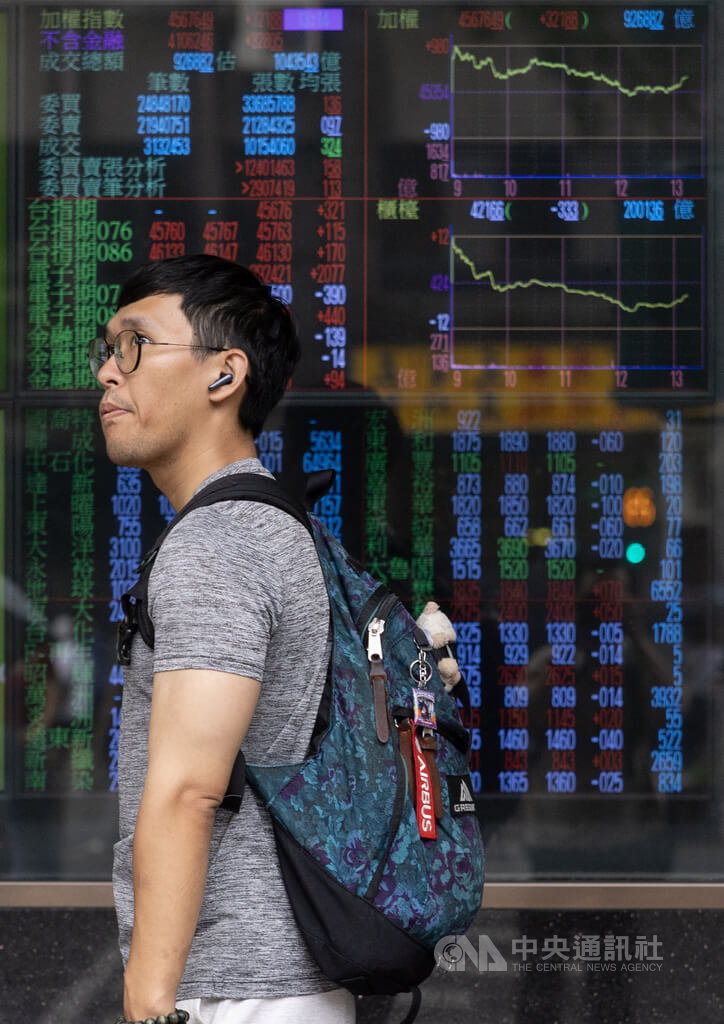
(Central News Agency reporter He Xiu-ling, Taipei, 13th) Taiwan's stock market opened higher and traded in a high-range consolidation today, reaching a peak of 46,330.91 points. However, the rally slightly cooled due to corrections in Japanese and Korean markets, with the index stabilizing near the 46,000-point level. TSMC led the heavyweight stocks with a gain of over 2%, while MediaTek turned negative. The optics sector and Formosa Plastics 'Four Jewels' performed strongly.
As of 11:05 a.m., the main index stood at 45,795 points, up 440 points, or 0.97%, with trading volume reaching approximately TWD 628.5 billion.
Among key stocks, Hon Hai rose by TWD 1 to TWD 238.5; MediaTek turned red, falling TWD 30 to TWD 3,895; Delta Electronics gained TWD 35 to TWD 1,915.
The electronics sub-index rose 1%, while the financial sub-index declined 0.12%. The GreTai Securities Market Index, representing small and mid-cap stocks, opened high but turned lower, down 0.48%.
The optics sector surged in early trading. Largan Precision, the 'king of stocks', jumped to its daily limit of TWD 4,345 following positive news from its investor briefing on Co-Packaged Optics (CPO) progress. This momentum pushed Largan Optronics and Advanced Optical to their daily limits at TWD 74.3 and TWD 198, respectively, while Sunny Optical rose over 5% in early trade.
The Formosa 'Four Jewels' showed strong performance: Formosa Chemicals & Fibers, Nan Ya Plastics, and Formosa Plastics all hit their daily limits at TWD 66, TWD 199.5, and TWD 60.2, respectively, while Formosa Petrochemical rose over 8%.
Wanbao Investment Consulting CEO Wang Rong-xu told the Central News Agency that today's strong opening was a catch-up rally, as U.S. markets rose during Taiwan's holiday, particularly the Philadelphia Semiconductor Index, which gained over 3% across two days. Japanese and Korean markets also advanced, pushing Taiwan's index up nearly 2% in early trading.
However, Wang noted that the mid-session pullback was influenced not only by Middle East tensions but also by weakening Japanese and Korean markets—especially South Korea, which fell around 5%, triggering regional sell-offs.
South Korea has recently experienced repeated sharp declines, becoming a leading indicator for Asian market downturns. This is due to high levels of leveraged and ETF trading in the local market, which amplifies volatility. When Korean stocks plunge, it often triggers selling pressure across other Asian markets.
Wang expects today's trading volume to reach approximately TWD 1 trillion, with higher liquidity supporting a bullish trend. Despite increased volatility, Taiwan's market remains relatively strong compared to Korea, supported by gains in the Formosa group and TSMC's stabilizing role. (Edited by Zhang Liang-zhi) 1150713
Stand with facts. Your support is a force in defending press freedom.
Download the CNA 'First News' app to stay updated with real-time news.
Text, images, and videos on this website may not be reproduced, broadcast, or transmitted without authorization.
FACT BOX
- Source: CNA (Central News Agency)
- Category: Taiwan