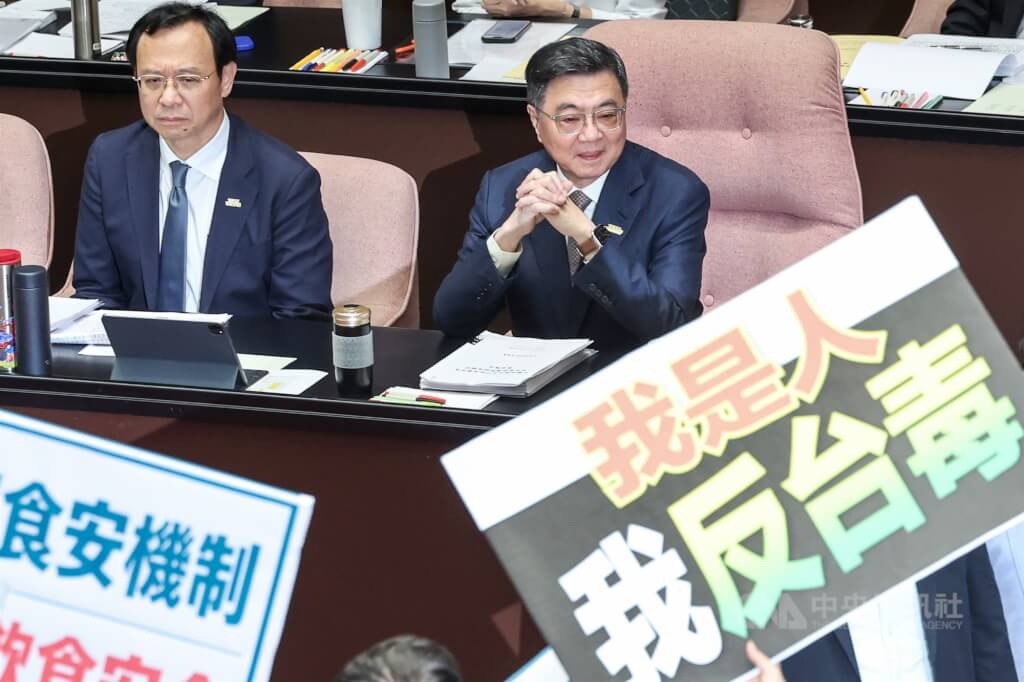
Taipei, July 14 (Central News Agency reporter Wang Yang-yu) — The Chung Lien Oils food safety scandal continues to escalate. Democratic Progressive Party (DPP) legislator Wang Cheng-hsu questioned the government today, demanding strict punishment for non-compliant manufacturers and the recovery of tax incentives and subsidies in accordance with relevant regulations. Premier Cho Jung-tai responded that companies receiving tax benefits while causing significant harm to society will face administrative review under current systems, in addition to ongoing judicial investigations.
The Legislative Yuan convened this afternoon, inviting Premier Cho Jung-tai and heads of relevant ministries to deliver a special report titled 'Review of the Chung Lien Oils Soybean Salad Oil Incident and Deficiencies in Food Safety Regulatory Mechanisms,' followed by a question-and-answer session.
During questioning, Wang Cheng-hsu highlighted that the Ministry of Education's 'Campus Food Ingredients Registration Platform' enabled government and schools to complete inspections and issue recalls within one day during this incident. He urged the government to extend similar measures to institutions serving health-sensitive populations, such as hospital group meals, long-term care facilities, postpartum care centers, and disability welfare institutions.
Premier Cho emphasized that vulnerable groups deserve stronger government protection. He instructed the Ministry of Health and Welfare to strengthen coordination with other ministries and local governments to integrate these institutions into the food safety protection system.
On the issue of penalizing illegal manufacturers, Wang cited the Tax Collection Act and the Industrial Innovation Act, stating that companies violating the Food Safety and Health Management Act under serious circumstances should have their tax incentives, awards, or subsidies suspended or recovered. He inquired whether the five companies—Chung Lien, Taisun, Fushou, Fumao, and Nanchiao—had previously received any government incentives or subsidies.
Deputy Minister of Economic Affairs Ho Chin-tsang reported that while no direct subsidy applications from these five firms were found, Chung Lien and Fumao had applied for investment tax credits related to smart machinery and information security between 2022 and 2025 (Minguo 111–114). Fushou had applied for R&D and smart machinery investment tax credits between 2021 and 2022 (Minguo 110–111).
Ho added that eligibility for investment tax credits depends on whether companies have committed major violations in food safety, environmental safety, or labor safety in the past three years. While past credits cannot be retroactively revoked under current regulations, future applications (2026–2028, Minguo 115–117) may be denied.
Premier Cho reiterated that all actions will follow legal procedures. He condemned companies that, despite receiving tax benefits, caused severe social harm and engaged in deliberate concealment or delayed reporting. In addition to judicial investigations, administrative tax incentives will be reviewed and handled under existing systems.
KMT legislator Wu Tsung-hsien called for the National Health Research Institutes or the Health Promotion Administration to conduct long-term public health risk assessments. He also urged the government to promote public awareness of antioxidant-rich foods to accelerate metabolism. Minister of Health and Welfare Shih Chou-liang responded, 'We will study this.' (Edited by Lin Hsing-meng) 1150714
FACT BOX
- Source: CNA (Central News Agency)
- Category: Taiwan