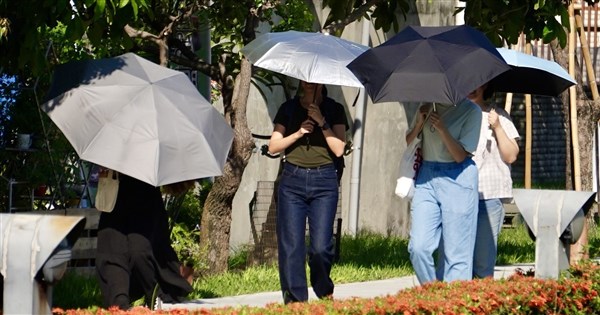
(Central News Agency reporter Chang Hsiung-feng, Taipei, July 14) The Central Weather Administration today issued a warning for eight counties and cities—including Changhua and Hualien—about high temperatures exceeding 36°C. Meteorological expert Wu Derong stated that from today through July 20, abundant moisture from the south will frequently lead to strong convective development in mountainous areas during afternoons, resulting in sudden heavy rainfall. Prior to rainfall, weather conditions will be hot and muggy.
The Central Weather Administration released high-temperature advisories today, indicating extremely hot weather. Changhua County and Hualien County are under an orange alert, with a high likelihood of consecutive days reaching 36°C. Yunlin County, Chiayi City, Chiayi County, Tainan City, Kaohsiung City, and Pingtung County are under a yellow alert, urging vigilance against temperatures above 36°C.
Wu Derong, adjunct associate professor in the Department of Atmospheric Sciences at National Central University, wrote in the 'Leak the Heavens Classroom' column of the Meteorological Application and Promotion Foundation that the latest European model simulations show southerly winds at low levels and abundant moisture from the southern seas from today through July 20. Scattered brief showers are expected in southern and southeastern regions over the next two days, and in southern areas from July 16 to 20.
Wu pointed out that due to a relatively weak Pacific high-pressure system, the atmosphere remains unstable. Strong afternoon convection frequently develops in mountainous areas and may extend into some flatlands, increasing risks of lightning, strong winds, and sudden heavy rainfall. Before rain occurs, the weather will be hot, so sun protection and heatstroke prevention are essential.
Wu added that model simulations indicate weakening southerly winds and reduced moisture from the south between July 21 and 23. The Pacific high-pressure system remains weak, allowing afternoon convection in mountainous areas, though only a small portion of adjacent flatlands will be affected. Daytime temperatures across regions will remain high, requiring continued attention to sun protection and heatstroke prevention.
Wu also commented on Typhoon No. 11, Haishen, noting it barely crossed the threshold to become a minimal typhoon, with poor intensification conditions and a short lifespan. Despite being in a high sea-surface temperature environment, international models show strong vertical wind shear hindering its development. The U.S. model predicts a track initially northward, then turning northeast, posing no threat to Taiwan. Even during a 'super El Niño year,' not all typhoons have the conditions to strengthen into powerful storms. (Editor: Chen Jen-hua) 1150714
FACT BOX
- Source: CNA (Central News Agency)
- Category: Taiwan