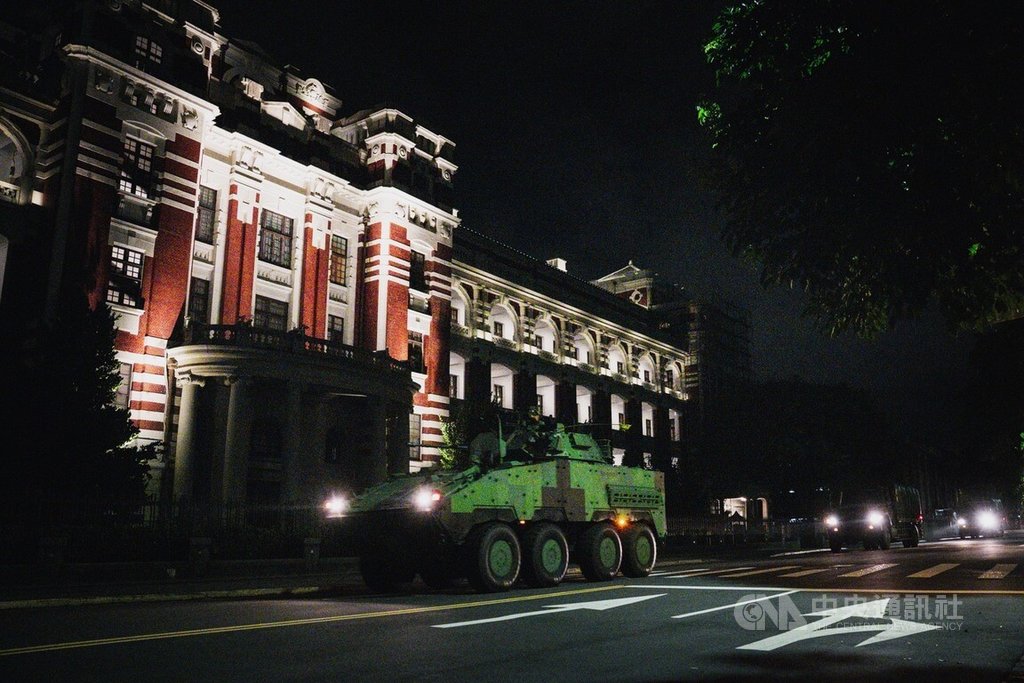
(Taipei, July 15, reporter You Kai-xiang) The Republic of China Armed Forces' Joint Defense Exercise entered its third day today. In the early hours, the 202nd Military Police Command deployed multiple batches of Yunpao 8-wheeled armored vehicles in a nighttime mobility exercise from the Presidential Office to the vicinity of the Bo'ai Military Camp in Dazhi, validating decentralized command and control (C2), protection of key targets, and civil-to-military transition capabilities, thereby strengthening central security protection and overall response readiness.
The five-day Joint Defense Exercise entered its third day today. Unlike the Immediate Readiness Exercise held in June, which focused on pre-attack preparedness, initial military readiness, and civil-to-military transition, the current exercise simulates scenarios where enemy forces have launched and entered Taiwan's territorial waters. It emphasizes integrated operations across all military branches, focusing on decentralized execution of the 'kill chain,' validating 'distributed command' and command and control (C2), and implementing Rules of Engagement (ROE).
To strengthen central security, the 202nd Military Police Command began deploying forces from 11 PM last night until early this morning, based on simulated enemy threats. Using live troops, real terrain, real-time operations, actual equipment, and hands-on execution, multiple batches of Yunpao series 8-wheeled armored vehicles—CM-32/33 and the CM-34 equipped with a 30mm autocannon—departed from the Presidential Office area and conducted drills near the Ministry of National Defense's Bo'ai Camp in Dazhi to enhance central security protection. During the movement, military and police forces implemented traffic control at multiple key intersections.
Military sources indicated that this drill validated the unit's ability to conduct force preparation, zonal assembly, and mobile deployment under a decentralized command and control mechanism. Combined with key target protection and combat power preservation, it comprehensively tested the unit's mission coordination and emergency response capabilities, strengthening central security protection and overall operational readiness.
Military officials stated that this exercise builds upon the operational scenario of the 'Immediate Readiness Exercise,' using scenario-based induction to validate the unit's response to various sudden situations. Through realistic drills, it enhances personnel's familiarity with mission characteristics, strengthens rapid civil-to-military transition and priority deployment capabilities, ensures the safety of critical infrastructure and key military protection targets in the garrison area, maintains normal government operations, and achieves joint defense combat objectives. (Editor: Lin Ke-lun) 1150715
FACT BOX
- Source: CNA (Central News Agency)
- Category: Event