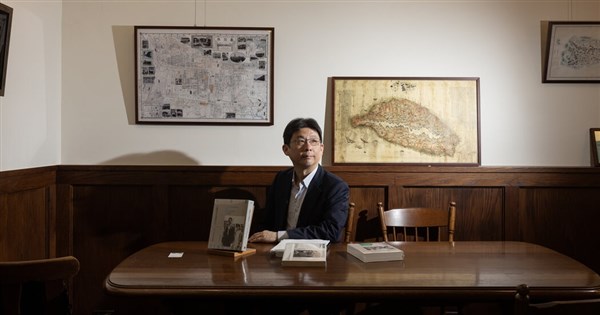
(CNA reporter Yang Yao-ju, Taipei, 15th) Hoover Institution scholar Ho Pin Linn's new book, 'Taiwan's Lee Teng-hui Era,' meticulously analyzes declassified documents, diplomatic cables from foreign envoys stationed in Taiwan, and oral history interviews to re-examine Taiwan's democratization process through historical evidence. In an exclusive interview with CNA, Linn stated that this book not only narrates former President Lee Teng-hui from a local perspective but elevates the study of Taiwan's democratization to an international level.
Following his previous works, 'Accidental State: Chiang Kai-shek, the United States, and the Formation of Modern Taiwan' and 'Chiang Ching-kuo's Taiwan Era: The Republic of China and Cold War Taiwan,' Linn, a research fellow and Director of East Asian Collections at the Hoover Institution, Stanford University, will release his latest book, 'Taiwan's Lee Teng-hui Era: Remaking the Accidental State,' on the 22nd.
'Taiwan's Lee Teng-hui Era' is the third volume in Linn's trilogy on postwar Taiwan history. Centered on Lee Teng-hui—the first democratically elected president of Taiwan—his political career, and Taiwan's transition from authoritarianism to democracy, the book explores Taiwan's domestic politics, foreign relations, cross-strait dynamics, and how the island navigated its identity amid shifting global geopolitics.
Linn, influenced by historians Huang Renyu and Jonathan Spence, emphasizes narrative grounded in rigorous archival research. He aims not only for academic audiences but also for general readers to understand the deeper messages behind 'Taiwan's Lee Teng-hui Era.'
Over several years, Linn traveled to archives and libraries worldwide, including the presidential libraries of George H. W. Bush and Bill Clinton—whose administrations spanned Lee's 12-year presidency. Additionally, the Lee Teng-hui Foundation's recent donation of valuable materials to Taiwan's National History Museum has made this historical reassessment particularly timely.
Linn stresses that understanding how Japan, the UK, the US, and France perceived Taiwan's democratization is as crucial as Taiwan's own perspective. The book uses declassified documents from the US White House National Security Council, State Department, and CIA, as well as internal communications and cables from American, Japanese, British, and French diplomats in Taiwan, allowing primary sources to 'converse' with one another.
Linn found significant discrepancies between foreign governments' assessments of Taiwan's political developments and the actual situation. He notes that such 'misjudgments' are part of history, revealing how Americans, British, and Japanese officials interpreted Taiwan's politics at the time. The unpredictability of political dynamics—even leading to misreadings by the US—adds depth to historical inquiry. This remains relevant today, as foreign diplomats' analyses of President Lai Ching-te, Taiwan's domestic affairs, and cross-strait relations are unlikely to be entirely accurate.
Two revelations from the declassified records particularly struck Linn. First, in spring 1995, President Clinton overruled opposition to grant Lee Teng-hui a visa to visit his alma mater, Cornell University. Linn reveals that Clinton's decision was not based on strategic recalibration but on domestic political balancing and personal sentiment—translating his dislike of then-Chinese leader Jiang Zemin into support for Lee.
For Taipei, Lee's US visit was a strategic move to elevate Taiwan's 'de facto existence' into 'international visibility.' For Beijing, however, it was a severe challenge to national sovereignty. Such geopolitical shifts often stem from individual leaders' decisions, shaped by diverse motivations—a key lesson from historical research.
Second, declassified records reveal a heated dispute in 1998 between high-ranking US and Taiwanese military officials. In June that year, during Clinton's visit to China, Taiwan's military reported a Chinese fighter jet crossing the Taiwan Strait median line. The White House NSC, however, insisted there was 'no unusual activity,' accusing Taiwan of exaggerating tensions to damage US-China relations. Taiwanese military officials strongly contested this, eventually forcing the US to soften its stance. This incident highlights the US's then-unfriendly posture toward Taiwan. The cross-strait tension was so severe that Chief of General Staff Tang Fei reportedly advised Lee to consider withdrawing troops from some offshore islands in favor of regular patrols—though Lee ultimately rejected the proposal.
Linn hopes younger generations will deeply understand that Taiwan's current democratic freedoms—such as openly criticizing the president on television or expressing views without fear of reprisal—are the result of a long and arduous transformation. These rights must be cherished, as 'our freedom, our way of life and values, did not fall from the sky.' (Edited by Su Lung-chi) 1150715
FACT BOX
- Source: CNA (Central News Agency)
- Category: Taiwan